This is already a thing, at least in the US -- do you sign up for the "savers program" at your local grocery store? Generally this looks like filling out a form including your phone number to join it, and then inputting your phone number at the payment terminal in order to get various discounts advertised on the shelves. The "default price" is the one that people who are wealthy enough not to care about such savings will pay.
>> The "default price" is the one that people who are wealthy enough not to care about such savings will pay.
The interesting thing is most of the "wealthy" people I know are the most voracious coupon hunters and users. They also spend a majority of the time trying to find the best deal on quality stuff outside of groceries. If there is some high end item they want, THEN they are ok paying more for it like a Gucci bag or something similar in order to keep up the idea they are able to afford such things.
Great example is I've known two billionaires and there were exactly like this. One (he made his money in finance and owned a large bank) sent his kids to two different Ivy Leagues schools, but he made sure they both procured scholarships, both athletic and academic as well as leveraging his "legacy" status to get even more of a cut on tuition. He said for everyday items they do everything they can to be frugal. Anything he can find a way to get a discount, he will. Any relationships he can leverage to get a better deal on anything, he will. But all the artwork you saw in his house? He still confided in me he did, for the most part, pay full price for all of the stuff he had. It was one of a few things he was willing to pay full price on.
So if you didn't know about his habits as a part-time art dealer, you would simply assume since he's "wealthy" he pays full price for all the stuff he has. Nothing could be further from the truth.
Membership loyalty cards typically gate "yellow tag" pricing. Some yellow tags are for bulk purchase discounts but some are just "discounted prices". The FTC says that it's deceptive pricing to advertise a sale while raising prices, but since yellow tags are membership pricing, not a discount, it's defensible to raise prices with the original price as a yellow tag rate, available only to members. Yellow tags are not always promotional prices.
only works if you pay all cash - major supermarkets' data ingestion systems are linked up with credit card companies. it doesn't take a genius to correlate the data.
who made a $73.86 visa transaction at the maple st store at 6:23PM, then another transaction for $12.20 the next day at.. etc
Every supermarket checkout I've been to rings up all the items and shows the total (with any discounts) before you pay. By the time they receive card info, it's already too late to change the total or refuse the discount. At best they can refuse discounts to phone numbers that are used by too many people.
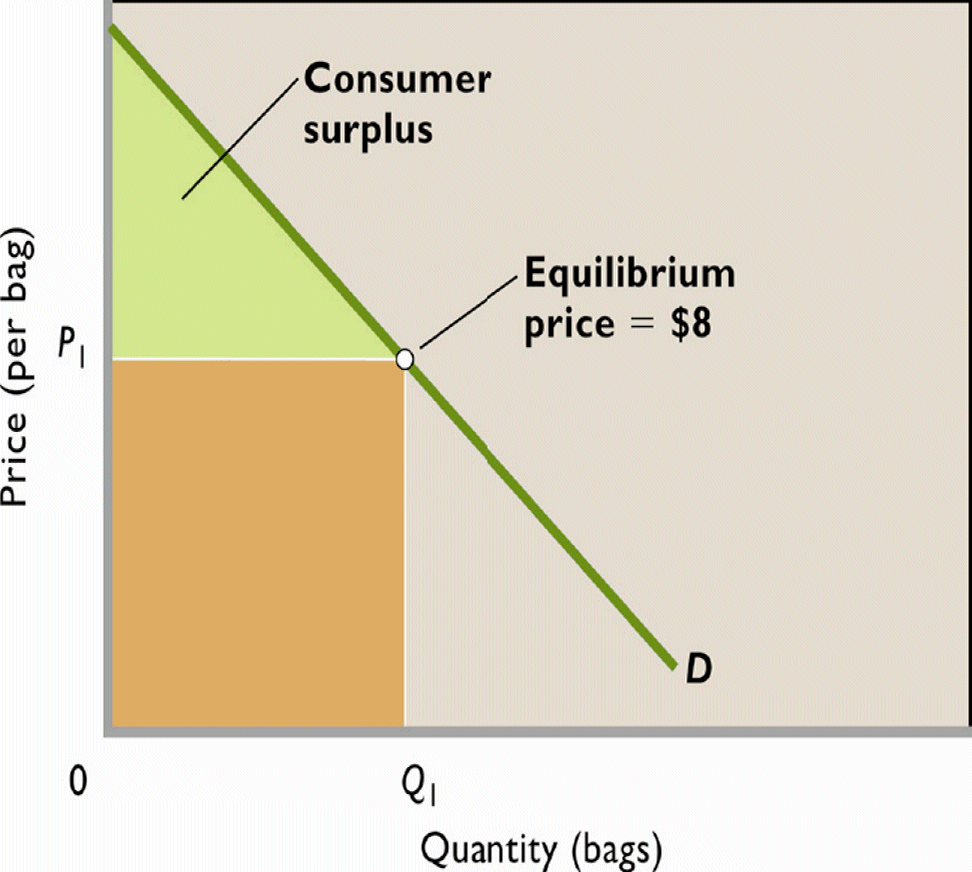
In the small, yes, but I believe there are innovations still undiscovered that will allow retailers to replace the areas roughly approximated by multiple price points with a model which captures the entire consumer surplus. Think about the advantages a retailer would have over competitors if they could capture the entire consumer surplus. It would be incredible.
>Think about the advantages a retailer would have over competitors if they could capture the entire consumer surplus. It would be incredible.
Not really. Even if they know exactly how much you can/are willing to pay, that's useless if the store next door is undercutting their pricing. Grocery stores are a relatively competitive industry with razor thin margins, so being able to "capture the entire consumer surplus" seems doubtful.
Undercutting doesn't really address the area below the demand curve, but above the equilibrium point. You can draw out the supply and demand curves of the undercutting scenario you're describing and see for yourself.
HN doesn't support charts, but here's a snippet from wikipedia:
>Consumer surplus, or consumers' surplus, is the monetary gain obtained by consumers because they are able to purchase a product for a price that is less than the highest price that they would be willing to pay.
Sure, producers can claim that surplus by charging more (up to the willingness the consumer is willing to pay), but if there's a competitor that isn't doing this, then the consumer will switch to the competitor and keep their surplus.
I don't disagree that's the case when a producer sells at a single price. Their revenue is the the rectangle formed under the demand curve[1] bounded by price * quantity.
What I'm saying is that having a single price means that consumer surplus is left on the table and that charging each consumer exactly what they'll pay for the good will capture that surplus. It will essentially "fill in" the space not captured by the revenue rectangle.
In microeconomics this is called first-degree or perfect price discrimination[2].
We see the kind of thing you're describing in a market like housing, but it only shows up there because of a strange combination of a) we live in a democracy and b) blocking new housing supply in desirable areas is hugely politically popular among multiple classes of people who vote. We don't see it in the grocery business, where even modest price increases like we've seen recently (that are mostly covering real costs) are hugely unpopular and drive people to the already numerous competitors very easily, and on top of that startup costs for grocery businesses aren't all that high so moats are very shallow for existing entrants.
We do see attempts at price discrimination in haggling and negotiations, but this is stereo-typically a human-human interaction rather than one mediated by predictive analytics.
Theoretically there are margins to be gained by identifying customers, retrieving their personal financial information, predicting the price they would be "just" willing to buy for that's still above the equilibrium price of the good, and doing this at scale and automatically.
I think a grocers could absolutely do the online ordering and pickup/delivery space where prices could be tailored to individual consumers and there was market dominance.
Sorry, I don't have the data to give a figure. I'd have to build the model, and have a complete transaction record dataset.