I took a basic falconry lesson with my dad last year. Besides being one of the coolest things I did all year, I got to learn all about the species we worked with: the Harris hawk. Native to the Southwest region of North America, they are of the only (the only?) raptors that strategize together and hunt in packs. Apparently if you introduce two groups who have never interacted before, they will play games and talk to each other for a while, and just a couple hours later go out hunting together (with their human trainers).
Also, according to our two instructors, the "universal" (read: they witnessed two Harris hawks do this independently) call for a dog or wolf, their natural predator, sounds like "Dog!"
I witnessed a Harris hawk attack a mockingbird in mid-flight outside my window once. It was brutal, blood and feathers sprayed everywhere, though the mockingbird managed to fly off with the hawk in hot pursuit. At first, I was like WTF!? Then I became curious. I identified the Harris hawk based on my brief sighting, and discovered that they were native to Texas, where I was living, and one of their main sources of prey is the mockingbird.
It's cheap and easy to encourage birds (and other animals) to come by your window more, if you want to see more of their behavior in person.
A coworker has been putting out food for birds for several months, and regularly has something like 20 different species coming by for it, and another 10 or so species that only show up occasionally. It's to the point now that when he puts out food, he regularly has something like a couple dozen birds at once showing up.
This includes some hawk species. He's got a camera running and has shown my some impressive footage of the hawks hunting the other birds.
After seeing his videos and photos, and hearing his descriptions, I decided to give it a try. For the last few weeks I've been going out and putting unshelled unsalted peanuts on the rails of my deck, which I can watch from the window in front of my computer desk. I've since added black oil sunflower seeds to the mix [1].
I haven't seen nearly the variety of birds he has, and have seen no predator birds. I've mostly got Dark-eyed Juncos, Black-capped and Chestnut-backed Chickadees, Steller's Jays, Spotted Towees, and some kind of Crow (either American or Northwestern). A couple of times I've had some kind of gull, and I've seen one or two things about the size of the crows and jays but did not see it long enough to remember enough to look it up.
Besides birds, he's also getting a lot of squirrels, some chipmunks, at least one opossum, and at least one raccoon. His squirrels have gotten to the point that they are not afraid of him. When he goes out to toss peanuts most of them gather at the edge of the bushes and watch him, and then will come get the peanuts while he is there if he doesn't get too close. (I think he also said that the birds have grown much more tolerant of his presence, too, such as eating from a feeder while he is right there filling it).
One, though, actually comes up to his window and jumps around until the squirrel sees that it has been seen, and then runs to the door to wait for my coworker to come out. That squirrel will actually come up and take an offered peanut from his hand.
He's also had the raccoon approach, but was uncomfortable with that and so tossed some peanuts behind the raccoon to get it to move away. A couple evenings ago he went out, and the raccoon was there. It ran away and he thought he'd scared it off and sat down on the porch. The raccoon had actually just circled around the house to come up from the other side. The coworker tossed the raccoon a peanut. It was a weak toss and only went a couple feet. After a few more tosses, the raccoon would hold out his hands palm up, and wait for a peanut to be handed to him. (He (the human, not the raccoon) was wearing protective gloves just in case).
The only thing I've gotten besides birds is squirrels (at least that I've seen). I've seen raccoons in my neighborhood before, but not recently, and a couple of times I put out some seed and peanuts to close too the bird's bedtime, and so there was food on my deck overnight, and it was all undisturbed in the morning.
(I'm only putting out food. The coworker has also added some water features to his landscaping that provide good drinking water for animals. From what he told me and what I've read, that makes a place much more attractive to raccoons, which could be why he's getting them. I do not want raccoons, so will not be providing water to the animals).
I'm pretty sure a lot of the little birds I see live in the bushes and trees in my front yard, because if I put out food near sunrise, I now get up to a dozen of them quickly coming out of those bushes and trees, taking a seed or peanut, and flying back.
If I do the same thing at random times throughout the day, the little birds still mostly come from those trees and bushes, but instead of a dozen or more at once, it is in ones and twos over a longer time.
Finally, if I put out food as sunset nears, it is back to a whole bunch showing up at once.
Thus, I'm guessing that they live in those trees and bushes, and so near sunrise and sunset that are all home. Hence the crowd. In the middle of the day, they are mostly out roaming around looking for food, and so they only find my food when their roaming brings them back home.
I wish I had thought to do some kind of survey of bird population in those trees and bushes before I started putting out food. I'd like to know if they have moved in there because of the regular food, or if they were always there and I just didn't notice them.
[1] ...because they are cheap and birds like them. A 10 pound bag is around $9 at Walmart, and will last for me about 45 days. A 40 pound bag is around $20 dollars.
Be careful with this. We hired an exterminator once to deal with a carpenter ant problem and he said the number one cause of vermin infestation (rats, mice, squirrels, chipmunks, etc) is putting bird feeders near your house. Apparently the nuts and seeds attract vermin, which inevitably tunnel into your house through openings, and make it their house. I love the sight of birds, but after seeing chipmunks (ground squirrels) dig a huge tunnel network under our front yard, to the point where the lawn was collapsing, I'm not risking it.
The "Deserts" episode of Planet Earth 2 (currently on Netflix) has a decent segment on the Harris hawk for anyone curious. It shows a group of them hunting ground squirrels.
Is the Harris hawk also known for being unusually trainable? I've seen them used in London for pigeon control, despite them not being native to the UK.
> Mr Gosford said he had never actually seen a bird at a fire front, intentionally spreading the fire.
> So he said he decided to appeal to people to come forward if they had seen birds behaving in that way.
> Mr Gosford said he received 16 firsthand accounts from people who said they had witnessed birds spreading bushfires to flush out prey.
> ...
> He said he hoped by filming birds spreading fires, others would see how valuable Aboriginal knowledge could be to the broader community.
This is a much more speculative thing than a reading of that abstract makes it out to be. It's not impossible, but there's no hard evidence of it as yet. Certainly, there's no video.
I think that the abstract is clear, and probably they are using the correct terminology in their field. But the first time I read it I didn't notice that they are documenting first hand stories about the events, but not the events themselves (aka videos).
> We document Indigenous Ecological Knowledge and non-Indigenous observations of intentional fire-spreading by the fire-foraging raptors Black Kite, Whistling Kite, and Brown Falcon in tropical Australian savannas. Observers report both solo and cooperative attempts, often successful, to spread wildfires intentionally via single-occasion or repeated transport of burning sticks in talons or beaks.* [..]
In each of those categories we're far and away the best. I really don't understand this feeling that humans need to be modest or that describing ourselves as special is wrong. We are special.
I think among some people that are frustrated with the human world for whatever - either personal or abstract - reason, there's a feeling of misanthropy that colors their thinking, and so they try to belittle humanity.
>I really don't understand this feeling that humans need to be modest or that describing ourselves as special is wrong. We are special.
To simply state that humans are best adapted at certain traits is true, but humans have tended to think of themselves as "special" in that "we're not even animals, but beings made in the image of God and given divine right to conquer Nature and do with it what we will." That anthropocentric bias has led to a multitude of evils and scientific falsehoods, and that's what needs to be corrected. It's got nothing to do with misanthropy.
But the opposite view could just as easily be used as a justification: I.e. "We're just animals, no different from any other. So anything we do is a part of nature, and we shouldn't second guess it, any more than any other animal would second guess its instincts."
I think we need to recognise that we are, at least, unique. And that we have a unique ability to affect the world, for good or ill, that sets us apart from other animals. That shouldn't be an excuse for hubris, but it should be reflected in how we view ourselves as a species.
I mostly agree with you, but I would frame things differently.
We are animals, and everything we do is part of nature.
Nature isn't either inherently good or evil, and natural processes can be self-destructive.
And while we probably don't have qualitatively unique features we distinguish ourselves quantitatively on many axes, especially when it comes to storing and transmitting information and
therefore influencing the rest of the world.
We may be more powerful than other species, but I'm afraid that on the knowledge/wisdom scale, we're only good enough to be dangerous. Seeing ourselves as a part of nature is necessary to limit the damage we do.
> That anthropocentric bias has led to a multitude of evils
How about we're the only species which we hold to a moral standard? Unless you're going to hold other species to that standard, you have to admit that we're special.
“Special” is a human concept which may not exist objectively, empirically. Distinct, unique, etc... are probably more honest, assuming that we don’t exist in a multiverse.
No, but then, I like physics so I’d start rattling off fundamentals like the hyperfine transitions of Hydrogen, the speed of light in vacuum, and the mass of the proton.
That's a fair point. Recognizing it as true shouldn't prevent us from recognizing how special we are, but you're right that we need to take a conscious approach to act as stewards of the world with our great power over it.
The point of this, I think, is that we justify our behavior towards animals on the belief that they are not "the same" as us. That is, that they aren't beings capable of the same rich experiences of the world that we are and, therefore, their suffering is less important than ours. This same sort of rationalization has been used throughout history to justify similar behavior towards other human beings.
Evidence is increasingly showing us that the qualities we believed differentiated us from animals, that made our lives more worthy of respect, aren't actually unique to us.
If you're going to come back at that with "we're better at these things than they are", then that philosophy suggests again that there are lesser classes of human being as well, the ones that aren't as good as others at whatever metric you happen to be using.
It is natural that we seek to justify behavior on which our living standards are dependent, but that doesn't make our reasoning sound.
It is often bad tone to assume some (more or less unethical) motives behind a contrary view. Why would you do that? is it because of <insert something bad>? The technique seldom lends itself to a balanced discussion and will tend to deteriorate into ad hominem type arguments (I know, I used to do it a lot :-/ ...) . Anyway to your point: I find it probably that all species will find themselves more special than others, and I could easily imagine a conversation between dogs find that they are the most special of all creatures: tell me who can smell as good as we? Eagles would claim to have better eyesight than most etc. Either we as humans can claim to be better than everyone else at everything (clearly false), or claim that we are best at being us, something we share with every other species. A third position, which evaluates species from species-neutral characteristics doesn't seem to exist. And so the modest attitude which you criticize could at least be said to be guided by logic, not misanthropy at all.
I only wrote what I did from what I've seen in my own life. It's an anecdote but common enough for me that I'd imagine it applies to other people too.
And you're right. If other animals were self aware enough to recognize their own exceptional qualities I'm sure they'd be proud of them. Humans have an awful sense of smell. Our vision is good, but animals have better vision. Same for hearing.
But we are extremely good at thinking and cooperating with other members of our species. We're special because we form a highly dynamic super-organism like an ant colony, which amplifies our individual exceptionalism.
Great, so we agree to some extent. And I agree that we are right to be proud of our special qualities. It's the assertion that humans are exceptionally special in any objective sense which I don't agree with, and which would require some super-specie value system to be logically valid. Religion or some similar belief can obviously be such a system, but I personally find such incompatible with what I can reasonably infer from established facts. I guess we can leave it at that.
Which animal we morally can eat is a huge and difficult concept...
In some cultures eating horse meat is normal, in others vegetarianism is the honourable goal. Have you ever asked yourself why you eat or why you don't eat some animals? It is typically a product of the culture we grew up in, rarely the product of an intentional thought process.
Would you eat another human? What about another ape? An elephant? A monkey? A cat? A rabbit? A cow? Where do you draw the line?
I once decided that the "mirror test"[1] was my litmus test for eating or not an animal. But then as I looked more into it I realised that that test isn't as straight forward as I thought, lots of false positive, methodology issues (eg: some animal start passing the test after being exposed to mirrors for a long time). And the final blow was that most humans under 6 months fail the test and I decided not to use this test rather than starting to eat human infants.
Plants release pheromones when being collected, cut etc...[1] which some people argue is a way to express suffering and has lead some people to "eat only fallen fruit" [2]. The whole debate of vegetarianism vs vegan, is exploiting animal for food (milk, eggs) ethical? Some people argue that a pure vegetarian lifestyle is unhealthy...
This is why I am saying that one needs to draw a line, and that it isn't necessarily easy. It sounds like you made your choice and that it was easy for you, but that isn't the case for everybody.
I fail to see how the possibility of further debate in the finer details makes the answer to your original question, what animals are moral to consume, less obvious.
Would you accept a plantation owner claiming slavery's immorality was not obvious because there were arguments to be had about the ethics of "wage slavery" etc?
Where does the implication that other animals are moral come from? Is a wolf that eats pigs moral? If so, then why is a human eating pigs immoral or even 'disgusting' as you put it?
In my opinion it's quite simple. I eat what I would be willing to personally kill and butcher myself. I think trying to justify why 'A' and not 'B' to ourselves is somewhat unproductive. Two people watch a movie, one person likes it - the other dislikes it. Both can give their reasons for such, but neither is right or wrong.
Attempting to quantify subjective matters is arguably one of the big reasons so many of the social sciences are facing replication crises. There are so many factors in play that the quantifications, or justifications, we provide to explain social phenomena like this are not very meaningful even if we think they are! The most important thing is to be aware of the facts, so much as possible, but beyond that simply to take your opinion as what it is - a subjective view based on a complex series of mental interactions that even you are not fully privy to.
We all, all living beings, are eaten. Such is life. If might be sacrophitic fungi, earthworms, and bacteria, it might be a wolf, it might be a housecat, it might be a vulture. It will likely be a combination of them. But our big brains doesnt escape us from nature, we are every bit a part of the grand life experience that all life shares in. Our desire for a softer gentler life while noble, doesnt check us out in any way shape or form. It just seems nicer. The one invariant on this earth, is you will be consumed. If that concept is obscene, then so is all of life.
I'm not really sure by what you mean "OK with that." I'm perfectly fine with people having views I find detestable. Going further there, I suspect if we were all 100% honest then any two people could find at least some reason to find the other detestable.
This is interesting as slavery is something that ostensibly has no room for shades of gray. So let's try it. Can you justify to me why you believe slavery is wrong? And to be clear, I am not suggesting that it is not - but rather I think you'll find that creating completely coherent arguments for why it is - without exception, is not as easy as you would think.
Widely eaten animals are those easy to farm. This limits them mostly to land herbivores, like cows, and water herbi/omnivores, like shrimp or tilapia.
The level of intelligence plays little role, as long as the animals don't use it to actively try to fight back or escape. E.g. pigs are no less smart than dogs.
I just think thad dog meat can't be anything but an expensive delicacy, because to produce one unit of dog meat you already need many more units of other meat, to feed the dog.
This helps dogs and cats stay pets, largely protected from eating by human emotional attachment, while cows or pigs get pushed to the cattle sector, emotionally detached for food purposes.
Why not draw the line at consciousness? don't eat animals that science has proven to have IQ that approaches human 1-3 year old IQ, like parrots, crows, dolphins, etc.
all other animals are fair game.
So we can eat humans that also do not have that IQ, right?
Thing about consciousness, in the philosophical sense that you clearly mean it, is that it is completely unempirical and therefore does not exist within the scientific model. I know I have consciousness because I experience it, I assume you have consciousness because you are very like me, you assume these low IQ animals don't have consciousness because they are not like you. There exists no objective measurement of consciousness.
yeah, but there exist objective measurements of ability. As in my parakeet objectively cannot be taught to read and understand a book, for example.
no, we wouldn't eat humans who do not have IQ of 1-3 year old, because we would recognize that they are human and don't have that IQ from disease or misfortune, not because of their inherent incapability of having it.
it's relevant. My philosophy assigns a lower worth to beings, who are not human, who have low IQ. I assign low worth to individuals who belong to low IQ species, not to low IQ individuals.
And I'm saying, why? What does it matter what species they are?
Your original claim implied that you believe this is because lower IQ equates to a lack of consciousness, which as I've already described cannot be objectively determined and is therefore a poor metric. If I understand you correctly, you are now saying that it's really the species that determines consciousness, which is equally invalid.
Either you are taking it on pure faith that certain species have consciousness and others do not, in which case there is little point in further discussion, or you are trying to claim that certain species are worth more than others because they seem to have a greater aptitude in certain categories. For some reason, this does not apply on an individual basis. How convenient for you, then, that these categories align perfectly with all the areas your species has great aptitude!
I invite you to consider this possibility: Your belief is not based on rational reasoning, you are just rationalizing your behavior.
you are engaging in semantics and sophistry. It can be objectively determined that cows are significantly less intelligent than humans, or even african grey parrots, or dolphins. I do not want to eat species that, as a species, exhibit intelligence level that is similar to human intelligence. The reason i wouldn't eat a dumb human is because I don't want to perform an intelligence test on every parrot or every human. Aggregate knowledge about the species is enough knowledge. You may say this is arbitrary, but to tell me I shouldn't eat a cow is even more arbitrary.
Also, discussing whether or not I would eat a human is silly because I can't go to the supermarket and buy human flesh. So, let's keep this discussion away from meaningless hypotheticals.
If it is ok to eat less intelligent things then if you know for certain that a particular human doesn't meet the criteria (infants, for instance), why are they exempt? No testing need be performed. We know that the category of "infant humans" is going to have an IQ under your stated limit.
You are not making rational logical arguments. You have started with your preferred conclusion and are employing rationalization to justify it. Every time I show you that your philosophy allows for things you find uncomfortable, you move the goalposts.
Case in point:
>Also, discussing whether or not I would eat a human is silly because I can't go to the supermarket and buy human flesh. So, let's keep this discussion away from meaningless hypotheticals.
This is a copout that means "I am afraid of what my philosophy actually means, so let's just ignore it". You could easily acquire and consume an infant if you wanted. There'd be severe consequences for doing so, of course, but that doesn't mean you can't do it. People do do it. None of that is relevant to the question of whether or not it is morally permissible to do so, now is it?
But you, you're not interested in making sense. You're uncomfortable, so you rationalize. Oh, it's not ok to eat infants even though they're well below my IQ threshold, even though it's completely possible, because they aren't sold in the grocery store!
Infants are exempt because they are not less intelligent. They are humans with human potential. For example, it could be the next Einstein we are talking about or Elon Musk. It is yoi who is not making sense. You are doing exactly what you accuse me of doing. I don't want to eat other humans for the same rational reason I don't want to mass murder humans - I enjoy being part of a functioning human society. To equate this with eating a cow just makes no sense at all.
I believe that's pretty much it. I remember going fishing with my uncle as a kid and I was disturbed what I was doing to these animals but my uncle told me that fish can't feel pain. I didn't believe it then, and even less now.
To combine the eating of other animals, a rational brain and a mind at peace, you need some amount of self deception. Without it, you can only pick two.
For evolutionary reasons, it's obvious why eating meat is very beneficial. Today, it might not even be necessary for good health.
combine the eating of other animals, a rational brain and a mind at peace, you need some amount of self deception
i'm at peace with killing animals for food. i know that they feel pain, but life is pain in general. maybe i'm a terrible person or something, but a good bbq is def worth more than the life of a pig or a cow.
In my worldview, it is simply an immutable law of nature that more complex genera prey upon less complex ones. But as we are complex enough to empathize, we also have the moral responsibility to make the best of our predatory nature, whether that means minimizing the suffering of our prey, or minimizing the ecological impact of our predation.
As long as you accept then that there is no moral problem with some superior species coming along and and deciding the same about you, at least your backwards philosophy will be consistent.
The thing is though, animals die anyway. And it's not like they die peacefully in their sleep, either. They mostly either get injured or old and starve to death, or get eaten by predators.
That's a false equivalence though; if you look into many vegetarians' justifications for their diet it often isn't the killing or eating of animals that they find objectionable as much as the intentional process of breeding and raising animals for food. I know many "vegetarians" (for want of a better word) who will willingly eat hunted or fished food, but avoid industrial meat.
> To combine the eating of other animals, a rational brain and a mind at peace, you need some amount of self deception.
Not necessarily. Many people who eat animals do so because they are not in a position where their nutritional needs can be met by a purely vegetarian diet (largely this is a problem of availability). When it comes to survival, I have a difficult time judging others from my comfortable position of not being in mortal danger.
I think another point to add is that raising animals for food can be seen as a symbiotic relationship.
If not for the development of animal husbandry, would pigs, chickens, and such be as successful (from a total population pov)? I think not. Many animals have the chance to be alive, only because they are supported by humans. This relationship is not only one-way: they are protected from predators, sheltered, and fed.
Of course this doesn't justify mistreatment. But it puts in perspective the idea that turning vegetarian, and banning meat would be good for those animals in question. It wouldn't: they wouldn't be alive in the first place.
By the way, even animal husbandry is not specific to humans. Ants for example, have "farmed" aphids for millions of years. They milk them for honeydew and eventually eat them.
> Of course this doesn't justify mistreatment. But it puts in perspective the idea that turning vegetarian, and banning meat would be good for those animals in question. It wouldn't: they wouldn't be alive in the first place.
It's highly arguable whether they are better off being "alive", when this "aliveness" is so far off what they are genetically programmed to enjoy as a normal life.
For example, if an alien species took over Earth's biosphere and treated humans like we treat cows, raising them in overcrowded pens, feeding them food that occasionally contains human meat, forcefully inseminating the females every year and separating them from their young 24 hours after birth, then killing the females when they reach their mid-twenties because their fertility drops, and basically using a tiny proportion of males to make sperm and slaughtering the rest at a young age... would you make the argument that there's a two-way relationship there? That humans are benefitting in some way?
Even if they took these domesticated humans and spread them to the stars, ensuring their survival for millions of years, and protection from other predator alien species, so long as these "humans" were treated in this way we would not consider this to be beneficial to our species in any way. At least I wouldn't: better extinction than such a "life".
Obviously we can't ask the cows what they would prefer (or perhaps we can, we just don't have much interest in figuring out how to do it). If we did ask them, though, I doubt they'd see this relationship as beneficial to them in any way.
Yes the way we treat them is definitely a point of contention.
> when this "aliveness" is so far off what they are genetically programmed to enjoy as a normal life.
I assume, just like humans, other animals can adapt and even enjoy a life partly controlled and radically different from natural conditions.
I think the basis should be: are they better off than in the wild? In terms of pain, comfort and stress. And I'd argue that we can give them a better life. But, especially with factory farming, we often don't.
In your specific example of aliens raising humans. If aliens let them live in decent conditions, with some added benefits: say diseases, illnesses and poverty completely eradicated, and wars forbidden. But with the caveat that aliens do decide when you die. (Somewhat similar to Logan's run...). I think many may see it as better than our current life.
True- though it does not have to be binary. Our current levels of meat consumption are unsustainable and the levels of production required make treating the animals well a laughable proposition. I've tried to greatly reduce my meat consumption recently.
Wouldn't be surprised. The more we learn about the animals we eat the more we seem to learn that they're sentient, have a full range of emotions, and they most definitely experience suffering because of intensive farming and other things we put them through.
Acknowledging both the blindingly obvious point that we are the apex species on this planet and that we do a lot of complicated, interesting things we have yet to observe in others does not mean observing similarities to other species somehow diminishes humanity. On the contrary, telling ourselves just-so stories that appeal to our arrogance and need to be special discourages research and progress. If I "know" that we're the only species that talks (because some other human convinced me that god, some super-researcher or whoever said so), I'm not very likely to go looking for counterexamples.
Drifting into aesthetic/religious/philosophical territory for a second, I personally feel that humans are deeply interesting because of what an odd mishmash of traits we have. If one is prone to anthropomorphizing evolution, one way to still appeal to human vanity is to view it as a pretty risky slow-burn strategy that, after succeeding, made us our own worst predator/environmental risk[1]. If we were just some toy made by $deity for whatever reason, it becomes a lot less interesting of a story.
[1] Of course, evolution doesn't work that way, but it makes a nice story.
A good read, especially on the last page the paragraph beginning with, “The history of science contains, one after another, a series of blows to mankind’s anthropocentric ego.”
For instance, on the planet Earth, man had always assumed that he was more intelligent than dolphins because he had achieved so much—the wheel, New York, wars and so on—whilst all the dolphins had ever done was muck about in the water having a good time. But conversely, the dolphins had always believed that they were far more intelligent than man—for precisely the same reasons.
I'd be very interested to see what dolphins could accomplish if they were to have hands and feet.
Maybe one day we will be able to give them robotic limbs controlled through brain function and see if they able able to that utility. My guess is that we would be impressed, especially if the experiment were done on a pack.
Yet the dolphin dies whenever it encounters something it's body can't heal on it's own. The whole "whoever lives the simpler life is smarter" doesn't really hold up when science/medicine/engineering solve life threatening problems.
According to Dr. Michael Greger, medical care is the third leading cause of death in America:
"Since side effects from prescription drugs kill an estimated 106,000 Americans a year, the sixth leading cause of death may actually be (gulp) doctors. And that’s just from adverse drug reactions. Add in medical mistakes (which the U.S. Institute of Medicine estimates kills at least 44,000) and that brings “healthcare” up to our country’s third leading cause of death. Throw in hospital-acquired infections, and we’re talking maybe 187,000 Americans dead every year (and millions injured) by medical care."
> According to Dr. Michael Greger, medical care is the third leading cause of death in America:
Everyone is going to die of something. If our medicine is good enough that, barring errors, it solves all other sources of mortality, then medical care would be the first (and indeed only) cause of death.
That it's the third (and there are still others after it) is obviously not ideal, but it's not necessarily a bad sign, either.
Nor does it mean a large share of the problems we face are of our own science/medicine/engineering, it means a large share of the problems we face that aren't solved by our own science/medicine/engineering involve failure of that science/medicine/engineering when deployed against some problem (of whatever origin.)
Sure. First, I want to make it clear that I am a technophile: I really like technology. I'm also really grateful for the benefits of modern technology. I'm also a Nature-lover, but I don't think that technology is necessarily antithetical to healthy ecology. (For example, I am pro-nuclear-power.)
With that out of the way...
Here's a thought experiment. Humans lived for a few million years before developing agriculture and villages starting about ten to fourteen thousand years ago. I'm not an anthropologist, but I think we would be safe to assume that the causes of death during the first period were "natural": disease, predators, fighting, famine... have I missed any?
We can then call the causes of death arising after the advent of agriculture "technological" and add up all the deaths so far from each category and see which number is bigger.
I would reckon the "natural" deaths would be outstripped by the "technological" deaths by a wide margin, with the tipping point sometime in the last few thousand years.
So, heart disease, infectious and parasitic diseases, cancer, ... Er, um, I think I have to "roll back" my comment...
I was thinking of car accidents, pollution, and the general ecological problems that have developed as unintended consequences of our technology. (We're victims of our own success.)
(There is also the "medical care is the third leading cause of death in America" issue already mentioned by jmulho, which should be a much bigger deal than it is: side-effects and out-right errors kill over 100,000 people in the US a year!)
But really, it's the time-scale that matters: if the ecology tanks and takes us with it then our technology (in hindsight) really is (was) the existential threat, despite the good run we had.
“Tiger got to hunt, bird got to fly;
Man got to sit and wonder 'why, why, why?'
Tiger got to sleep, bird got to land;
Man got to tell himself he understand.”
Perhaps in another 20 million years the birds will go from carrying sticks to discovering antibiotics. Until then... I think we can still consider ourselves special.
We talk about the use of tools because it's a very significant conceptual leap. Once you understand that you can manipulate your environment to accomplish your goals the abilities in your list are comparatively incremental.
Our use of tools isn't the only measure of specialness, but I'm not sure there are many cognitive leaps quite so significant... language would be one but seems trickier to pin down because there are degrees of sophistication.
I think the real only limiting factor prevent them from accomplishing what we have is that they do not have the limbs and dexterity available which we have. This enabled us to perform many tasks which are out of the question for them. I'd say they do damn well for what their body's allow them to do.
Of course not, but there just has to be one apart from ours, right? Besides we will all be extinct anyway before that because evolution takes billions of years.
That's probably a question that CS researches will get to address one day in the future... Estimating what percentage of reasonable length DNA arrangements leads to intelligent organisms.
We actually live in a symbiotic relationship with cats: we provide them with noms and warmth (and the cleaning of their litterboxes), they reward us with love. And the occasional thrown-off-the-table TV.
I think we are rewarded with "tolerance" which we interpret as love, based on our perception of the cat; if it is our own we see it as love; if it is someone else's, we think it is a friendly cat.
Don't forget things like emotion, compassion and physical pain too; we're far too quick to decide that animals "obviously can't" experience these things.
One could argue (as Yuval Noah Harari does in the book Sapiens) that the ability to "come up with reasons why we're special", or more generally to reason about things that don't exist in a material form (like limited-liability corporations, deities, nation-states, or the notion that we're special) is exactly what makes humans special.
Careful there with the phrasing. When we talk about animals communicating we generally mean animals using signals (e.g. to indicate the presence of a predator or a source of food). I'm not aware of any reliably documented case of animals communicating abstract concepts.
There is some research with great apes that makes the rounds every now and then but the findings are dubious at best as there's a lot of conflict of interest, handwaving and wishful thinking (see Koko "mourning" when told that Robin Williams died because they met once at some point in the past).
EDIT: Also it's probably a good idea to limit the conversation to social animals. Solitary animals don't have much use for communication other than challenging the competition and impressing potential mates -- insert celebrity joke here.
> I'm not aware of any reliably documented case of animals communicating abstract concepts.
I guess this is difficult to prove. I'm not sure if it matches with the definition of "abstract concepts" but I was reading earlier today that Bottlenose Dolphins "transmit cultural knowledge across generations".[0] So maybe yes?
As far as I can tell from that section this is more about show-and-tell. There's a difference between demonstrating something to teach it (mimicry) and using language to teach it (explanation).
If I tell you that you can put a stick in a certain tree and get honey out, that's different from me bringing you to that tree, putting a stick in it and showing you the honey (while being swarmed by angry bees but I digress).
Because when people say "language" they usually imply certain capabilities we have not yet observed in other animals, especially when talking about what humans have that other animals don't.
It's similar to being able to use tools (which we've seen in many species) versus being able to create tools (which we've seen e.g. in certain corvids). The former is a significant first step but the later is what proves a certain amount of abstract thinking beyond the immediate here and now that goes far beyond mere instinct.
Hmm I haven't really thought about this but I was hoping there was some new development in the understanding of animal communication. I'm not a linguist but as far as I understand communication is not language. Language is communication however.
You can never convince an animal to give it's food in promise of a place in heaven or to die for it's country. That's something only humans are capable of. Beat that!
Sure you can argue semantic about how animals don't have countries, but it's a fact that animals do fight and kill each other to protect their territory.
Those are hardwired instincts, not a conscious reflection on the fact that in the future things might be worse.
In fact they are limited to a specific behavior, like storing food, and not generalized across all things that could happen.
Fighting to defend territory or feeding offspring are strategies that prove successful for the survival of the species, not tied to consciousness of the future.
For example, zebras run away from lions, but only when lions chase them. They are perfectly fine with lions sitting around if all they do is sitting. They don’t think: “at some point that lion will stand up and chase me”
Squirrels don't even remember where they've buried the acorns. They just bury and dig, and with enough squirrels involved it works out. Its an instinct that happens to contribute to survival.
They sacrifice something - an abundant summer acorn - today to get something better - a scarce winter acorn - in the future. It's a clear counter example to the claim above.
Except they don't mean to do anything. They're carrying an acorn, they pass a juicy spot, they feel compelled to stick the acorn in the spot. At no time does the squirrel think "I'll sacrifice this food now for food later!" So it's not reasonable to call it a sacrifice except metaphorically?
By reading, being educated.
Its far to late to be mystified about how animals work. Its a couple of centuries of study by now, about their instincts and behaviors.
And recall, 'understanding the concept of sacrifice' was the topic.
I think (but I'm happy to be proved wrong on this) that we are the only animal that uses abstract symbols (rather than just vocalizations or other physical displays or gestures) to communicate and build models of natural phenomena, although those abilities are probably of relatively recent origin in our species. However, I've heard that animals like chimpanzees and dolphins can learn to use symbols when taught by humans.
Laws are enforced by force. It's not just civil laws, but the acceptance of chiefs, then kings, then Presidents. Contracts, and other duties, are also shared fictions.
it's striking to see 6-12 month old infants bopping up and down to music. They're not taught to do this and I've never heard of animals responding to music...
Scientists are generally quick to give such vocalisations -- along with bird song, etc. -- purely functional attributes, thereby dismissing any aesthetic or emotional meaning it might have for the animal. "It's a territorial signifier". "It's for mate selection." Etc. This is a mistake: Mozart used his music to get laid; what musician doesn't? We can't know what these sounds truly mean -- subjectively, not functionally -- to an animal, because we can't talk about it with them. But that doesn't mean that it is empty of meaning.
“[M]an had always assumed that he was more intelligent than dolphins because he had achieved so much—the wheel, New York, wars and so on—whilst all the dolphins had ever done was muck about in the water having a good time. But conversely, the dolphins had always believed that they were far more intelligent than man—for precisely the same reasons.”
― Douglas Adams, The Hitchhiker's Guide to the Galaxy
Personal integrity? Calm? Harmony with surroundings?
I wonder if there are animals that produce ElsaGate videos, or come up with rationalizations for them. I'm sure there's animals who eat their offspring in certain situations, but are there any that just bite them to death, to then proceed to run in hysterical circles, counting symbols and telling themselves "narratives"? Where can I find such a pathetic thing in the wild?
Humans are maybe special in that we can't seem to cope with anything that's not neatly black and white. Our brains tend to halt and catch fire when we have to analyze gray areas. Just look at politics or technical discussions. "Guns are (good|bad)." "It's slightly mathematically possible to compromise this system; we can't possibly ship like this!"
The vast majority of humanity can't accomplish that. I guess we all get credit for the achievements of any of our species? Are we then also burdened with credit for any individual's atrocities?
We are the only mammal with consciousness, which leads to knowledge of the future and the discerning of good and evil.
Despite the fact that we still don’t understand the least about how consciousness arises in our brain, we are nonetheless the only animal that shows this.
Even in cases like monkeys recognizing themselves una mirror, no animal seem to go past that and be aware of the future like we do.
"Convergent evidence indicates that non-human animals have the neuroanatomical, neurochemical, and neurophysiological substrates of conscious states along with the capacity to exhibit intentional behaviors. Consequently, the weight of evidence indicates that humans are not unique in possessing the neurological substrates that generate consciousness. Non-human animals, including all mammals and birds, and many other creatures, including octopuses, also possess these neurological substrates." [0]
We've found evidence in some animal or another for pretty much everything we've ever thought was unique about human cognitive abilities. So far, the only unique thing about humans is how broad and powerful our cognition is.
You're falling for the assumption the brain's role is generating consciousness. It could also not do so yet still be part of an organism which is conscious. I can say that confidently because I understand how consciousness is generated. I could easily say it here and have in the past. Sure, I'll be downvoted by idiots who do not know whether I do or do not know how consciousness works, but are instead acting on their instincts and emotions. But perhaps there's at least one person in the world who is truthful enough not to have to downvote and to instead ask themselves the question of what it would take for what I assert to be true.
What is consciousness? I don't believe that it's universally accepted that it even exists amongst rsearchers. Even those who believe it exists have trouble defining it.
Even rats have demonstrated empathy in the form of aiding other rats out of bad situations knowing they will receive no reward for their troubles.
A skeptic might say that such behavior is simply part of any social animal's instinct, for various reasons, to which I ask: other than being able to rationalize our behavior, what makes human demonstrations of empathy different?
Yes, chimps dictators don’t fare well. That’s not what I meant.
Chimps don’t have a complex set of morals about which they discuss and evolve with time. I didn’t say we know for sure what is good or what is not. But we can abstract the concepts and evolve our morals. Chimps will never get to debate about gay marriage or other “chimp” rights.
You're moving the goalposts, but are still wrong. I don't have time to dig up the references, but there are plenty of studies showing that apes (and other animals) can develop arbitrary culturally-transmitted "taboos", with violation of those taboos provoking dissent and general politicking.
We can't speak to the depths of such a debate, because we can't participate in the debate. It's an (inter-)subjective matter for the animals involved; all we can do as external observes is be objective. But this then leads us into a categorical error: because we can describe a behaviour using objective language, we therefore decide that it in fact contains no subjectivity; eg., is not truly conscious.
We used to mis-apply this logic to so-called "inferior" human cultures, denying their humanity because we couldn't get inside their minds. This was wrong, and led to great evil. Until recently, we've applied the same thinking to animals -- but it's just as wrong. There are a shrinking number of Descartian holdouts, and I guess you're one of them. But all evidence and logic is against you.
You seem to be making a lot of objective claims about things being wrong because they can't be objectively measured. Why can't you use that same reasoning to claim things like homeopathy actually work but we just can't objectively measure why?
Additionally, if these things can't be objectively measured, why are you so sure they are true?
Humans don't have such a capacity. The notions of 'good' and 'evil' have historically been in flux and went through many huge changes. Modern humans consider the typical behaviors of past humans as 'evil'.
Vikings - rape after conquering is good. People today: that's evil.
India until 2 generations ago - arranged marriage is good. Today that's evil.
Homosexuality - has oscillated many times between good and evil. In fact, different geographic regions will still have polar opposite views on this today.
> India until 2 generations ago - arranged marriage is good. Today that's evil.
Suggest you do some homework. Something like 80%-90% of marriages in India are still arranged. And most people are pretty happy with this situation, or at least no more miserable than "Love marriages" -- which remain highly controversial -- would make them.
The definition of 'arranged marriage' today has been neutered. Until 2 generations ago, arranged marriage meant that women had absolutely no say in their marriage - it was at the decision of the parents and to further the desires of the parents.
Today, arranged marriage means that the woman's parents will present her with prospective marriage partners but leave the decision making to her, including veto or asking the parents to 'arrange' for a man that the woman fancies - kind of like Tinder but the matching algorithm is parents. That version of arranged marriage is straight up better than the (serious) dating scene in westernized countries.
The original version is definitely considered evil by today's morals.
Okay, you have an alright understanding of the contemporary meaning of the term "arranged marriage" in that case. I find that sticking with contemporary parlance really helps avoid misunderstanding. The term you presumably meant to use -- in today's language -- would be "forced marriage". In which case: agreed!
The notion of what is acceptable and good fluctuating throughout time and cultures doesn't remove the fact that the distinction is made. And your nitpicking criticism that misses the forest for the trees is an excellent example of the capacity to distinguish between good and evil, with its implicit value judgements.
Well when you find the great badger city where badgers have been able to put aside their differences and work towards common goals together then let me know. I'd love to see it.
In the meantime I'll stick with the assumption that there is still some sort of difference.
And you'll call that difference 'consciousness'. OK.
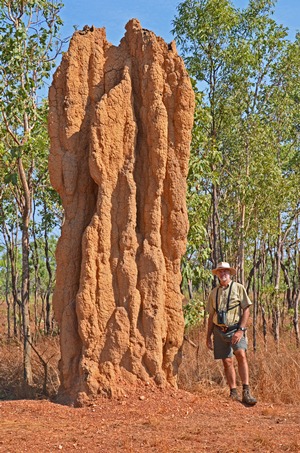
Meanwhile, I found a great termite city where termites have put aside their differences and work towards common goals together. Also coral. Their city is a thousand kilometres long.
There are some really interesting features in some of the constructs of mound-building termites (Macrotermes spp.) Air flow, thermal control, and water management have been the subjects of some research; it's clearly a fertile area for cross-discipline cooperation by human researchers.
Whatever one makes of the mental capacity of these individual eusocial animals (they're not too bright; you can lure them into termite windmills), collectively they substantially alter their local environment to their benefit.
There are whole valleys full of mounds rising a couple of metres above ground level in places where they are endemic:
That's a lot of biomass with a lot of total neurons, and even though aren't as tightly coupled as the ones in our skulls, they still manage to coordinate a lot of constructive activity. I think it's reasonable to wonder if culture and aesthetics emerge as termite numbers grow large.
I'm not saying that difference is called anything in particular but I can expect wildly different results from interacting with a city than I can from a mound of coral or a termite nest.
Don't be so disingenuous with these ideas of abstract equivalence. Yes humans are arrogant sods but there is some sort of reason or reasons (that are likely not to be purely environmental) that have resulted in this outcome where we're having a conversion via electricity across the planet instead spending most our lives trying to roll a breadcrumb around never having a chance to know one another.
Something about this gig is different isn't it? Are you genuinely asserting that if we could take the brain of a (insert whatever animal you're considering) and put it in a human shell you wouldn't be able to tell the difference? That's extremely bold.
> Are you genuinely asserting that if we could take the brain of a (insert whatever animal you're considering) and put it in a human shell you wouldn't be able to tell the difference? That's extremely bold.
He never said that. So don't be surprised if people downvote you, if you use that kind of manipulative arguing.
so what is the argument beyond "humans so arrogant and humdrum"?
I'm trying to frame where we are by finding out what we are arguing and what we aren't, if we're not there then where are we? That's not manipulative I'm just trying to fix us to specific points so we can progress.
Lets not forget that the parent comment I'm answering is the pithy:
> > We are the only mammal with consciousness
> Uh huh.
Our parent is an unfaithful sarcastic position so I don't see why that gets a pass yet my attempts to solidify the argument justifies this negativity.
I've devoted my professional life to understanding how animals work. It's been the most interesting and challenging topic to study that I can imagine. Science and art knows a lot about what animals do, and a little about how they do it.
Your opening statement
> We are the only mammal with consciousness
is rather controversial, and has been for at least a couple of thousand years. Whether it's true or not is one of the great questions humanity has ever considered. We aren't even sure whether the question is meaningful. Everyone sort of understands what it's getting at, but there is no definition of consciousness that is widely agreed upon. As comments by others have said, for almost all human behaviours once considered exclusive to humans we have found animal behaviours that look very similar.
So, my faithful commentary on your blithely confident statement that ignores the existence of any debate on this topic is: uh huh.
I NEVER SAID THAT.
Look at the user names ya plonk. I was calling YOU out for just responding "uh-huh" when you could have actually broken it down for the OP. But you didn't, you wanted to have fun so you did but with the wrong fucking person. Dick.
This is super cool, if a bit scary. Man Australia has it all though, 8/10 of the deadliest spiders, half the deadliest snakes, crocodiles, rockfish, and now firebirds.
Inhabiting Australia is a testament to man's arrogance.
> Inhabiting Australia is a testament to man's arrogance.
Given that humans inhabited Australia for at least 40,000 years without the benefits of domesticable crops or herd animals, I'd say it's a testament to incredible perseverance.
As a native-born Australian, your last sentence really resonates with me. I was lucky to have been born there, and raised a bit, but when I was old enough to have a religious-like experience out there in the north-western deserts, I realised I couldn't ever feel comfortable for as long as I, a privileged white boy, lived on the Australian continent.
So, I left. 30 years later, I'm taking my kids back for a bit of tourism.
And for sure, we'll be keeping an eye out, back up on those long stretches, for the odd kite or two .. not that there's much to burn where we're going.
Australia is a huge, and most awesome place in the world. It's a pity what its current humans are doing with it.
I love the land, but I have no interest in Australian culture or politics. I think its a real pity that, as guardians of one of the most diverse ecosystems on the planet, Australians have let it fall into serious disrepair. See, for example, what has happened to the Great Barrier Reef.
I learned to travel at a very young age, and don't have any national identity worth defending. I think of Australia as a wonderful country; pity about the people. Its no fun going back there every few years and seeing the landscape covered in copy-paste strip malls from Arizona ...
I left Australia 17 years ago, for what seems like similar reasons, although I have a hard time articulating them. Perhaps in another 13 years.....
However, as time passes, my views are starting to change somewhat. There is a large enough body of literature to lead me to believe that there are more progressive elements of Australian society, that I was not broadly exposed to previously. Perhaps this realisation has come in time, through maturity, and I am also seeking it out more.
I'm currently reading Reynold's The Other Side of the Frontier[1], a ground breaking work from 1981. Other publications like The Monthly[2] are also worth reading (Noel Pearson's essay this month particularly so). The more I seek out such alternative views, the more I'm convinced there is a large enough minority who do give a damn and that positive change is still possible.
If I was to return on a permanent basis, which seems ever more difficult as I'm seriously embedded in my current European location now, I'm quite sure I will not live in a major metropolitan location like Sydney or Melbourne. I'm thinking now more like Tasmania, maybe Adelaide region or even far north Queensland. Somewhere the white noise of boganism may not have penetrated quite so deeply.
Thanks for those great links, I will devour them avidly and attempt to temper my disgust at the Australian people with a bit of self-education. I too am now more European than Australian (after quite some time in the USA as well), and find myself less attracted to Australian society and culture as the years wear on. For sure, we see eye to eye on the move back, if it were to happen: for me, somewhere in the North-West (deserty/beachy regions), or indeed .. Tasmania. The rest of the country can suck rocks.
Meh. Thanks to the technological and cultural advancements of the Afro-Euro-Asian human cluster, we could wipe 99% of these “threats” tomorrow if we wanted to. In fact, we did have comparable dangers in other continents in the past - we just had no qualms with killing every single one of them or burning their ecosystem to the ground, because we had no concept of “ecosystem”: everything in nature was a threat to be dealt with, and that was that. Back in the day, you could be attacked by rabid wolves while sitting in your garden! So we killed them, we hunted them down systematically until they were no longer a threat. We had terrible insects, killing and spreading diseases! So we removed all swamps and invented chemicals to massacre them. Etc etc.
Australia, for geographical reasons, simply started the process too late, when we were already getting cold feet. Now that we understand how Nature works a bit more, it’s become difficult to justify large-scale efforts to remove these threats to human life. We find it more acceptable to suffer a potential spider bite here and there, than to risk irreparable losses to the variety of life and the quality of our planet’s natural state.
If anything, the fact that Australia manages to slowly expand human footprint while still maintaining a balanced truce with our predators, is testament to the level of emotional maturity that our animal race has reached.
>Thanks to the technological and cultural advancements of the Afro-Euro-Asian human cluster, we could wipe 99% of these “threats” tomorrow if we wanted to.
We can be wiped out by some of the simplest lifeforms, and even simpler, not quite lifeforms on the planet.
> We can be wiped out by some of the simplest lifeforms, and even simpler, not quite lifeforms on the planet.
Until that actually happens, I'm gonna call that BS pessimism. Humans are waaaay more durable, persistent, clever, stubborn, and hard to kill en-masse than you are giving us credit for.
Haha, this has been a well-trod rant of mine for years. Don't forget scorpions, vampire bats, great white sharks, and the world's top 4 deadliest jellyfish!
So long as I am not doing something dumb like going near an estuarine river filled with invisible deathbeasts, or getting into an ocean filled with transparently-tentacled murder-squigglies, or stomping through grass near logs with dozing fangjectors, I will be fine.
One doesn't have to be "dumb" to be in some danger from the fangjectors.
A friend of mine was driving around his property and found the track blocked by a fallen tree. He started pulling branches off the road and trod on a tiger snake in the grass. He was bitten and survived after administration of anti-venom. He wasn't doing anything particularly dumb and probably 99.9% of the time wouldn't have trodden on a snake.
I used to work on a farm. One day after moving the irrigation sprays I went to the well to turn the pump on. Around the well was about a 3 foot high concrete wall, maybe 3 inches wide. I sat on the edge of the wall to wait until the pressure came up and sprays started working. As I turned to leave I happened to notice on the wall, about 30cm from my hand, was a red-bellied black snake sunning itself. Close call.
I remember as a child, my mother chasing brown snakes out of our front garden so they wouldn't be a danger to us children.
If you're outside of a major urban environment in Australia, snakes are around. One just needs to be a bit careful.
Your diagram got me a bit confused as the empty space was right over the fold and I was wondering why the comments wouldn't load and what a weird error [place where bad things are] is.
On the flip side of this incessantly boring argument, once you've actually dealt with a swarm of all of these things successfully, i.e. lived to make lunch out of it, then .. pretty much .. everyone elses' zeitgeist seems pretty fucking boring.
The dangers in life are what make it interesting to think about, right at the end of it all...
Hmm. The dangerous animals (say the stats) are humans, horses and dogs (in that order). None are particularly special to Australia, though Homo Sapiens Boganus is a unique local variation (often spotted Queensland).
The so-called 'deadly' animals (some of which, including a variety of snakes, I come across frequently where I live) barely rate a statistical mention.
Hang on a minute. Just because more people die from humans, dogs and horses, doesn't mean that snakes, spiders and jellyfish (in Australia) are not dangerous.
For instance, if you throw me in the sea next to a great white in a feeding frenzy, my chances of dying will have nothing to do with the probability of dying from a dog bite.
The statistics for the probability of dying from specific causes can help predict what one is most likely to die from- but not to how likely one is to die from encountering a spider or a snake.
In other words, people are afraid of, say, black widow spiders, because the probability of dying given one is attacked by a black widow is extremely high. And that is perfectly reasonable and a very good statistic to keep in mind if one is in any situation where encountering a black widow is a possibility (even one with a small probability).
True, but I wasn't advocating doing silly things with dangerous animals. I was replying to a comment suggesting that their presence indicates that ..
> Inhabiting Australia is a testament to man's arrogance
.. whereas the stats indicate that the dangers in practice are minimal, and the measures to obviate them are largely obvious, easy to implement and almost universally observed.
Rare's the week I won't come across a brown snake or redback. Never's the week that either is the most significant danger I face.
Well, excellent though our ABS (Australian Bureau of Statistics) is, I can't claim to peruse their data that often! But from what I remember from news reports that come out on slow news days, my weekend ladder-foray onto the roof in bush fire season to remove leaves & branches is far more dangerous than any animal. Then although I don't have pets, there's a dog on the shared property I see most days - she's more likely to kill me than a snake is.
But far and away my most dangerous daily encounter will be with other road users. If I drove a car, that would be my highest risk of death. And that's multiplied by about 30 (IIRC) because instead I ride a motorbike. It's Japanese, not Australian, and poisonous to nothing but the atmosphere.
Thanks for satisfying my curiousity. I don't know the statistics about motorcycles but I always did think riding one was more dangerous than driving a car.
Bird, R. B., D. W. Bird, B. F. Codding, C. H. Parker, and J. H. Jones. 2008. The “Fire Stick Farming” Hypothesis: Australian Aboriginal Foraging Strategies, Biodiversity, and Anthropogenic Fire Mosaics. Proceedings of the National Academy of Sciences 105:14796–14801. Crossref, PubMed, Google Scholar
Because the fire flushes out small prey that the bird can catch and eat. This applies to snakes, small animals, and insects, all of which this species of bird and others can feed upon.
I’m in the same boat as you, but in the book Sapiens it’s written that bush fires in Australia are started to force animals out of the forest and to create plains where they can be more effectively hunted in the future. Maybe the birds do this too (or learned it from people?)
You may have conflated a couple of things here that I think might be worthy of clarification.
1. Fires will force animals out of the forest for hunting. It sounds to me that this is the most likely reason for animals learning to spread fire.
2. While I expect sufficiently fierce fires will create plains, much of Australia's native flora is adapted to bush fires, and use it as an opportunity to regenerate. Many plants have seed pods that will only open after being burned. Thus, while much of Australia's bushland is dry, bushland that has been burned recently tends to be quite green and full of life, and many of the trees remain - however much furrier for their fresh growth of leaves.
3. Australian Aborigines (to my best recollection) were known for cycling parts of their territories as part of their nomadic lifestyle, farming somewhere, burning the land as the left, moving on, then returning again later when the land is restored and more plentiful.
Wait, is it the raptors that are intentionally spreading fires by carrying burning sticks around, or is it the local people intentially spreading fires by giving them by burning sticks to carry?
"Though Aboriginal rangers and others who deal with bushfires take into account the risks posed by raptors that cause controlled burns to jump across firebreaks, official skepticism about the reality of avian fire-spreading hampers effective planning for landscape management and restoration. Via ethno-ornithological workshops and controlled field experiments with land managers, our collaborative research aims to situate fire-spreading as an important factor in fire management and fire ecology."
I'll believe this when I see video proof, thanks. In the meantime I'm going to mentally file it with UFOs that are alien spacecraft, and reptilian overlords.
This may be a personal failing on my part - argument from personal incredulity as Dawkins puts it - but the idea of a bird intentionally carrying fire instead of fleeing it seems a bit odd.
> the idea of a bird intentionally carrying fire instead of fleeing it seems a bit odd.
Fire-stick farming has probably been practiced for tens of thousands of years, which gives a lot of time for birds to evolve in response. Most bushfires in the top end attract raptors as-is (especially Wedge-Tailed Eagles), because there are strong thermals to ride and lots of prey is forced to move, making it easier to hunt.
> It seems Mr. Gosford shares my desire to see a video of the birds in action. And hasn't been able to produce one yet.
The remote parts of the NT are not a suburban or downtown environment. They are not drenched with folks carrying smart phones who are looking for such behaviour. It's vast, mostly empty and when a bushfire is coming what you're meant to be doing is getting the hell away from it before it catches up and kills you.
I appreciate the skepticism, but I wouldn't put bush lore on the same footing as UFOs. One requires a plausible thesis consistent with our knowledge of physics and plausible within the increasingly large scope of observed animal behaviour. The other requires civilisations with FTL travel but no X-ray machines.
Okay, that's fair - it's more likely to be true than UFOs being aliens ;)
Personally, I'd be excited for this to be true for a number of reasons:
* I'm Australian. Any advance in the understanding of how fires spread is of material benefit to me and people I care about.
* I love animals. It'd be amazing if another species used fire, and may open up whole areas of research.
* I'm Australian, which means I take a bizarre pride in our image of having the most dangerous wildlife in the world. The existence of fire-wielding raptors would turn this knob to 11 :)
But I'm afraid I'm still betting "bush legend inspired by old Aboriginal myths" on this one.
It's true that most people flee fires, but a lot of people observe them closely, these days with some very shiny equipment (including IR cameras on helis, to see thermal sources clearly through smoke).
I'm fairly (but not entirely) sure that this behaviour would have been observed already if it were true.
I don't disagree that it would be better to have video evidence and that it might be a side effect of breathing too much campfire smoke.
But there really is a lot of understudied country out there. Hopefully curious ornithologists and others will start to head out bush during the Dry. If it's a bush legend -- though I hardly put this on par with yowies and bunyips -- then the picture will probably become firmer either way.
FWIW I'm Australian too. Darwinite turned New Yorker.
I'm actually first-generation Australian, grew up in New Zealand, and spent a lot of time immersed in the indigenous culture, learning the language, etc. One of the highlights of my school years was participating in the dramatization of the Maori creation myth. So I know quite a bit about indigenous myths and legends (albeit not many Australian ones), and the way they're used and interpreted in contemporary indigenous society.
But the thing about myths and legends - indigenous or otherwise - is that they're mostly bollocks. Sure they can have social value. But it behooves us to be _very_ cautious about how we interpret those myths and legends.
Some are basically true, and it can be frustrating when that's ignored. "No-one knows how the Moai at Easter Island were erected! It must have been aliens!" "Errr, we're local, we can show you if you'd like. Would've been nice if you'd asked."
But many _aren't_. And it annoys me to see people who should know better - actual scientists - treating them with altogether too much credulity.
I suspect that the idea that birds actively seed bushfires falls into this category.
But we'll see. As I say, I'd love to see actual proof of this behaviour. But I know which way I'd bet (see, gambling, I must be Australian ;) ).
the idea of a bird intentionally carrying fire instead of fleeing it seems a bit odd
Small prey flees fire -> raptor associates fire with food -> raptor is attracted to fire -> raptor picks up stick with fire -> raptor drops stick since it isn't actually food -> small prey flees new fire -> raptor associates dropping fire stick with food.
technically, raptors don't need to intend anything in this instance. they merely need to be attracted to burning sticks long enough to carry them some distance away. in that case, no adaptive justification is really required (aside from that pertaining to the attraction itself (curiosity, or whatever).
still, one can come up with at least a few stories that might "explain" it. outing prey to where they can be caught might be one.
It's a racist trope in which a questionable/exaggerated historical claim is conflated with any suggestion of knowledge/innovation originating outside a eurocentric historical paradigm.



Also, according to our two instructors, the "universal" (read: they witnessed two Harris hawks do this independently) call for a dog or wolf, their natural predator, sounds like "Dog!"