You commonly hear that it's ridiculous for California to try to build a high-speed rail network, because people are "so far apart". But France -- a nation called out in this article for being well-connected by high-speed trains, is about the same vertical height as California. It's a bit wider.
If you place the northern tip of France on the northern border of California, the southern tip of France lands just north of San Diego. We have about 40 million people; France has about 60 million.
Japan (another country with great trains), is about the same vertical distance north/south as the west coast of the US. And while Japan's population is crammed into the coastline of an island nation where it's expensive to build, we have gobs of open space where it's comparatively cheap to run rail.
There's simply no excuse. Sure, it doesn't make sense to try to make a high-speed train across the country, but we should have great regional rail systems in the US. The east/west coasts, in particular, should be corridors for rail -- if you can get from Kagoshima to Tokyo in 6 hours by Shinkansen, there's no reason you couldn't get from New York to Miami in the same amount of time.
The question is why? Why should the U.S. spend billions on a great passenger rail system? High speed rail is almost always a serious money loser. What are the benefits?
Japan and Europe's high speed rail is nice, but it hasn't necessarily resulted in a greater share of passengers taking rail. "Since Japan introduced high-speed bullet trains, passenger rail has lost more than half its market share to the automobile. Since Italy, France, and other European countries opened their high-speed rail lines, rail’s market share in Europe has dwindled from 8.2 to 5.8 percent of travel. If high-speed rail doesn’t work in Japan and Europe, how can it work in the United States?" http://www.cato.org/publications/policy-analysis/highspeed-r...
You are kidding, right? Do you have any idea of how many hours of lives are lost in traffic? If you sum up all those hours and divide by average lifespan, I bet it comes out to few thousand people getting killed each day.
Trains also hugely impact how much people must pay on housing. In areas with great train network, people can chose to live farther and still can avoid unreasonable commute. Just imagine what if Californians can spend their earnings on meaningful activities rather than just housing.
When I visited Russia, I just began to realize how important is train network and how badly neglected it is in US. Moscow has one of the absolutely best train network anywhere - all built by Soviets. Trains comes every 2 mins, they are fast and there are plenty of routes with plenty of stops to basically go anywhere without wasting your life getting stuck in commute, finding parking and pay bucket loads of money on gas.
In US, governments are extremely inefficient - no matter what party is in White House (this is not to say Russia is better but trains are something they did got right). People are always busy in philosophical issues around abortions, gay marriage, gun rights while doing 3 hours commute one way everyday in frustrating traffic never asking why government isn't fixing it for decades.
Utter nonsense. Automated driving aids have been developed for a long time by European car manufactuerers. Audi is now testing a fully automated var. Daimler just released a partially self driving truck.
Aids and full auto is not the same concept at all. What they're doing now is no indication of where the idea came from. So no, it's not "utter nonsense". No matter how many downvotes you pour on me, the fact that it was Google that brought this idea to mainstream in undeniable.
>High speed rail is almost always a serious money loser.
Passenger rail is a public good, just like tax-funded public roads (which also don't make a profit, by the way.) Both are necessary for an effective and fully functioning transportation system.
>Since Japan introduced high-speed bullet trains, passenger rail has lost more than half its market share to the automobile.
This is largely due to an increase in rural car ownership since the 60's and the closure of unprofitable rural lines. The profitable Tokaido Shinkansen's ridership continues to increase, with 75% of passenger trips between Osaka and Tokyo using the line. The Shinkansen between Tokyo and Hiroshima, which is a comparable distance to that of LA to SF, carries more than half of the passengers between those two cities.
http://www.jrtr.net/jrtr48/pdf/f06_Tak.pdf
It seems to me that California High Speed Rail will have the greatest impact on medium distance trips where it is too far to conveniently drive and not cost effective to fly. For example, it may become more practical to commute between the central valley cities the Bay Area.
- increased throughput compared to highways due to lower volume per passenger (something the US is trying to achieve with carpooling lines),
- increased reliability (there are no train-jams),
- increased passenger convenience (no need to look for parking or do maintenance on the train you ride),
- increased passenger productivity (you can work or read on a train),
- ease of transition to green source of energy.
Advantages of the car over the train:
- greater flexibility (generally roads offer denser network than railways, even in Europe or Japan),
- car is much more convenient for families with children.
I love trains. I love driving. I find that the latter is much more fun and convenience in places where the former works well. San Francisco's 101 could be one of such places if Caltrain was more like SBB.
EDIT: one more important benefit of the train:
- increased safety (much fewer fatalities per passenger; also no need for a designated driver when you go to a party).
Remember the US is the nation of the helicopter parents, where it is common to drive the kids to school and everywhere else until they get their own driving license.
And cops are common to pick up younger kids which are around on their own because it is so unusual
Putting a kid on its own on a train would be absolutely unthinkable.
The only time I used Amtrak there was a child in the opposite seat. Staff put a sticker over his seat announcing that he was alone, which I thought was odd.
Meanwhile round here in London children get free bus travel, so it's very common to see them on local buses, and sometimes trains (tends to be wealthier kids on trains).
> -increased reliability (there are no train-jams),
``Ding dong Due to planned maintenance/a defective signal/ a computer error/ a tree on the tracks (or a leaf, or snow)/a collision with a person no connection is possible between Utrecht Central and Amsterdam Central.''
Generally you can take a detour, or busses will be employed to ferry people (after several hours usually), but it's not a very uncommon situation, I'd say we have a really major jam about 2-4 times a year, hard to judge. Still prefer the train over the car, but when I need to go to the airport to catch a plane I won't risk it.
Also, our main rail maintainer, train provider, and the Gov't officials involved are a special kind of screw-up. So it might be a whole lot better if you can get the right people in charge.
"Due to planned maintenance/a defective signal/ a computer error/ a tree on the tracks (or a leaf, or snow)/a collision with a person no connection is possible between Utrecht Central and Amsterdam Central"
Are you joking? Utrecht to Amsterdam is a local train. That's like saying that CalTrain is frequently delayed, therefore we shouldn't build any high-speed lines. Appels en Peren.
Oh don't get me wrong. I like rail-networks, I was just pointing out that while trains might not get jams there is still plenty of comparable ails they suffer from. I only picked Amsterdam and Utrecht because they popped into my head first.
Also of note is that you mention the Netherlands, which for routes like the one you mentioned still has the option for alternative routes with, in that particular case, at most a 30-60 minute delay from your original travel plan. At a larger scale / longer distances, that's no longer the case; if the track between Meppel and Zwolle has an issue, it'd be better comparable; that basically severs the north from the south. Compare NL with France, too: http://www.fairriqh.nl/stations/Spoorkaart/Spoorkaart%20Nede..., http://www.bonjourlafrance.com/france-trains/images/france-t..., NL looks more like a subway system.
> -increased reliability (there are no train-jams)
Exactly, and let's not forget the ongoing strikes in France, very common among SNCF employees (who are akin to civil servants and go on strike at least a dozen times a year). If you job depends on it, you are screwed.
That is a political problem. We had a considerably more reliable railway system before the whole faux privatisation nonsense.
We screwed it up exactly because the political obsession with creating a more Americanised version of capitalism, partially forced down our throats by the divide and conquer strategy of the EU.
Most of your train benefits are only relevant to local trains. The interstates outside of the big cities aren't really crowded at all (e.g. The 101 through central CA).
Some clear issues with long distance railway system:
- it costs TONS of money to built.
- you need to buy tons of land.
- to keep straight lines in a place like Europe, it often means you have to go through places where people live, and you need to have villages partly destroyed by it. Yay, democracy. You'll notice that high speed train systems are usually very much correlated with socialism (France and Japan are both well known socialistic countries - no surprise here at all).
- Above certain distances it makes no sense to take the train over the plane. I take the train in Japan every week for work between Kansai and Kantou, and it takes about 3 hours. A plane takes one hour, and it is 40% cheaper. Remind me why we need trains there?
- The maintenance of a railway is a huge ongoing cost.
- if there is one incident on the main railways, your subsequent trains are delayed or blocked. Yay for flexibility and "reliability".
- Try working in economy class in TGV in France. It's about as narrow as plane economy, and it sucks for working. In Japan the situation is much better but don't make a generalization there.
- green energy ? Oh, like in Japan where most of the electricity is produced by gas, petrol, imported at high costs from overseas since they have no such natural resources? Yay for efficiency! (truth is, Fukushima did not help, and electricity bills have been doubling since then (even home bills)).
- Anything that does not depend on railways can be upgraded, transformed, improved. We will have self driving cars at some point, and we will be stuck with high cost trains running on linear tracks forever, because there's no improvement to be made there. It's a 18th century concept pushed to the max.
There are cases for high speed trains, but even in Japan what they are doing is stretching it - nobody takes a train from north Japan to south Japan even if it's possible. It is just too expensive and takes too much time to be actually worth it.
I take the train in Japan every week for work between Kansai and Kantou, and it takes about 3 hours. A plane takes one hour, and it is 40% cheaper. Remind me why we need trains there?
So, you take the train despite having a cheaper and faster option, and you're asking us why the trains are needed? We should ask you why do you use the train, if the planes are so much better.
"it costs TONS of money to built. - you need to buy tons of land. - to keep straight lines in a place like Europe, it often means you have to go through places where people live, and you need to have villages partly destroyed by it. Yay, democracy.... if there is one incident on the main railways, your subsequent trains are delayed or blocked. Yay for flexibility and 'reliability'"
Yes, because highways are free, require no land, never go through places where people live (/self warily eyes the massive elevated freeway overpass system lurking near my home...), and never have congestion.
With the exception of "trains aren't good for all distances", none of your arguments make much sense. They apply equally to all forms of mass transit.
> Yes, because highways are free, require no land, never go through places where people live (/self warily eyes the massive elevated freeway overpass system lurking near my home...), and never have congestion.
A single car accident does not block the whole highway usually. For trains, it's very much likely it would or seriously delay the following trains.
As for the land part, sure, highways take lands too, but they don't have to be only in straight lines and they usually have to accommodate with the local populace. Numerous highways make detours around mid-size cities, which is simply impractical with trains designed to be on linear tracks as much as possible.
> With the exception of "trains aren't good for all distances", none of your arguments make much sense. They apply equally to all forms of mass transit.
Take this one then. In France all TGV lines converge to Paris. Try going from Lyon to Bordeau, and you are fucked, you need to go up to Paris and then down to Bordeau, which is utterly stupid. Either a car or a plane trip is faster. Japan is slightly better in that regard simply because all cities are on the coast. For large surface the amount of lines you need build is just not worth the investment.
> In France all TGV lines converge to Paris. Try going from Lyon to Bordeau, and you are fucked, you need to go up to Paris and then down to Bordeau, which is utterly stupid. Either a car or a plane trip is faster.
Isn't that just because traveling from Lyon to Paris or Bordeau to Paris is far more common than traveling from Lyon to Bordeau. No one is saying that trains should replace all other modes of travel, just that they are useful for high traffic routes.
I agree that planes are faster over longer distances, and cheaper too. The amount of hassle involved in planes is definitely more though, more waiting, you're supposed to be there earlier, more transit time to and from the airport. I think a 3h train and 1h flight are pretty comparable in the end.
Couldn't agree more. Short haul airlines are only profitable because they treat passengers' wasted time as free (and for some reason passengers agree).
Clearly trolling. Calling Japan a "well known socialist country" ignores most of late 20th century Japanese politics: the fact that Japan was generally ruled by the LDP, often described in Japan as "neither liberal, nor democratic, nor a real party." The only socialist prime minister was Tomiichi Murayama, who managed to stay in power for all of 1.5 years.
You know, the Culture of Socialism does not always need the parties to be called Socialist. Look at the spending of Japan governments and please tell me with a straight face that this is not the spending of a Socialist state. Have fun.
You'll notice that high speed train systems are usually very much correlated with socialism
My god, socialism. Building high speed rail are they? The fiends. I bet they spend all night twirling their extensive mustachios wondering how to destroy the economy with high speed rail projects.
The bit you've quoted from Cato is not a solid point, in my opinion. It is conflating two different things - local / commuter rail, which is in competition with cars, and high speed rail, which is not.
Clearly there has been a massive long term trend towards increasing dominance of the car over the last sixty years, but there has never been any expectation that high speed rail could reverse that trend - after all, the vast majority of journeys and of journey miles are not between cities, but everyday local transport, which has nothing to do with high speed rail.
The benefits are really to do with bringing city centres closer together, to be able to get on a train in London and arrive in Paris (220 miles away, and across a sea) within two and a half hours, or in Manchester (170 miles away) within an hour - the latter is the subject of the next high speed line project in the UK.
It would take four hours to drive London to Manchester, on excellent motorways, and an hour would hardly get you from the city centre to the start of Heathrow airport security. Having another city within an hour of two of hassle free travel just alters fundamentally the sense of distance between those cities. Bridge building is also often not profitable, but has a long term effect on interconnectedness and the development of the area around.
Being profitable shouldn't be the only measure to implement or improve a public transit system TBF; faster transit times, cleaner fuel, lower highway usage, less stress from driving, working on the go (if people work in coffee shops they can work in the train), tax benefits, cheaper commute costs, all of those should be taken into consideration too. It's not a crime for a government to fund an unprofitable business if said business does good things.
it's exactly why education, especially primary schools etc. are financed by the government in a lot of countries, because educating the mass is not profitable.
passenger rail system and 'high-speed rail' are two different things. If I want to take the train from Hamburg to Frankfurt, I can take the more expensive and faster ICE or a cheaper and slower EC or IC. personally I would not fly or use the car from Hamburg to Frankfurt, I would take the train, Fast, no check-in, city center to city center, full internet access (free for me).
Plus I have a BahnCard 100, which allows me to use the whole German train system for one year. Fast and slow. local public transport and ICE. That beats the alternatives easily.
It's not a money loser. TGV is highly profitable in France. All the major intercity routes in the UK run at a profit and these operate at 125-140mph, which is high speed by US standards.
LOL. French here. I am not sure where you get that impression, but TGV lines cost dozens of billions of euros to be built, and the ROI is calculated in 30-40 years time, so saying the "TGV is highly profitable" is a pure lie, because we don't know in 40 years if people will still take it as much as now. On top of that, the SNCF (public company operating the TGV) is a sponge debt and if it were not for the ongoing government spending to keep it alive every single year with huge cash injections, it would have disappeared long ago.
The national highway system isn't making anyone any money, and we don't criticize it for costing upkeep and the billions it cost to build.
I'm of the opinion that good infrastructure should not be turning a profit. If it were profitable out of the gate you would just let private enterprise build it. The reason you get the state involved is because good infrastructure like high speed rail is a force multiplier on the effectiveness of everyone around it, even when it isn't turning a profit in and of itself (and usually you get the best societal value out of these things when they are a loss leader, and tickets are not prohibitively expensive...).
You want a high speed rail system in California so that hundreds of thousands or millions of workers could stop spending significantly more combined time and money on the much more inefficient road network when it comes to commuting. It would be a net positive in less need to maintain over-capacity highways, less car deaths, less anxiety and stress from the traffic conditions, and more workplace mobility along the rail lines.
> The reason you get the state involved is because good infrastructure like high speed rail is a force multiplier on the effectiveness of everyone around it, even when it isn't turning a profit in and of itself
This is absolutely true. I live a distance from Toronto that can be covered in about 40 minutes of driving, but the traffic jams in the Greater Toronto Area (GTA) are absolutely insane, and as a result it is not uncommon for this 40 minute trip to take 1.5 to 2 hours, with a random but not infrequent chance that it will take 3 hours instead, based on an accident.
A study in 2013 (http://www.canadianbusiness.com/economy/the-end-of-gridlock/) found that gridlock was costing Toronto $11 billion CAD every year. That's just Toronto, and says nothing about surrounding communities. The cost to Ontario as a whole has to be in the tens of billions annually. There's no way that the agencies that build and run public transport in Ontario will earn billions of dollars in annual profits from it, but that's not the point - the point is to create public infrastructure that generates a healthy economy which does return money to the public purse in the long run.
> and we don't criticize it for costing upkeep and the billions it cost to build.
Why shouldn't we criticize it ? Ever read Bastiat ? The money you spend somewhere is money you don't spend somewhere else. Wouldn't that be better to spend those billions in better schools, better hospitals, better metros, etc ? The choices you made have long ramifications in time and billions do not come cheap.
By we I mean average, not all. More in the "nobody criticizes it, even though there are plenty of reasons one could or should" less in the "nobody has a right to criticize a massive government spending project that has demonstrably warped society as a result".
I've gone through way too many debates on the costs and benefits of free public roads, and I've argued from both sides. Be critical - just don't be hypocritical (which a lot of people are when they make a false dichotomy between the value and feasibility of rail vs road).
The national highway system is funded in the main by user fees like the Federal gas tax and could readily be funded entirely by such fees if politically desirable.
It strains belief that Federal rail service could similarly survive without infusions from general revenue.
But if you are comparing to highways in the US then surely a fair comparison would socialise some of the capital and maintenance costs of the infrastructure. Even so 30-40 year payback on the whole lot is not that bad. SNCF is probably in debt because commuter rail is heavily subsidised, something that is necessary to do to keep cities flowing.
Also, The "Cour des Comptes" (Government level Court of Audit) recently pointed some lines were inefficient due to poor stations selection. Because everyone along a line want their share of it, the trains stop too much and cannot be "high speed" long enough. They argue the TGV should connect a handful of hub stations and delegate the rest to local transportation network, which is also well developed.
If governments tax carbon, then electric trains will be profitable, especially in nearly carbon electricity free France. (France uses mostly nuclear power)
While I strongly support a good rail network, while it may be possible that specific routes in the UK run at a profit, note that the vast majority of UK rail franchises only return a profit because of massive subsidies. The overall UK rail network is heavily subsidised overall - the few franchises that return more in franchise payments than they receive in subsidies hardly makes a dent in the overall subsidies.
The exact breakdown from DfT and Network Rail are easily accessible on gov.uk.
> High speed rail is almost always a serious money loser. What are the benefits?
When people make this statements is usually because they forget the cost of building and maintaining roads and highways (that is payed by all taxpayers, even if they don't use the car), the actual cost of the land occupied by paved roads and parking (almost 50% in most cities), the deaths by traffic accidents, the deaths caused by the pollution, etc...
Another thing that people use to forget is that low cost flights, the main competitor for high speed train, will be less and less competitive when the fuel prices will rise again.
Taking cars out of the road is always a good investment.
> If high-speed rail doesn’t work in Japan and Europe, how can it work in the United States?
This article uses one fallacy after the other. Some have been answered by others; but no one who has put a foot in France, and specially in Japan, would say that High Speed train doesn't work there.
Market share is misleading as high speed trains have been deployed on only a few corridors. These are expensive systems that need high volumes - in which case they work. Checking train share of market by corridor gives a better view.
Regarding info from Cato or Reason, I'd take it with caution. They used to produce good research but unfortunately they seem to be driven by ideological choices more than facts. Still a good read but needs fact-checking.
Last - about environmentalists: the overall impact of high speed train depends on how many people ride it. California should be a no brainer as traffic potential is huge. I wouldn't say the same of Spain (where lines are under used).
Overall: don't trust the definitive arguments. Most people have hidden agendas on the high speed rail topic.
From a realistic analysis of facts, you may conclude that California hsr should easily be a commercial success, therefore environmentally good, and has a good chance to be profitable if properly managed/built.
Texas hsr is the same. North east has a great potential but the costs are so high that just a small deviation ends up in huge sums of money in overspent. Guaranteed commercial success but risky from a construction/financial standpoint.
Other projects can be more questionable. I've participated to a review of all them for a potential investor and this is what I remember of it. Don't take it as truth, check the facts.
What is valuable and what we need more of isn't regional trains is light commuter rail. This is the rapid transit system the SF Bay Area could have had today had people had more foresight to approve it back in the 1950s.
The question is why? Why should the U.S. spend billions on a great passenger rail system? High speed rail is almost always a serious money loser. What are the benefits?
How much money does the state road infrastructure make? What are the benefits?
Why are you quoting political thinktanks as verbatim. Their job is to pick out facts and arrange them so that it suits their narrative. Let's shine some light on their spin:
(a) Japanese HSR. It started in 1964[1]. Is anyone surprised that it lost 50% of its market share to cars if cars were literally at the verge of becoming popular when it started? Japan is a huge car country. The relevant statistic here is that an average Japanese does 25x the rail kilometers per year an American is doing[2], yet has less car km per year[3]. They are second only to Switzerland in that statistic. Japan's railway companies are profitable, both as HSR[5] and local transport in big cities[4].
(b) Rail in Europe: Why are two countries picked out and then their success is measured by the market share in all of Europe, including the severely underdeveloped East? Europe is a big and diverse place too.
(c) "some environmentalist don't like it either" - I really don't see the relevance there.
The freight train system in the US is a good point - IMO Europe and Asia should take it as an example. I still don't see the relevance for passenger rail though, it's a separate issue. The question is: Does is make sense to push public transport, both locally and regionally. Given that (a) we have examples like Japan that clearly show how it can work and (b) environmental footprint of each person needs to be drastically lowered if we want to survive as a 6+ billion species, I'd put my money on 'yes'.
Edit: The USA is still the only big country with a carbon footprint way above 10 tonnes per capita and year. Americans still emit 1.8x the CO2 of Japan, even though Japanese houses have no isolation to speak of (earthquake safety / corrupt builders). It's getting better, but there's still a huge gap between the USA and and the rest of the highly industrialized world. Everyone needs to get better there, but there are a few countries that absolutely need to do a lot, or we're all fucked. So far I'd put USA, China and Russia on that list, soon probably India and Brazil as well.
Generally, non-hs trains go as fast as you would on the highway or a bit faster anyway. In the Netherlands our normal trains have a speed limit of 90 Mph I believe, but Wikipedia tells me that 80-120Mph is the normal range for intercitys. HS lines are often 180Mph+.
Yes, but train tracks are often a more direct line, and they rarely have to stop or slow down for anything; when driving, your speed is generally reduced severely once you get off the highway. Of course, it also depends heavily on where you're coming from / going to; the train commuters often live and work nearby a train station (I do).
Rail has a side-effect of also highly urbanizing travelers where secondary mass-transit systems (bus, subway, etc.) makes it easy to get from/to the train station.
Sure, high-speed trains were great. So was the Edge Network at one point. The point is that we shouldn't spend time planning for the future with yesterday's technology. The CA high speed rail isn't scheduled for completion until 2029. I would prefer that we invest those 14 years and that 68 billion dollars in advancing driverless car infrastructure (luckily much of this can piggyback on existing highway system). It doesn't take much of an imagination to grasp the impact of driverless cars (on demand, shared, smaller 1 person vehicles, no parking, fewer deaths, etc)... even for longer distances (faster speeds, less traffic, caravanned vehicles).
how about this for no excuse: the train between SF and silicon valley is a diesel train. Loud. Shaking and vibrating.
Romania & the Ukraine have electric trains all over the place. I'd bet that Albania has them too.
Why not Silicon Valley?
(for those of you asking why is electric better: lower Co2 emissions in sunny california. It's quiet, so you can get your work done in peace. probably missing another plus point. )
That's great to hear! I haven't ridden it in years, you are right. Back then they made a survey on how much it would cost & the price tag was something ludicrous. Hundreds of millions or maybe a billion? I dunno. That was when I formulated the idea that this is lame. Much poorer countries manage electric trains. etc etc. Good to hear they are making the switch.
A local branch line (UK) has been testing battery powered trains this year, to save the expensive of electrifying the line. They charge the batteries on the electrified main line. Hopefully this will take off on other branch lines.
My intuition tells me it wouldn't even be close, but let's do the math since it's pretty straightforward.
Caltrain uses cars that are 26 meters long and 3 meters wide[1]. That's 78m^2 of area to catch sunlight. The largest trains have 6 passenger cars and one locomotive. Let's cover all 7 in solar cells, giving 532m^2 of sunlight. At noon on the equator, approximately 1kW/m^2 of energy hits the earth. The bay area is around 37ºN latitude. sin(37º) ≈ 0.6x the energy per unit area. While 600 watts per square meter sounds like a lot of power, we must also account for solar panel efficiency. The best commercially-feasible panels are around 19% efficient. That gives us 114 watts per square meter. Multiply by the total area and we have 60kW of power at noon on a cloudless day. To compare with your car: 60kW is 80 horsepower. The locomotives used by Caltrain put out 3600-4000 horsepower[2].
To sum up: 26m * 3m * 7 * 1kW/m^2 * sin(37º) * 0.19 ≈ 60kW.[3]
On a cloudless day at noon, with no tunnels or shade on the tracks, solar cells could generate 2-3% of the train's needed power. As I thought, not even close.
While you're basically correct, there's one point worth correcting: Caltrain locos need to put out 4000 hp because diesel trains built to US standards are ridiculously heavy, see eg. https://bikeeastbay.org/rail/fra.html. A modern EMU is much lighter and consequently needs a lot less power.
Yes, these suggestions of powering cars / trains with the solar panels stuck to their rooftops is ludicrous. I sometimes imagine that these "great ideas" are actually introduced & elaborated by the dirty energy companies to make the clean energy folks look like a bunch of drifting dreamers. Sadly it's probably well meaning people without any sort of science understanding.
I also think it's also well-meaning people without science understanding, or that didn't do the math. Intuition for those things is hard. While the result for this calculation is roughly where I expected it to be, I know that my intuition fails me wrt. houses - I just can't believe, without doing the math, that a typical solar installation people put up is sufficient to actually power a household, with washing machine, fridge and computer equipment.
I think the bigger issue in the US it that it appears no longer possible to start large public infrastructure projects that aren't bogged down by corruption and incompetence at every level.
As an example the "Big Dig" in Boston was almost $12 Billion over budget and many years late. There are huge water leaks and there are many cases of bad work. In one case a woman was killed because the epoxy bolt of a ceiling panel broke and fell on the car she was a passenger in. [1]
Compare this with the Swiss NEAT train tunnel [2] which cost $10.3 billion and will be open for rail on December 2016 under budget by $300 Million. It had Problems as well, such as a stuck drill and bad concreet delivered by a company cheating by selling lower quality for the higher quality price. However these kinds of problems can occur and can be dealt with if you hire the right people for the job which may not always be the lowest bidder.
In Japan here. Trains in Japan (especially Shinkansen) are extremely expensive. Even for trips like Osaka to Tokyo the plane is much much cheaper (we are talking about 40%-50% cheaper). And lines take dozens of years to be paid in full before they generate money. It's just debt that is likely never going to be paid again (another very japanese concept).
Your claims didn't match my recollection, so I just looked up a one-way fare from Tokyo to Osaka (6/25/2015; date randomly chosen) on the train, and on Kayak. The first train I found (not necessarily the cheapest) was $117 USD, vs. a cheapest airfare that was $55-$140 via the deep-discount airlines and $200+ for the less crappy ones. So yes, if you're willing to fly the discount airlines, you can save about $60.
That said, flying takes 1h30, plus an hour on each end, give or take, and then you have to get to the city. The train takes 170 minutes (~3 hours), doesn't require security, and drops you right in the center of town. That seems pretty competitive to me -- which is probably why most trains I've taken in Japan have been at least half full, and popular routes sell out on a regular basis.
I won't dispute that Japan has spent a great deal on their train system. The US has easily spent hundreds of billions on the highway system. It's a matter of priorities.
> So yes, if you're willing to fly the discount airlines, you can save about $60.
The point is that Shinkansen never offers discounts. The price is always the same. So if you are poor or if your company asks you to travel for business on the cheap, they will save on the trips using airlines instead of trains, because there is virtually no difference between ANA and any other discount airline for such short distances.
> That said, flying takes 1h30, plus an hour on each end, give or take, and then you have to get to the city
The Shinkansen arrived either in Shinagawa or Tokyo, which may be far from where you want to go as well. Let's not assume that "in the city" is close to your actual destination. Most of the time I need to take subway/train for another 30-40 mins so I'd say it's about the same with the plane. And security checks in Japan for domestic travel is very, very fast.
Even if you need to get to the other side of Tokyo, it's better to start from Tokyo station than Haneda (or far worse, Narita).
But like I said: trains don't have security checks, or the 2+ hours of boarding/taxiing/waiting that come with any commercial flight. A three-hour train ride is...three hours. A three-hour flight will take half of your day (at least), and then you have to get from the airport to your actual destination.
For a journey from Tokyo to Osaka, I'd have to be pretty cash-strapped to prefer a flight simply because it was $50 cheaper than the train.
Trains in Japan you mean. When I travel bullet train in China, the station is far away (often outside the city, at least on the other side of town), there are security checks, and I get there a couple of hours early just in case. Then I am on the train for 8 hours vs. a 3 hour plane trip (but can get off at my wife's hometown directly, so we still save time).
I agree that the Shinkansen can be regarded as a competitive option for medium-distance inter-city travel, but I think that daily use of trains in Japan can be expensive. A Tokyo Metropolitan pass costs 750 yen/day, and that's only sufficient if you don't travel outside the metropolitan area. In contrast, I only pay $5.50 round trip going between Evanston and Chicago on the L. Although I guess that comparison had more impact when the exchange rate was worse.
The airport in Tokyo was an hour to our hotel. I remember the Shinkansen being close to the hotel. We took it to Kyoto then to Osaka. The train was packed so even if it was expensive, it was full.
If you go during the tourist season, it's very likely full. If you go during early morning or evenings, they are likely to be full as well for people who do daily trips. During day-time, Shinkansen are half-full or even less that that. And I am assuming you had a JR pass, which means you had to seat with the "reservation free seats" which are usually always pretty much full and do not reflect the actual situation of the other wagons.
I think the point of "far apart" is the great emptiness between California's cities. In France or Japan, one train line services many many cities, right? In California, you might hit SF, LA, SD, SJ, SAC...
That's not necessarily terrible, because you can carry high speed through the empty stretches, but I think what it really says is any California train would be more like the shinkansen, which (while a great train line) is not as rosy as the other lines. Even in train-loving Japan, I believe it operates at a loss.
Here in Germany it is almost comical how smaller cities fight to be on the high-speed ICE train network. But not all trains are high-speed. There are lots of slower speed trains which reach around 200km/h. The ICE are supposed to connect the larger cities. The ICE from Hamburg to Berlin has a fast connection which allows people to commute over that distance - something which was unthinkable with slower trains. But there are also cheaper and slower trains, which are servicing more cities between Hamburg and Berlin.
Over the years, I've begun to suspect that the resistance to trains and public transport in general comes from politicians in the pockets of either big business or a particular branch of big business. Is that wrong? If not, what's the crux of it? Maintenance contracts? The auto manufacturing industry? Strength of AAA (RAA in Australia) as lobbyists?
Australian PM Tony Abbott said in a book years back that even the "humblest person is king in his own car."
There are currently battle lines seemingly drawn over (largely left) state governments wanting funding for rail projects with the (right) federal government refusing and only wanting to fund large road projects.
One interesting difference with both France and Japan compared to the U.S. is that both countries have "chosen" a central city to focus all transit through. It's a kind of modern "all roads lead to Rome" phenomenon.
In other words, in both countries, rail spiders out from Paris or Tokyo respectively. It can be faster to go from the North of the central city to the South of the city, than between two "arms" of the system that are basically right next to one another. For example, it takes about 18 hours to go from Lille to Montpellier by train, on opposite ends of the country. While it takes about the same to go from Metz to Dijon, a 2 hour drive.
The Paris Metro Area has about 12.3 million people, or almost 1/5th of the country. Tokyo Metro has 32.5 million or about 1/4 of the country.
The U.S. on the other hand doesn't have a central capital city. There are no cities that have nearly that kind of gravity.
Despite that, New York to Miami by train takes about 19 hours. Lille to Montpellier is about half the distance of New York to Miami. That's not too bad considering the crap infrastructure the U.S. has in place.
You're right, my time for Lille to Montpellier was by bus, by train it's closer to 24 hrs, I double checked. By TGV it's 6-8 hours.
SNCF lists Metz to Dijon as between 3 - 6 hours depending on route. But the quickest route (on TGV) still goes through Paris, which is nonsensical for two cities almost next to one another.
An analogy with the U.S. would be like going from San Francisco to L.A. via Denver or Kansas City.
> You're right, my time for Lille to Montpellier was by bus, by train it's closer to 24 hrs, I double checked. By TGV it's 6-8 hours.
Well no, it's really 5 hours.
And I don't understand how you can say "by train it's closer to 24 hrs" as TGV is a train. If you mean intercity, well... I'm not even sure how you could take intercity-only tickets and as far as I know there are no intercity trains going from Lille to the south. It would probably be around 10 hours even as the slower speed of such a train, never 24.
The point is that Metz->Dijon, two cities almost next to each other, takes as long as Lille to Montpellier, two cities on opposite ends of the country due to the centralization of the rail system.
So I'm checking the itinerary I received:
Take the Thalys -> Paris Nord ~ 2hr
Navigating around Paris to Gare Paris-Bercy ~ 20 min
Then actually, I can't find train service to Montpellier I just get the iDBUS
Towards Milano (stopping at Lyon-Perrache) ~ 6.5 hours
then Towards Barcelona (stopping at Monpellier) ~ 4.5 hours
That's the fastest route I can find. TGV doesn't even seem to be an option on the sites I'm checking.
Why wouldn't you just take the direct Lille-Montpellier train that leaves Lille at 09:00 and arrives in Montpellier at 14:01?
I don't understand your contorted itinerary. You start by taking a 2hr Thalys instead of the regular TGV that goes from Lille to Paris in 1 hour. One of these leaves Lille every 30 minutes or so.
Then somehow you go from Paris Nord to... Bercy instead of Paris Lyon? Bercy only serves regional trains, TGVs leave from gare de Lyon. Then you look for a train that goes to Barcelona instead of one that only goes to Montpellier?
Voyages-sncf.com, Capitaine Train and Bahn.de all show the direct 9812 TGV that I have already taken a few times to go to Lyon or Montpellier. It doesn't go through Paris, stops in a few places like Charles-de-Gaulle airport and Lyon. It actually departs from Brussels, not Lille. It's moderately expensive, at 144€.
The problem with trains in the US is the incompetence of institutions running them.
Acela, for example, was supposed to be a high-speed service, enabled by a tilting mechanism to counter turning forces. But the mechanism is frequently unusable, because the train's tracks are too narrow. It cannot tilt without risk of hitting another train, or a telephone pole. [1] While advertised at 150 mph, it only briefly reaches that speed. Its shorter travel time is mostly a function of being an express. [2]
This was knowable well before Amtrak spent billions on the project, but wasn't realized until after they had. The Acela cars are nice, but their expense was driven by a feature they largely don't use. The whole project is a waste of capital.
What's really needed for high-speed rail between Washington and NY would be straight track. This could be found by going north of DC to Pennsylvania, and then in -- but this would take Baltimore and Philadelphia off the route. A similar route could be found for NY to Boston, but this would abandon Providence. Does anyone think Congress will allow that?
It might also be found by clearing a new right of way by eminent domain. This would already be hugely expensive. And it too would be fraught by politics, as local communities vied to have the route curved to serve them. And can you imagine the corruption possibilities -- to move the route, to gain knowledge of where the route would go for land speculation?
And the construction of the route, and the train equipment, would become opportunities for Congress to take care of their various union and corporate partners, all at tremendous cost, and at risk of the technical requirements of the service.
The US lacks really good rail because it lacks really good civil institutions to build and maintain it. The problem isn't money -- look at the billions that went into Acela -- it is the lack of the competence and focus to actually serve the public interest.
Look at the routes they analyze (p. 9 and 11). Rather than look to straighten track, they bend the NY-Boston route to catch such vital places as Westchester Airport, Danbury and Hartford. The DC - NY route turns to catch Baltimore, Wilmington, Philadelphia and Trenton. The economic case studies talk about the benefits of high-speed rail for Hartford and Baltimore. We can only guess at the cost increases and service impairments associated with routing to those cities.
The point of this isn't to get people from DC - NY - Boston faster. It is to get the promise of that service -- which people do want -- to justify enormous spending serving the interests and vanities of incumbent players.
Some of the travel times quoted don't even do justice to reality !
“I was really surprised how well connected Paris is. Both London and the Mediterranean coast are less than four hours away,”
The Mediterranean coast (Marseille) is actually just 3 hours away, and London to Paris a mere 2h15 on the Eurostar train, with stations conveniently located in the heart of each city.
Almost nobody is masochistic enough to fly the London-Paris route, apart from people on connections or some American tourists who didn't do their research and fly by default.
Also "Less than 8 hours" from Stockholm to Copenhagen is actually 5 hours IIRC, on comfy, clean trains with free Wi-Fi and AC power.
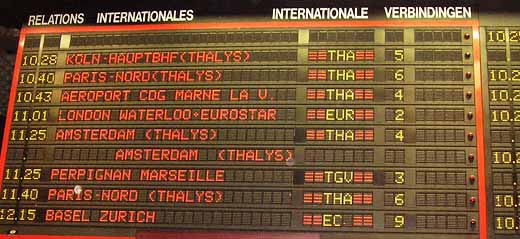
There's something very special about walking into a train station in the heart of a European city, and seeing a departure board that looks like this: http://www.enjoy-europe.com/hte/chap17/images/P1020015-Bruss... the sense that you could just buy a ticket and jump on a train to anywhere. You tend not to get the same feeling from an airport departure board, where for the most part you couldn't just buy a ticket and fly to any of those destinations.
I'll second Oslo to Bergen. We did it in reverse, as part of the 'Norway in a Nutshell' itinerary which is about 12 hours (can be done over two days) because it replaces some of the rail journey with a fjord cruise, the Flam railway, and a mountain coach.
In Europe, the convenience/inconvenience of airport locations varies a ton (which does influence purchase choices somewhat). For example Frankfurt's airport is only 8 minutes by commuter rail from the city center, and Copenhagen's is 12 minutes. But Paris-CDG and London-LHR are far from their city centers.
You still have to trek through the airport, wait in security lines etc etc. so in reality it takes much longer than the time it takes the train to travel from the airport to the city. That said flying is often if not nearly always cheaper for short hauls in Europe.
In the Baltics there is an ongoing project to upgrade and switch to standard gauge, which will provide a direct link from Berlin to Helsinki (to start with via ferry, but a tunnel is planned). However a lot of trade done there is with Russia via rail, so it's beneficial for them to keep that as seamless as possible - switching passengers is one thing, cargo is another. Lithuania apparently transports 57% of goods by rail.
For any non-Europeans looking to explore Europe by rail, I can highly recommend getting an Interrail ticket that gives you unlimited rail travel for various durations. For a reasonable price you can get a multi zone ticket that will let you explore most of Europe for a very reasonable price.
Non-European citizens can't use Interrail. There's a similar product called Eurail but with the discounts available for advance-purchase tickets, the pass often doesn't make sense if you're traveling with a relatively specific itinerary and can plan ahead.
The surcharges on the various high-speed trains really killed the cost-effectiveness of the Eurail pass.
Not true. You have to be a resident to use Interrail. So if you don't have a European passport, but live there, you can still use Interrail.
Note also, "European" here means a lot more countries than the EU. Other eligible countries of residence include: Albania, Andorra, Belarus, Bosnia-Herzegovina, FYR Macedonia, Gibraltar, Iceland, Kosovo, Liechtenstein, Moldova, Monaco, Montenegro, Norway, Russian Federation, San Marino, Serbia, Switzerland, Turkey, Ukraine and Vatican City.
It's only cheaper if you take only the most expensive possible routes
BUT, you can use it to get on any train in Europe even if only by confusing the local conductor with a complicated Eurail pass, even if it's fully reserved or not part of Eurail.
You can't just hop on any train anymore, that's the problem. Many high-speed routes require reservations and a surcharge. Those are also the trains most likely to have conductors who actually know the rules.
Interrail is only really worth it if you are under 26. If you have to get the "Adult" price then you only save money if you travel very frequently on expensive routes (e.g. once ever 2-3 days). Also you have to deal with the hassle of using interrail - nobody knows how the hell it works, you can't book tickets online!, you have to pay supplements on many journeys but again nobody knows which ones and how much.
Worth it if you're under 26 though because it is much cheaper.
Arguments in the U.S. about rail often center on the vastness of the U.S. compared to individual European countries.
However, Europe is about the same size as the U.S. (or bigger depending how you compare) and has generally better rail across the entire territory, this renders the argument fairly moot.
I don't see any mention of the US in the article. Not any "why can't the US be like this", not "let's contrast Europe to America": nothing. I guess some people just want to guide any topic back to their own America.
As opposed to another comment[1] which brings up the issue of rail in California. You just post some images which are comparisons -- according to what? Because I got the exact opposite impression of you intention -- that you meant to say "See, the US is crazy big so that is why we can't have nice things like fast rail!". Are we supposed to guess both the issue you are alluding to and your own stance on it from no introduction at all? Did you accidentally post your post as its own comment instead as a reply to another subthread?
(On the matter that you are referring to -- Europe is pretty densely populated overall, except for places like the Nordic countries north of Denmark. One point in the US' favour is that it is a single country.)
You may have noticed here on HN that conversations often expand beyond the confines of the article. I'm sorry you're unable to bring in knowledge of this topic from both the article and other sources, and an understanding of arguments pro/con for both European and American rail, into the conversation and provide productive commentary.
Yeah, I'm also pondering different ways of visualizing this data.. I wonder if it is possible to distort the map of europe so that map distance actually corresponds to train travel time. I guess not in general, because of metric curvature: you could have a small (fast) triangle that surrounds a large (slow to access) area.
I was confused as to why Ireland was showing up as accessible in these maps. Mainland Ireland isn't accessible by train from Europe. I found this excerpt in the original blog post which makes the concept slightly misleading:
Any points on water were assigned a swimming rate of 100 minutes / kilometer in order to create dense contours at the coasts.
In Holyhead (ferry port in Wales with many daily connections to Dublin) you board the ferry from the end of the train station platform of the high speed rail. The slow ferry takes three hours, the express ferry takes 1.5 hours. When I was there in 2006 there were many direct trains from there to London Euston.
The other option might be ferries that carry trains. I believe they don't do this across the Irish Sea, but I've been on a train that drives onto a ferry across the Baltic sea connecting Berlin and Malmo (Sweden). You can get off the train while on the ferry, but you don't have to.
I take this ferry every few months and it takes a minimum of 1hr 50mins on a good day.
>The other option might be ferries that carry trains.
Not between Ireland and England.
My point is, I can get a train direct to any major airport in London and fly to a significant chunk of Europe in under 2hrs and continue my journey via train so why not factor in those options too?
Or 7hrs to fly if you turn up the suggested 2hrs before your flight at the airport, live an hour away from the airport (true for much of London), plus an hour to get through the border and baggage reclaim the other end and an hour bus/train ride to destination.
This is why Eurostar to Paris/Brussels is so nice. Get on train in centre of London. Only need to turn up 20-30mins before departure and arrive right in the city centre at the other end.
It might seem inconsequential and I can't answer on behalf of the author of the article however if you have ever done the rail and sail you might understand it a bit better. I get what you are saying but the difference in faff between taking a plane and casually walking from the train to the boat is huge.
At least, in my opinion --- I live in Switzerland now, so my standards are... different. But, basically, overpriced, unreliable, dirty, and slow. The only places where the train system actually works well is the south-east of England, where it's horribly expensive. I used to live in Reading; a peak time day return into London, which is maybe half an hour a way, costs about £40.
Bear in mind that I know perfectly well that Britain's rail network is amazing compared to, say, America or eastern Europe. But the local perception of it is that it's bad. (Not helped by several rounds of botched privatisation, too.)
Incidentally, I'd love to know how to get from Ireland to Great Britain by train. Do they float?
You're correct that this is people's perception, but they probably haven't wandered into a typical German city station and found there's a two hour wait for the next train to another city, or that the only cheap option is a very slow local train.
Having recently visited the UK for a couple of months, I don't really understand why the people there hold their rail system in such low regard. Every time I compared prices between rail and coach, there was almost always a rail ticket that cost about the same as the bus and got me to my destination faster, even at the last minute. The trains were also very slick and clean, and often had outlets and working Wi-Fi. Better than many places in mainland Europe!
Because the majority of train journeys in the UK are commutes into metro areas at peak time rather than intercity journeys. They tend to be overcrowded with variable reliability due to the fact the networks are at capacity, and are not cheap.
How did you get into Switzerland? I've been considering / researching the possibility for a while, but it seems like a very long process to legally enter the country. Did you find it that way? Any recommendations?
[I looked for a personal email, but there isn't one listed on your profile.]
If you're an EU citizen, you can settle just outside of Switzerland and commute across the border. It's very common. Anyway, it can't be that hard as a quarter of the Swiss population are foreign residents[0]
Schengen is irrelevant here, British people have the same rights as every other EU citizen (i.e. go, then register as a citizen which is just a formality).
But the person asking is American, which is presumably very different.
What aspects of the train system did you find only work well in the south-east?
Curious because I regularly take trains all over the UK and have generally found the ones in the south-east and south in general to be the worst, as well as the most expensive, which seems reflected in customer satisfaction surveys at least – http://www.which.co.uk/home-and-garden/leisure/reviews-ns/be...
Virgin Trains, running only long-distance intercity journeys, is compared to London Overground, which runs trains within London every 4-6 minutes for commuters. I'd also guess the average Which? reader is much more likely to rely on a train for work if they live in the south east.
If we compare local services, the south east is much better: much more frequent service, newer trains, generally staffed stations, better value fares within London.
If we compare long-distance services, the trains often start or end in the south east anyway.
As a French who lives in London, my limited experience (London - Brighton mostly) is that they're fine, reliable, and cheaper than the French TGV (which is generally awesome and uncomparably faster, but ridiculously expensive)
I have a feeling the question might be linked to some common myths about the UK being spread by the French left for ages (evil privatized Thatcherite trains crashing into each other, third-world healthcare with people dying in droves in hospital corridors, etc). Right ? :)
What standard(s) are you asking about here? Other modes of transport? Our rail system from 20 years ago? Similar services in other European nations? I’d say our rail system is probably significantly better than it was 20 years ago. For some journeys I would almost always choose rail travel while for others I would hardly even consider it, usually as a result of cost or timing — how direct a route you can choose and the convenience of the connections makes a huge difference in our system.
As for comparisons with our European neighbours, there was some interesting discussion a week or so ago about how international rail within Europe works (or, sometimes, does not work yet). I added some comments there about a recent experience travelling between the UK and the Netherlands by train:
The short version is that international rail travel within continental Europe (well, Schengen really) seems to be much less hassle than travelling to or from the UK by train.
Overpriced. Overcrowded. Unclean. Cramped. Occasionally unreliable. We don't have any high speed rail apart from the link to Paris, but our standard intercity trains have connected most major cities at 200kph since the 1970's which is faster than conventional rail in Europe. TGV style High speed lines are a real pain to build in the UK because of the high population density of the countryside coupled with the extensive and laborious public consultations required. We don't have Alps but we do have quite a lot hills between the main cities. Once the route has taken account of all these concerns there are often not many parts where the trains will go at full speed. This is why the new HS2 route will only save 15mins off the time from London to Birmingham.
Compared to Germany, Denmark, Switzerland, Holland. Spain. E.g. Once travelling Copenhagen to London. The train from Copenhagen to the airport is spotless. The train from Stanstead to London is dirty and full of litter. There was a pile of rubbish on that train which was waist height; burger boxes, bits of foods, drinks cartons. I was embarrassed to be British. Also nobody cleans the crevices on British trains there's always black grime in there and the toilets often malfunction and stink out the carriage.
I'm French, I was in St Pancras / Margate / Brighton last summer and they have new lines, one of them called The Javelin, it's extremely fast, on time, reliable, so I'd say they've made tremendous progress.
Expensive (London to Manchester 80 pounds, composed to 15 by coach), mostly always delayed and not getting any better apart from the two or so lines Virgin runs which are super nice (but which are very expensive).
France's trains seem futuristic in comparison.
Germany's are super puctural and great value.
Germany's nationalised rail company, DB, who now own Arriva, are servicing some of UK's lines, I see now. The private UK system is helping to fund the puplic German system, heh.
Apart from all the Arriva-branded services, several train operators in the UK belong to Arriva (CrossCountry, Chiltern, and Grand Central Railway). Also, on the freight side of the railway business, DB own EWS (which is now called "DB Schenker Rail (UK)"). Since DB is fully state-owned, parts of Britain's railway system are state-owned again, but by the German rather than the British state :D
But to defend rail travel in the UK, advance tickets are much cheaper (I don't think I ever paid more than £25 between London and Leicester, maybe £15 on average, but then I didn't use the peak trains), but do require planning ahead. If you're lucky you can even snag a first class advance ticket for less than £3 more than standard, which is quite nice (tea! biscuits! juice!). Railcards are also quite affordable (certainly more so than DB's BahnCard) and amortise rather quickly, even more so when considering that you can have the Railcard discount applied to your Oyster Card. All in all, I was quite positively surprised given all the negative things I heard beforehand.
You can get london to manchester for £15 by train. You just need to book in advance. The fare structure is bizarrely complex and it's hard to knkw how much a journey is goin to cost until you get actually buy a ticket.
Having travelled by train in other European countries, I'd say it is actually very good. It connects more places than most countries, buying tickets is easy, trains are frequent.
The downside is that is it is phenomenally expensive. Far more than any other country. Yeay privatisation?
It's very expensive, but services are amazingly frequent compared to on the continent, with multiple trains per hour been major cities. There's little compassion from the Staff of there's a problem, since everything's privatised.
To the world really, because we do not have to drive to Frankfurt first to use a proper airport.
I look forward to the Frankfurt-London rail link operated by Deutsche Bahn. Strange times, when the UK thinks about moving away from the EU and staying alone on their little island like in the good old times and yet London is nearly as close to Frankfurt as Frankfurt is to Berlin.
Actually i've recently had a chat with people from DB Strategy, they've said that the Frankfurt-London connection is now technically possible and has been tested, but the ICE that should be used on it has a lot of technical issues that push the chances of having technical issues on one trip to above 20%.
That is a reason why they have pushed that connection off into the undisclosed future.
He wasn't a technical person, but the way he described it was that everytime an ICE crosses a country border, it has to change the settings on how the train operates, to comply with local laws and standards. This is stuff like how rapidly it is supposed to brake, etc.
He says that there is a 1 in 10 chance that when doing that "settings-swap" some part of the train software crashes irrecoverably and the whole train has to be rebooted, which can take up to 15 minutes.
So when crossing from germany into belgium, then france, then uk and back again there would be a high chance that those trains would have to be rebooted somewhere along that track, and that would wreck havoc within the international train system.
I enjoy traveling by train, but it's a bit of a shame that it's often economically unwise to pick a train over a coach bus if you're sensitive at all about the price. Difference can be 3x or higher, though some countries are better than others. (Italy, the UK, and Eastern Europe have pretty cheap trains, I've found.) Rail passes seem to only make things better if you're travelling a bunch over a short period of time, not once every few weeks. Still, I'd much rather travel by coach than air!
For DjangoCon Europe this past week I flew into London, stayed a few days being touristy, went to the conference in Cardiff, then came back to London and am flying out (home to the US) in a few hours.
I took a train to and from Cardiff. It was £22 each direction, roughly 2.5 hour trip from London Paddington to Cardiff Central, and the same in the opposite direction.
I doubt very much I'd have been able to hire a car for that trip for £22 each way. In fact, I probably couldn't even have gotten out of London for £22.
In Britain, you pay a lot for peak-time travel, or last-minute travel.
London to Cardiff and back is £218 at peak times(!) on a fully-flexible ticket, £74 with a flexible off-peak ticket, and as low as £40-ish (which you paid) if booked well in advance for particular trains.
It would have cost about £50 in petrol (return) to drive, plus £40/day for a small rental car.
How "last-minute" are we talking here? I booked the ticket on May 24, for the trip to Cardiff on May 30.
In the US, where intercity trips above a couple hundred miles are typically by air, six days out would be "last-minute" for most people, so that's my frame of reference.
Also, the return to London corresponded with the hordes of One Direction fans (whose suddenly-announced concert in Cardiff forced a shuffling of the conference schedule since every hotel in town sold out instantly).
In Germany I usually buy my ticket on my phone on the way to the station (I do have a BahnCard 50, i.e. 50% off all journeys). I could typically save a few quid if I booked non-flexible tickets a few days in advance (3-7 days). For longer distances (>400km) the savings become more noticeable and my trips less spontaneous, so I do tend to book those in advance as far as possible.
In the UK (I had a Railcard), I booked everything as far as possible in advance (quite often on the day advance tickets became available), as prices for advance tickets do vary quite a lot when you get close (weeks instead of months) to the day of travel. If you don't care which train you take, then you'll usually find affordable tickets a week in advance, but when meeting people at a fixed time, booking close to the day can yield unwelcome surprises.
I'd like to buy the ticket shortly before the train leaves and not feel I've been ripped off, or have more flexibility in the return journey when booking in advance.
For most trips the train is competing with a car, which has no penalty for spontaneity other than journey time.
Having spent a couple of years commuting from West Wales to Cardiff daily, at peak, I have to say that there is no way that I could have hired a car for the £18 return.
SE England is ridiculous, I'll give you that, and never a seat.
I once got a lift from a friend from the South West of England to the South East, as the ticket price was £150 PP return (2 of us), and he needed to head up that way anyway.
Ultimately the lift ended up only being one way, the price of a single train ticket back.. £149 PP.
Over the course of my trip in the UK, I traveled short-distance last-minute dozens of times, and trains were practically as cheap as coach about half the time, so long as you picked the correct departure time. This simply is not the case at all in mainland Europe. Dunno anything about car hiring, but the coach prices were certainly cheaper than the price of gas.
I recently moved to Canada from Europe and one of the "cultural shock" were the difference in scale on the maps and what is commonly considered being "a short drive".
I did a tour of the most active hackerspaces of Europe in six months while I was in high-school. It was a fantastic experience and it is the cheap cost of night trains that made it possible. Granted those were not super confortable but I do not regret the experience one bit.


If you place the northern tip of France on the northern border of California, the southern tip of France lands just north of San Diego. We have about 40 million people; France has about 60 million.
Japan (another country with great trains), is about the same vertical distance north/south as the west coast of the US. And while Japan's population is crammed into the coastline of an island nation where it's expensive to build, we have gobs of open space where it's comparatively cheap to run rail.
There's simply no excuse. Sure, it doesn't make sense to try to make a high-speed train across the country, but we should have great regional rail systems in the US. The east/west coasts, in particular, should be corridors for rail -- if you can get from Kagoshima to Tokyo in 6 hours by Shinkansen, there's no reason you couldn't get from New York to Miami in the same amount of time.