I once assisted getting a barge into a port. Technically it was a barge, because it didn't have its own engines, but it was an FPSO[0] and it was 310 metres long and 80 metres wide - you could fit three football fields in its footprint.
My job was to provide real-time live radar from the land-based VTS[1]. It had been decided that only relying on GPS was a risk, and that independent radar images would be necessary to confirm position, course, and speed. We were transmitting live radar from Port Control over a 19.2k baud VHS data link to my laptop on the barge. Using the radar data we re-calibrated and cross-checked the GPS positioning to make sure there was no drift, error, or distortion. There was some interesting math going on underneath.
Modern radars sample at 50 MHz, giving a 3m inter-sample distance. Getting that 50 MBytes/sec data down a 19.2k bits/sec channel was a challenge. There were some easy gains (inter-pulse dead-time, blanking) but we still needed a radar image the pilots and captains could rely on, especially coming in from open water.
There's a picture of it coming in to the river[2] and a video[3] of the vessel, having been fitted, leaving the river. When it came in it didn't have all the super-structure, and the highest point was the heliport, which is where I stood for much of the time.
> Modern radars sample at 50 MHz, giving a 3m inter-sample distance. Getting that 50 MBytes/sec data down a 19.2k bits/sec channel was a challenge
Surely you would do the processing for target extraction on the radar's side of that link, and send much less frequent samples from the estimated track over the slow link? Tracking on scanning radars can be tricky, but I suspect that would something so big and so slow the processing would be quite simple. It's also a bit surprising that ports don't do this with secondary radar (like airports do). Using the ship's signals with PCL or similar technology would definately be feasible.
Radar is a technology with great promise. The advances in computing power, signal processing, and radio technology over the last decade or so is a radar revolution waiting to happen.
  > Surely you would do the processing for target
  > extraction on the radar's side of that link,
  > and send much less frequent samples from the
  > estimated track over the slow link?
That's the obvious thing to try, and it works well in ideal conditions when there are only large targets, and no clutter. Lots of people track at the radar head and only send what they believe to be the stuff that matters.
We work in contexts where there can be personal water-craft in areas of moderate clutter, and plot extractors have a very poor record and even worse reputation for finding the real targets that are most at risk of being run down by vessels.
We transmit the actual radar video so the operators can put the Mark I eyeball on the image. Customers like that, and we regularly out-perform our competitors at getting customers to find and identify small targets at risk.
There is a second story to it: about a decade ago, the shipyard owners realized that they had already reached the maximum ship size that they could transfer from the shipyard to the sea. So they announced that they would transfer the shipyard to the city of Eemshaven downstream the Ems river - a sensible decision you might think, however, Eemshaven is unfortunately already in the Netherlands. The state government, not wanting to lose a major employer in a rather poor area of the state, built a storm surge barrier to the tune of around 400 mio Euros, arguing it would be for flood prevention. Conveniently, it also allows blocking the outgoing tide, leaving the river at high tide for more than a couple of hours, allowing for larger ships to travel to the sea. At apparently quite an ecological cost.
Well, surprisingly the shipyard stayed in Lower Saxony. So much for European integration.
But it seems like they reached maximum ship size yet again, wondering what they are coming up with next.
I regularly visit Port Aransas Texas, often fishing the shipping channel that goes to Corpus Christi. The channel can not handle the biggest of tankers, the supertankers. But even so, i can not overstate the size of these ships. It never ceases to amazes me. When you are in the channel you have to take into account them coming through the channel, and i dont mean simply getting out of there way, the channel is plenty wide to hold two(as they go both ways) with much space on both sides. I mean the effect they have on the channel, specifically when they are coming in (full of cargo). When full they draft a full 10-15' more of water. Displacing this much water causes mini tsunami in the channel. If you are to close to the bank you could either find yourself beached or slammed against something.
Its really a spectacle when they come by, even after seeing it hundreds of times i still stop and watch.
One thing not mentioned in this article which is a HUGE factor with moving these large ships is wind drift. Any boat /ship will act as a sail, but the bigger you get the harder it is to control. As anyone who has piloted any vessel can tell you it only takes seconds to get out of control. When moving these huge ships through such tight quarters i can only imagine how difficult it is to control.
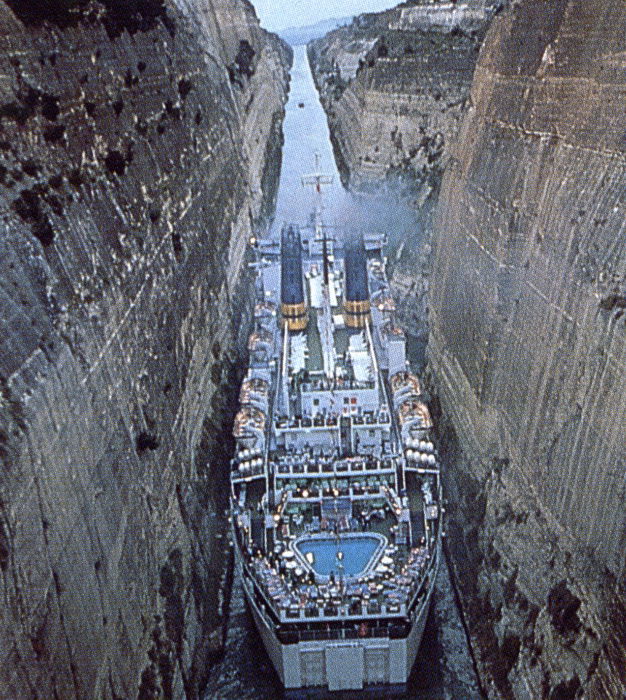
I once got to experience the other end of that: Being on a ship while it's going through a tiny canal. In my case, it was the Kiel Canal in Germany.
(When you're standing on the deck of a ship, you can't see the small gap -- between ship and land -- unless you stretch your neck over the rail and look down.)
So imagine this: You've spent many days on the open sea, with nothing but water in every direction. It's become so normal to you that you forget there's other life out there, beyond the steel hull.
Then one morning you wake up from a deep sleep and step outside, and... You're surrounded by land! You can't see the canal beneath you, but you can see the beautiful park you're in, with joggers, mothers with strollers, and couples holding hands.
It's very bizarre, and I'm not sure I'd get used to it either.
Even transiting the Panama Canal in a smallish (210 foot USCG medium endurance cutter) is kind of weird. One day you're underway making way in the Pacific, the next day you've got mules pulling you through locks.
"The second largest cruise ship in the world, Oasis of the Seas, used this effect as a contributing factor to pass under the Great Belt bridge, Denmark, 1 November 2009, on her voyage from the shipyard in Turku, Finland to Florida, USA.[5] Without the presence of the squat effect, the ship wouldn't have been able to clear the bridge safely - the margin would have been very slight. However, travelling at 20 knots (37 km/h) in the shallow channel, Oasis experienced a 30 cm squat, allowing sufficient room to clear the bridge safely."
So, you are captaining this brand new billion dollar cruise ship, and the deck of the bridge is too low to pass under it. Now, order your crew to speed up as much as they can, and trust physics to do its thing.
Yes, but the basic technique is (at least) decades old. To transit some of the tighter bends of the Panama canal, ships used the hydraulic effects between the ship and the bank to either pull closer to one side, or as a cushion to push the ship over so it could turn in a smaller radius.
I've never heard of squat being used to make it under a bridge, though. We were just taught that if you were heavily loaded and close to the channel bottom, increasing speed could be a bad idea.
Yikes, gotta be confident about that one. Apparently the Oasis of the Seas is also able to retract it's chimneys (I'm sure that's not the correct word) to get a bit of extra clearance.
Video of this ship, and it's sister ship Allure of the Seas, going under the Great Belt Bridge:
In the old days of steamers they were smoke stacks/chimneys. These days the are more just for aesthetics afaik. Those they do put some instrumentation on them im sure. Such as GPS/radar/antennas.
“Everything is unusual on this trip,” says Bernard Meyer, managing partner of the firm.
Meyer is the great-great-great-grandson of Willm Rolf Meyer. He founded the company in 1795, choosing a spot in Papenburg so construction projects would be safe from storms.
In his wildest dreams, I doubt Willm Rolf Meyer could have ever imagined this as a legacy. Or that his family business would survive 219 years and apply its experience this way. Remarkable.
The article reminds me of the "fitting a ladder around a corner" problem that I saw in numerical analysis class years ago. Expanded forms of this problem include the food trolley and sofa problems... take a look at
Unrelated, bit it irks me that in 2014 there are three countries left that have not adapted to the metric system: Liberia, Burma, and the United States. So when I read
"1,141 feet long with room for more than 4,000 passengers"
I have to mentally translate it to:
"348 meters long with room for more than 20-score passengers"
Judging from my experience on a cruise several years ago, the only major issues are arriving on/leaving the ship in port (and they somehow managed that process so that it wasn't that big of a deal) and scheduling dinner in the evening (there were two or three seatings and, by god, you had to be there on time).
The cost I was thinking of was the bad PR. Ships running aground with people dying, mass strandings at sea with people living in squalor unable to flush toilets, and general sickness run wild.
Ships and trains are the most fuel efficient ways to transport things - and things include people.
In terms of the bad PR, I confess I'm biased - I'm an epidemiologist, with a fondness for GI infections, so norovirus is near and dear to my heart. But cruises have good marketing, the failures like that are relatively rare on a mass scale, and it's a cheap vacation that feels like luxury to people.


My job was to provide real-time live radar from the land-based VTS[1]. It had been decided that only relying on GPS was a risk, and that independent radar images would be necessary to confirm position, course, and speed. We were transmitting live radar from Port Control over a 19.2k baud VHS data link to my laptop on the barge. Using the radar data we re-calibrated and cross-checked the GPS positioning to make sure there was no drift, error, or distortion. There was some interesting math going on underneath.
Modern radars sample at 50 MHz, giving a 3m inter-sample distance. Getting that 50 MBytes/sec data down a 19.2k bits/sec channel was a challenge. There were some easy gains (inter-pulse dead-time, blanking) but we still needed a radar image the pilots and captains could rely on, especially coming in from open water.
There's a picture of it coming in to the river[2] and a video[3] of the vessel, having been fitted, leaving the river. When it came in it didn't have all the super-structure, and the highest point was the heliport, which is where I stood for much of the time.
An interesting job.
[0] http://en.wikipedia.org/wiki/Floating_production_storage_and...
[1] http://en.wikipedia.org/wiki/Vessel_traffic_service
[2] http://www.ship-technology.com/projects/bonga-fpso/bonga-fps...
[3] https://www.youtube.com/watch?v=wKLXiHPNu8A