As dual-income households have become more the norm, it's really the household income, rather than an individual's income, that's a better measure of (material) richness.
For instance, you might have a family with a sole breadwinner who has a low six-figure salary, but that has to cover all the family's expenses. Meanwhile, even if his neighbors, a dual-income household, both earn less than him, their household income could be considerably more.
By the way, the rising percentage of dual-income households has been suggested as an exacerbating factor in the growing income inequality in the U.S.
If you figure that people tend to marry others of the same educational level (more so now than in generations past), and if educational level is roughly correlated with income, then you can see how the gulf widens.
Whereas 50 years ago, when single-income households were the norm, a lower-educated fellow might bring in SALARY and a higher-educated fellow might bring in SALARY * 2. But now, with dual-income households, a lower-educated couple might bring in (SALARY * 2) and a higher-educated couple might bring in (SALARY * 2) * 2.
So, 50 years ago, there was one SALARY worth of difference between the lower-educated household and the higher-educated household. Nowadays, there is (SALARY * 2) worth of difference.
Surely requiring two incomes in a household is extraordinarily problematic?
Before, one partner could sustain the household and the other could stay at home and raise kids.
Now, if both partners are expected to earn and have careers, who looks after the home life? Who looks after the kids? Surely this is really really damaging?
And doesn't that mean that in real terms we're earning half as much?
> And doesn't that mean that in real terms we're earning half as much?
Yes. It does. Average earnings per person started to drop once women entered the workforce, presumably since at the beginning it was a big bonanza - "hey look at this! twice as much household income!" Over time the dual income averaged out to what it is today, but now both people have to work.
It is problematic for dual-income households with kids.
In these situations, kids are raised by a combination of:
1) Extended family (typically retired grandparents)
2) Daycare / child-care / "school system"
3) Private child-care (e.g. nannies or babysitters)
#1 is cheapest, but ties the family down to where the grandparents are. Both parent jobs need to be located relatively close by.
#2 typically take a huge chunk out of the 2nd income (which is almost always unfairly compared against the mother's income), at least until a family can survive/pay for such child-care until public schooling becomes an option.
#3 is only really an option for those that earn enough to support a full or part-time babysitter.
Sometimes you'll see a combination of #2 and #3, but that again is only really an option for those with enough cash-flow. Some preschool programs are even more expensive than a decent nanny, although ones loses out on the socialization aspects that come built-in with a daycare program.
Home life (beyond kids) for dual-income households is a shared responsibility. I don't think much changes there whether you're a single income or dual-income household. If you're talking about chores like groceries, cooking dinner and cleaning up, that's what weekends and evenings are for.
In real terms, we may be earning half as much (or even less depending on the combined income), but the marginal incremental value of the career experience and/or additional dollars is usually enough that going dual-income wins out.
EDIT: @humanrebar mentioned the "safety premium". Households that have experienced layoffs in the past (friends/family/themselves) probably take into account that although both adults may be working today, that doesn't mean both adults will be guaranteed jobs X months/years in advance.
Yes, it is a bit of a burden for the grandparents. I hear that this is sometimes alleviated by using grandparents on both sides of the family, health permitting (/anecdata).
So what exactly was the point of the colossal developments in human productivity in the last ten decades?
So we can continue to function as desperately as our ancestors whilst a few people have more money and power than we can possibly imagine? Fucking great.
Two incomes in a home is not required, it is just that our lifestyles have evolved to "require" that. Home prices over last 40 years adjusted for inflation have not changed very much (besides in the bubble in mid 2000's).
Previously on that one income a reasonable 40 years ago family could have a home, a TV, a car, and take inexpensive road trip vacations. Now the typical family has multiple cars, homes much larger than in the past, a vacation could be flying to some destination, $100 cable bill, $150 phone bill...
So if one wanted to live like in the past it is certainly attainable on a single reasonable income. That may mean "only" having a 1700 sf house with one bathroom and one car.
Even since I was a child things have changed a lot. The typical new home today would be something I would have considered luxury as a child. I think that things changed a lot in the dot-com -> Real estate bubble era that gave Americans a taste for luxury that is now the normal.
> Home prices over last 40 years adjusted for inflation have not changed very much (besides in the bubble in mid 2000's).
This might be true as a national average, but it is definitely not true in areas where there has been consistent competition for housing. It's that competition which will push housing prices up to levels that require two middle-class incomes.
This includes most major cities. Even excluding bubbles, desirable urban real estate in the US has skyrocketed much faster than inflation. There are a lot of factors in that, but one of them is that the market has now priced in the fact that most homeowners in these areas are now dual income.
> So if one wanted to live like in the past it is certainly attainable on a single reasonable income.
I'm not sure that's true. Take Houston, for example. Some of the most expensive neighborhoods were originally suburbs in the 1950s filled with workers who commuted downtown. Now those neighborhoods are considered urban and there is an entirely new ring of suburbs beyond them (in fact two such rings). The homes in these now-urban neighborhoods are now all $1M+.
A family with a reasonable income of $100k will be completely priced out of all those homes. They'll be forced to either live much further out (meaning very long commutes) or to live in an apartment/condo or, maybe, a townhouse. If they had lived in the 50s, they'd have been living in a neighborhood that is now reserved for surgeons, corporate attorneys, and even CEOs.
> So if one wanted to live like in the past it is certainly attainable on a single reasonable income... That may mean "only" having a 1700 sf house with one bathroom and one car.
I agree with the attitude here but cultural norms have shifted so much that there isn't nearly enough supply of those sorts of homes. The reality is that people typically "downsize" by moving far outside of town and commuting long distances, which isn't really a solution to the problem.
You also produce more, which means you can export more, thus giving the economy a boost overall which raises standards of living because you can get more foreign goods for your $.
As dual-income households have become more the norm, it's really the household income, rather than an individual's income, that's a better measure of richness.
That depends on how the income is spent. If people spend their extra income on leisure activities, luxury goods, etc then it'll absolutely mean that a high household income will be a good measure of richness. That's obvious.
However, if dual income households decide to spend their income on investing in a better house, what will happen is that it'll push house prices up - a finite supply of housing stock means there'll be competition for the best homes, so people will have to pay more for them. That demand side pressure will filter down the housing ladder and pull all the prices up. After thirty or forty years this will have had the effect on house prices that single income families just can't afford to buy. Further, it'll mean that dual income families have to retain two incomes, so parents wanting to stay at home when they have children simply won't be able to afford to.
This has already happened in the UK. Lots of pundits are predicting a crash because the first-time buyers can't afford to buy, meaning no one is buying the lower price houses, and that's going to pull the whole thing down.
Mind you, the pundits have been saying as much for about twenty years.
This has already happened in almost every major city in the United States. My anecdotal observation is that townhomes in major cities are affordable to single folks with one (low six figure) income and single family homes require two such incomes. And that actually does make a bit of sense, as a married couple has a higher probability of making good use of a SFH than a single person does.
I don't predict a crash (at least not based on this phenomenon alone) precisely due to the abundance of townhomes that are being built in the US. In Houston, for instance, even though the townhomes are sort of hated since they're replacing old, historic bungalows in many cases, they are the one thing keeping the city somewhat affordable. Cities which have extreme zoning laws preventing this sort of development might be more susceptible to a crash.
There is "rent seeking" (a microeconomics term for a market inefficiency using politics for wealth creation instead of true wealth creation) by having zoning laws which keep land use density artificially reduced as well as over-using "historic landmark" laws. The zoning restrictions on land use and the overuse of historic landmark laws effectively make very wealthy landlords and other landowners wealthier still at the cost to others.
See writings of Harvard economist Edward Glaeser for more details.
This is something that can be fixed by reducing the market inefficiency of "rent seeking" through state law which overrides the desires of wealthy landowners at the city level.
Zoning laws can pose a lot of restrictions on where those houses can be built, so it depends heavily on the city. Basic physical obstructions and topology also play a role. Adding more homes onto far out suburbs isn't going to do much to massage the problem of unaffordable housing near downtown office districts if it means that homeowners have to commute an untenable distance.
Which makes substantial profits for the home builders but very little in the way of more affordable housing.
The price of a barrel of oil is determined by supply and demand. As the price goes up, more production is brought online which is now economically feasible. So at $100/barrel you've got the Canadian tar sands projects which make oil for something like $80 a barrel worth of cost so the company can make $20 a barrel.
But there are still tons of wells out in west Texas that are producing oil for $20 a barrel in cost. The people that own those wells are making $80 a barrel in profits.
If housing prices are high home builders might be able to build less expensive houses but they have no incentive to. They can sell the houses they build at market rather than below market prices. It might increase the supply but that doesn't necessarily translate into reduced prices in any kind of a reasonable timeframe.
The increased housing prices are caused by "rent seeking" by wealthy landlords (think people who own hundreds of rental units for example) that want to increase the value of their property. They do this through zoning ordinances that artificially restrict zoning density and also through overuse of "historic preservation" laws. See Harvard economist Edward Glaeser's writings for more details. He very clearly demonstrates the increasing cost of land and as distinct from the cost of construction.
It is important to understand this reason, "rent seeking" in microeconomics makes for market inefficiencies. It is a means for people to enrich themselves through politics by making people pay more for rent or for buying a house instead of through actual wealth creation. The solution to the ever increasing housing prices is to reverse the "rent seeking" by fixing zoning laws so that there are not unfair zoning density restrictions and restricting the overuse of "historic landmark" laws.
In the UK when house prices go up people tend to build more houses at the top end of the market where there's the most profit. No one builds cheap houses that people on a single income could afford. I don't know if the US is similar.
I think there are a couple of factors you're overlooking.
Consider the case of a dental hygienist married to a nurse. In SF, they both earn about 110k a year. So $220k is a high salary, comparable to a physician in a modestly paying speciality.
Here's the thing... I think payroll deductions apply to the entire 110K of each dh and nurse's salary, but only the first $110k of the physicians salary. However, the second salary in the two-income family will be taxed at a high rate, on top of the first salary. Furthermore, physician's husband, who doesn't work, is available for full time child care. The nurse and dental hygienist have to arrange full time day care for their two young kids, which runs about $20-25,000k a year per kid in SF. And because they are a very high income family, over the "ultra-rich" 200k threshold, they don't get a tax break.
Even close to 100k, that second salary may have a marginal value close to zero once kids enter the picture.
That doesn't mean you shouldn't work just because the marginal value is low in the moment - eventually you get to come back up for air, and people who continued to work are often much better positioned to advance again. So there are benefits.
In progressive tax situations that is called the 'marriage penalty' (second salary is all taxed at the higher marginal rate) which is mitigated somewhat by changing the tax thresholds for married people filing jointly. You can file separately of course, and it seems a number of people are living together and filing as individuals, it gets complicated as you get kids because they become dependents (and a tax credit) on one of the people's return.
There is a reason all this stuff keeps a legion of tax attorneys and CPAs employed.
> "the growing number of dual-income households has been suggested as an exacerbating factor in the growing income inequality in the U.S."
That's a red herring.
When people talk about inequality as a serious economic problem, they're not talking about any discrepancy between households living off a salary or two. They're not even talking about the discrepancy between the ninety-nine and the one percent -- they're talking about the point-one percent and everyone else.
I don't think it's as much of a red herring as you suggest. More and more, a dual income is required for basic sustenance. That has a significant impact in many intangible ways: stress, family dynamics, freedom to pursue entrepreneurial efforts, etc.
It was suggested that dual incomes were a cause of increased inequality, not a symptom. And that's wrong.
The inequality that's an economic problem is not between those earning more than 100k and those earning less [1]. The problematic inequality is the difference between those earning more than 1M and those earning less. [2]
I absolutely agree that dual incomes are an increasing-necessity, but they're a symptom of inequality. They're more-required because the "below 1M" earners have not been seeing their wages rise with their increased productivity. And those "lost wages" are going to the "above 1M" crowd -- not the above 100k crowd.
[1] Two incomes are not making anyone cross that line, save a hypothetical family with two executives at small-to-mid-size firms. And the problem is primarily the rates-of-change of wages between those earning more than 1M and those earning less. That there's a gulf is not, by itself, much of a problem. That it's getting wider, is concerning. That tangible objective increases in worker output and efficiency are not translating into increased worker rewards is the ticking time bomb.
Consumerism. It convinces people that once they make $100k/year, they require a vehicle that befits someone who makes that much money. It convinces people that they require a place to live that compares to their other 6-figure earning peers. More, bigger, better -- the importance of those three things outweighs most everything else.
I grew up (and now live) in rural Appalachia. The "American dream" is defined much differently here. The American dream is owning a trailer and not having to live off of food stamps.
Let's ignore the absurdity of comparing a 1980 $100k/year salary to a 2014 $100k/year salary. In most areas of the United States, six figures is enough to qualify as well-off. Compared against the backdrop of abject poverty, six figures is certainly rich.
My wife's cousin was talking to her about a new job he landed. He was giddy with excitement, as he told her he was going to be "making bank." The salary was $22k/year.
My point is that "rich" is relative to your geography and your upbringing. In most areas of the U.S., a six-figure household income is enough to have a warm place to live and healthy food to eat, with enough left over to provide security during times of famine
> There are a lot of ways to be frugal, but you can start with driving older (paid-off) cars and tracking your expenses to ensure that your family spending aligns with your values and goals.
So I guess being "frugal" means that you track your expenses and not live beyond your means?
I caught that too, words cannot express my distaste for that kind of mentality. It's unfortunate that normalcy to the author is not keeping track of finances and buying things you cannot afford.
> I grew up (and now live) in rural Appalachia... In most areas of the U.S., a six-figure household income is enough to have a warm place to live and healthy food to eat..
I completely agree with everything you wrote. I grew up in a rural community, too. I see how DINKs overspend on things they "need" all the time.
However, something you're missing is the safety premium. Often it's not possible to live modestly in a safe, clean neighborhood with good schools within a reasonable commute distance of work (especially if both spouses work).
The long-term answer might include more telecommuting so people can live in Appalachia and still be productive, but that requires a big cultural shift and doesn't help all jobs and careers.
I agree with you. But with many people, I would classify the safety premium with the other things that those people "need".
When I first arrived in Austin a few years ago, so many yuppies told me to NOT go east of I35. They were paying outrageous sums of money (actually quite tame by San Francisco standards) to live far from the side of town they perceived as dangerous.
However, once I became acclimated to the city, I realized that they were blowing a lot of smoke due to irrational fears. The east side was certainly more diverse. It wasn't as white-washed as the west side of Austin. It has more graffiti and was generally poorer. But, it was not dangerous.
Again I'm making some pretty broad brush strokes. I realize that other places have dangerous neighborhoods and many cities have a legitimate need for a safety premium. My main point is that for many people, the necessity of the safety premium is perceived unjustly.
I share the same sentiment regarding prejudice and snobbery. But safety and cleanliness are certainly needs. I think they are taken for granted by rural folks who don't really have neighborhoods as such so they they can (for the most part) trivially avoid crime (don't hang out with meth heads and drunks).
In urban areas, price and crime rate are inversely correlated. See also commute times and school quality. Usually the heads of households have to make significant trade-offs to save money on housing (usually the single biggest budget item). Not that they don't in rural areas, but the tradeoffs are of a completely different kind (access to high speed internet, paved roads, cell phone reception, downwind from a hog farm, etc.).
This comes up a lot. Sometimes they talk about a car, for a while there it was always a "plasma tv". Financial advisors, talking about middle class debt and financial struggles, would ask you, do you really need that "plasma tv".
San Francisco is probably an outlier, but with the median house price at 1.1 mil, and full time child care costs for two preschool kids at $40-50k a year, a plasma tv is a minor rounding error in the cost of living.
So while I agree with you about the TV, and the car, and the consumerism in general, I do think it may be a way to blame the middle class for not paddling hard enough toward shore as the ocean current carries them out around the rocks.
San Francisco, Manhattan, D.C. -- they're all outliers. My great-aunt runs a day-care facility in Kentucky. They charge $200/month/child. (This is definitely an outlier on the other end of the spectrum)
It's very difficult to talk about wealth, as wealth means different things in different places. My argument for a $100k/year salary being "rich" falls apart in expensive cities.
True, but keep in mind, 100k is a lot easier to achieve in those cities. Registered nurses and dental hygienists (and software developers), who all earn about 110k a year (median) in SF, tend to fall well below that threshold outside these centers.
Personally, I'm glad dental hygienists make enough money that, with two incomes, they can live a middle class life where they work. But it really does put that "critical shortage of software developers" at an average of $110k a year in SF in perspective.
There is little clear thought about the range of options in major expenses. Most feel intuitively the range of "not enough" vs. "not necessary" without giving it the contemplation it deserves.
For example, we wanted features in rental living space commonly only found in condos or more expensive rental property.
We prioritized and ended up cutting almost 40% off our rental costs and got every feature we needed and wanted most (e.g. on a park, in-home washer/dryer, corner unit, two-story floor plan, super-close parking, neighborhood living near freeway, etc., etc.)
We gave up a lot of square footage (but met all storage space needs). Lower rent was a predicting factor that maintenance would be poor (but it's not terrible), neighbor likeability varyies more than we would prefer, etc. But it really feels like a complete win.
Managing smart auto maintenance in part by using mechanics on JustAnswer has allowed similar savings for our vehicles.
The article lists factors such as inflation, geography (the coasts are more expensive), kids, and healthcare, but not underlying reasons.
Some people want larger homes, more cars, bigger lifestyles (over-the-top weddings as an example), communication and entertainment (expensive cable, internet, and phone providers, just to start). And the allocation or misallocation of resources within the health "care" system is another reason that average income doesn't seem enough.
The few tips at the end -- live modestly, save a lot, and don't get hung up on status -- are barely a start.
The goal of "living the dream" is left unexamined or unquestioned.
That's a fair point and I understand why you'd argue that.
However, you'll notice that most people consider rich to be "having more than what I have" or "having more than other people". Many millionaires don't think themselves wealthy -- and they're not necessarily wrong. They've reached a point where many of their peers have more capital than they do. Others may consider them "poor".
I'm not sure why the article is so obsessed with this "six-figure salary" thing (which seems to mean exactly $100,000).
$100k 30 years ago after inflation is $288k now. Anyone earning $288k now is definitely rich enough to "live the american dream" (in the article they price that at $130k).
It would have been a much more interesting article if it had just focused on cost of living increasing faster than inflation
> "I'm not sure why the article is so obsessed with this "six-figure salary" thing"
Because people ascribe meaning to "large numbers" that are unmoored from the actual objective context and meaning of those numbers.
See also: people's penchant for using totals, sometimes even lifetime totals, to argue that certain projects (public or private) are too expensive/boondoggles/etc. They ought to be looking at ROI, rates, per-capita-rates even -- but they don't. Because they know the audience has attached emotional meaning to "millions" and "billions".
There's some justification for them using the 100k number. They bring up that child tax credits and health care subsidies are phased out around that point, as are IRA contributions.
> It would have been a much more interesting article if it had just focused on cost of living increasing faster than inflation
I nearly fell out of my chair laughing at this line. Crazy Austrian folks call the increase in the supply of money "inflation" but that's not what most people think of when you say the word. The vast majority of people would agree that "inflation" and "the CPI" are basically the same thing. The CPI is the Consumer Price Index. It is a measure of the cost of living as set forth by the BLS here in the US.
So what you just said is that the cost of living is going up faster than the cost of living! That clearly can't be true, so there's a problem. The actual cost of living is going up faster than the government's measure of it. Okay, that's better. But it's still problematic.
If the government's measure of the cost of living is going up slower than the actual cost of living then a lot of people are getting screwed. Anyone on a fixed income that's inflation adjusted like Social Security or a pension. Anyone buying a TIPS bond, anyone who gets regular cost-of-living raises so that their salary keeps up with their expenses, etc.
If the CPI number was accurate then all these things would be OK. But since it seems like it's not the fact that huge swaths of socioeconomic activity is tied to these indicators is really pretty tragic.
I think Carl Sagan captured the essence of why these kinds of things take forever to get found out:
"One of the saddest lessons of history is this: If we’ve been bamboozled long enough, we tend to reject any evidence of the bamboozle. We’re no longer interested in finding out the truth. The bamboozle has captured us. It’s simply too painful to acknowledge, even to ourselves, that we’ve been taken. Once you give a charlatan power over you, you almost never get it back."
I think they're poking the perception even today that people have. If you say to someone that you earn 100K they might claim that you're wealthy or rich, but the as the article states it doesn't automatically mean that anymore.
I'd agree with you that $288K makes someone wealthy or rich, but human perception and the reality aren't often one in the same.
You're confident that the problem isn't that inflation is being intentionally understated via the government having altered the CPI to mask inflation? (ie that the cost of living is showing the true rate of inflation)
So pick another index. How about the Billion Prices Project [1] from MIT. Oops, that pretty much tracks the CPI. Guess maybe the CPI isn't intentionally understated.
You're still not poor though. In fact, if you have a million dollar net worth with expenses covered by your current income, you're definitely in the "rich" category compared to 99% of the US.
If you own a family home in some neighborhoods, you have a million dollar net worth. Even if you inherited it from your folks and minimum wage goes to property taxes instead of rent.
Granted, you could sell the home and join the regular rat race with everyone else, but what's the point of being frugal if you can't leave the surplus to your kids?
The average global citizen also isn't paying American costs of living. My cousins in Asia are earning easily 10x less than I am in real nominal currency, but their cost of living is commensurately less.
Measures of wealth are just numbers until put in context of local costs of living.
Which addresses the reply to your post: $100K is wealthy in parts of the country, it's not wealthy in others. Getting paid $100K in small-town Idaho is a whole different ball game than getting paid $100K in SF.
The trick is that there are a lot more $100K jobs in one place than the other. What PhasmaFelis insists on calling "living beyond your means" is often nothing more than people looking for work.
Agreed. Title is bullshit, and the article does nothing to change my mind: if you insist on living beyond your means, then no amount of income will seem like enough. $100,000/year is not a free license to move to the trendiest neighborhoods in the most expensive cities and start collecting yachts, but it's still rich by any reasonable human standards.
Not it sure as hell does not mean one is "rich." It is, at best, an indicator of marginal affluence. It certainly is stretching the bounds of credulity to call it "merely" middle-class, though, and forget calling it "poor."
"Rich" means more than having a relatively high income. It means having the means to obtain in relative short order, or having already obtained, relative financial independence. An income of $100,000 doesn't qualify in most places. Such a person would be required to find some income if he loses his current source, and he would almost certainly suffer financially and take many hits to his credit during a period without income. This person isn't "rich" until he's amassed enough savings that he can weather such a period without significant risk to his finances or credit, which will take literally decades in most cases.
What if your job is in Manhattan where that means you are making negative income vs. your rent? And a good meal is ten times more than a beef soup shop in Taiwan? Or spending 2 hours every morning commuting into the city and back out on a bus to somewhere you can afford on $50k/yr? Is that still rich?
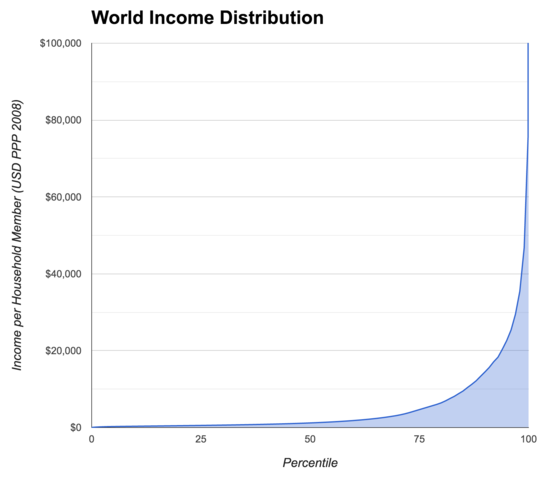
To handle questions like "And a good meal is ten times more than a beef soup shop in Taiwan?" we can use "Purchasing Power Parity". And adjusting for PPP we still see that an income of $100k is in the top few percent worldwide: http://jefftk.com/world-income-distribution.png
I've lived / worked in midtown Manhattan on both $35k/year and $90k/year (and between) within the past 3 years, and they are both doable. At 30k, I wasn't rich for sure, but I wasn't poor either. Still going out to eat mostly, and not missing out much with friends.
As it got closer to 90k, things got easier for sure. I'm not married, so no dual income, but my total monthly expenses come out around 2k (rent, good food (never eating at home), utilities, misc stuff) which leaves about 3k/mo left over. I would consider this materially wealthy, at least.
> I'm not married
So having roommates was an option. And you didn't need another bedroom for the kids. Your housing costs were far below those of an average family. Which is sort of the point of all the comments about dual incomes being required.
But it's just so hard affording a downtown condo while putting my kids through private school! I'm obviously living paycheck to paycheck exactly like the vast numbers of americans earning 2/3 or less of a living wage with no medical coverage, no paid time off, and spiraling debt!
Don't forget to take into account the massive amount of student debt people have now, and also the vast cost of living in larger tech centric cities such as SF and NYC. I'm not talking fancy apartments either, I'm talking regular standard 1 br apartments.
Just because someones income is a certain amount on paper it doesn't take into account other financial responsibilities that lower the amount you have leftover at the end of the month.
As the article mentions at the end, a big part of living within your means is reducing your spending -- and a lot of that has to do with recognizing what things are actually necessities. The chart of price increases mentions things like movie tickets, new cars, and private college tuition, which are certainly not necessities. Even high gas prices can be mitigated if you recognize the hidden costs of driving a fuel-inefficient vehicle long distances to and from work every day -- and that in many cases you're not forced to live so far away.
I recommend the Mr Money Mustache blog as a source of some decent advice about how to think more frugally and focus on early retirement: http://www.mrmoneymustache.com/
Investing more is certainly not a way to "stretch a six-figure salary." Not sure why they included that part. Investing in your own retirement (vs. a pension) is probably a big reason why salary money doesn't go as far.
Because we have to start with definition of what IS rich.
I want to think about it of as how many months/years I can live the life I'm living right now If out of a sudden I loose a job.
So being rich should be more about balance between earning and savings. And looking at those places like SF, how one can claim himself rich if 100k a year can barely cover cost of living there ( if can at all)
As someone who recently quit a six-figure tech job in SF... 100k/year does not "barely" cover cost of living. When I first got the job, I decided I wanted to live close to where I was working in SOMA, which meant paying quite a bit more in rent, but I never had any illusions that what I was paying for was a necessity of life.
Though I mainly picked it out for the location, it was easy to tell the building was built explicitly to cater to the wealthy (because that's the kind of building that's getting built in SF right now). When I first moved in, I felt everything about the place was conspiring to tell me, "Yup, you're a rich asshole now."
Even with that expense, I still had plenty of money. Even if you feel like you're too good to pack a lunch, and need to eat at a hip restaurant for every single meal, I have no idea where this "barely covering living expenses" is coming from.
Here's what my family's spending looked like over the last 12 months:
      $8,824  housing
      $1,870  food
      $2,965  medical
      $8,982  personal and transit
     $55,306  savings
     $52,761  taxes
    $130,708  donations

    $261,416  total (income)
For most of this year it was me and my wife, with our first child being born 2/3 of the way through. This is with both of us working; let's imagine instead we had two kids, one $100k income, and one of us stayed home with the kids.
To adjust for there being about twice as many people, let's double the first four categories. And because we're talking about a $100k income let's decrease taxes proportionally down to $20k. Now tax rates are graduated so we would really pay less than that, and kids cost less than adults per person in terms of food and housing, but let's be conservative and stick with this. What do we get?
    $17,648  housing
     $3,740  food
     $5,930  medical
    $17,964  personal and transit
    $21,753  savings
    $20,000  taxes
    $10,000  donations

   $100,000  total (income)
When an $100k income can support four people with enough left over to donate 10% and save 22% then I feel pretty confident calling it "rich".
(This is Boston, which is not quite as expensive as the bay area, but nearly so.)
I'm friends with a married couple who's got one kid, planning on having more. Husband works in tech, wife doesn't work. Their finances end up looking a lot like mine, except they live in an area of Palo Alto where my rent gets them a decent-sized apartment. (Both I and they are saving for retirement.)
$30k goes to taxes
$30k goes to family housing, unless it's a trailer park
probably about $10k goes/will go eventually to things like soccer, music, other misc kids stuff, unless you decide to punt on after-school development
the remaining $2.5k/month goes to food and clothing for 3 and I guess retirement savings? We also leave out cars, gas, vacations, cellphones, saving for college, etc etc.
There is not a chance to ever buy any housing in this area on that. I also don't see much room for more kids. Sounds like barely covering living expenses.
We live in a world where a lot of people are still living on $2 a day or less. And you consider $10k/year on soccer and music lessons a necessary living expense? Gimmie a break.
A major cause of the increased cost of living in NYC, SF, Boston, SV is the "rent seeking" activity increasing cost of renting or purchasing a house through restricting housing density through zoning and through overuse of historic buildings designations.
Harvard Economist Edward Glaeser speaks of this. In these cities, the cost of housing is far higher than the cost of construction because politics is used to make wealthy landowners even wealthier at the cost to others.
How much of this is just personal perspective? What exactly defines being rich? $100k a year? $1m a year? More? Why go after being rich when you can go after being wealthy? If you have enough money generating assets that cover all your expenses, you're pretty much set. It's all about the cashflow.
You're rich because existence itself is shockingly improbable. Beyond that, you even got to be human, with a human mind, which as far as we know is the most expensive thing the universe has ever produced. Lucky you!
You're poor because one day you will lose everything and everyone you've ever deeply cared for. That's a shame.
Enjoy the few moments you have left. You will have a better chance at this if you stop comparing yourself to others in terms of the milliliters of 'comfort' you can or cannot afford within an OCEAN, a absolute carnival of delight available to all.
No. A completely demoralized person (I think that's a better descriptor than 'homeless') would not experience much delight in life. Demoralization is genuine poverty. It's our duty to reduce and eliminate demoralization in all its forms to the greatest extent possible. You cannot do that with money, houses, or guns (aka govt. force). The character traits that prevent demoralization are courage, forgiveness, gratitude, authenticity and willpower.
But even so... finally, we all die a tragic, senseless, and humiliating death, the ultimate demoralization. So the only reasonable posture we can take towards a demoralized person (or any person for that matter) is empathy and compassion.
Yeah. I'm not an American but adjusted for inflation $100,000 in 1985 would be $221,508.36 today. That's pretty rich. You'd be in the top 5% with that.
When has this EVER meant that you're rich? It doesn't, never has, and never will. Even a 7-figure salary doesn't by itself make you rich. You are only rich when you've learned how to make money work for you and when you have the freedom to do with your time as you please. This automatically excludes any kind of salary making you rich. Salary and riches do not mix. It's the wrong mindset altogether. A high salary CAN be a good initial catalyst on your way to riches, but by itself will never get you there.
Is everyone on here a communist? Christ. The article is simple. The government uses it's hidden tax of inflation to steal the wealth of everyone and the media continues to (apparently successfully) fool people into thinking hard working wage slaves that make slightly over 100,000 are "rich". They are not. To make the equivalent of a 100k salary from 1980, you have to make 288k today. The government continues to print more money and this trend will continue until creating value instead of consuming it becomes what most americans strive to do. We have not reached utopia where everything is automated and work is an outdated concept. Yet, the "ism" of jealousy and envy, and perhaps more than a dash of laziness, prevents people from seeing the truth. Hating and taxing everyone that makes a living wage will not lead to prosperity. Yes I am talking about socialism. Although, most of the people on this site seem to lean more toward wanting full blown communism. Let the down votes commence.
Yes! It's about creation vs. consumption. We appear to be the only thing in the universe that has a choice about which of those two activities we want to be primarily engaged in moment to moment. It's a heady responsibility.


For instance, you might have a family with a sole breadwinner who has a low six-figure salary, but that has to cover all the family's expenses. Meanwhile, even if his neighbors, a dual-income household, both earn less than him, their household income could be considerably more.
By the way, the rising percentage of dual-income households has been suggested as an exacerbating factor in the growing income inequality in the U.S.
If you figure that people tend to marry others of the same educational level (more so now than in generations past), and if educational level is roughly correlated with income, then you can see how the gulf widens.
Whereas 50 years ago, when single-income households were the norm, a lower-educated fellow might bring in SALARY and a higher-educated fellow might bring in SALARY * 2. But now, with dual-income households, a lower-educated couple might bring in (SALARY * 2) and a higher-educated couple might bring in (SALARY * 2) * 2.
So, 50 years ago, there was one SALARY worth of difference between the lower-educated household and the higher-educated household. Nowadays, there is (SALARY * 2) worth of difference.