The 3 rivers (later ICL) Perq had one, predating this but post-dating Xerox Parc/SmallTalk.
I used the Perq in around 82/83, it was .. "idiosyncratic" -video memory was used for compiling so you got bitrot on the display as you compiled. Its single hard drive was vertically mounted at the side of the CPU cab in a smoked plastic box, you saw sparks off the axle (I never did work out what that was)
It had animated icons. a tool called "cedra" was used to write bitmaps which played. I used it to animate "Captain Haddock" from tintin with smoke coming out of his ears.
The Whitechapel workstation had one. There was also Blit ports to amiga OS which worked pretty well, and pre-dated 8th edition and MGR making it out the door.
All of this pre-dates SunView, and Decs offering to some extent, but all of them post-date SmallTalk.
Apollo Domain/OS was doing things around this time too, in the outer part which was "not unix" with domain/OS hosting UNIX inside.
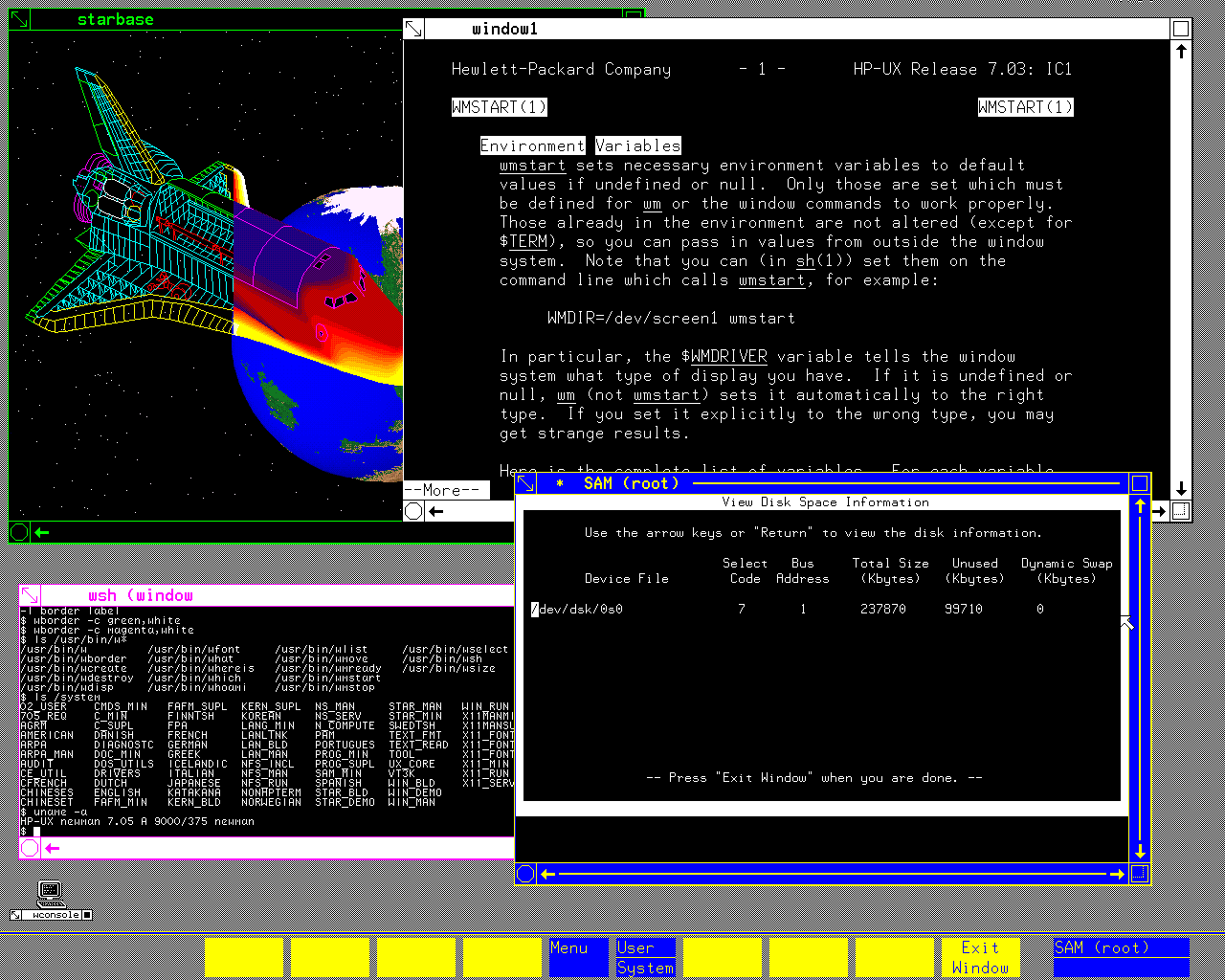
HPs work in medical imaging appeared to leverage X10 before R4, it looked like they took early MIT work and packaged it into their unix machines tied to NMR and Ultrasound. They had HPIB drivers for every sensor they made I guess, and unified them inside a primitive monochrome window display engine. I think it was X10 because it looked like X10 decor
Hence why Solaris, HP-UX, and OS X are the UNIXes I had/have more fun using.
I read almost everything I could about NeXTSTEP and Irix, and had access to a Cube during last university year, as we were porting software originally developed on it to Windows, but sadly no longer working state.
What all those UNIXes have that Linux/BSD kind of miss with their fragmentation, although Raspberry PI kind of has it, it is the soul of the machine, a whole stack experience, the hardware, software, desktop, programming environment, combined together on a full end to end experience.
I agree with this sentiment quite a lot. Solaris and IRIX have very special places in my heart (Solaris especially). Yet, Linux has two things that no other *nix system has had: unbelievable momentum and availability. It doesn’t quite have the elegance, the polish, or the charm of Solaris or IRIX or even … AIX, but it’s something I can use on almost anything, and it’s super easy easy to get my hands on.
One of the first things I did when setting up a Solaris desktop was to install a new window manager and configure my login to use it. I found both CDE and OpenWin to be awful.
Using Emacs and EXWM it's a different approach to Unix, which I almost use it
as a 'debugging/maintenance' tool for 'low' level stuff, for instance running pacman to upgrade the system from a TTY, or managing services such as the nntp and mail MUA/MTA backend for mu4e and GNUs. As DDT and Emacs users did back in the day, such as RMS on the ITS.
I mean, not using Unix as an interface, but as an underlying system with a very small userland.
GUIs changed the human-computer interface from CLI “remember and type” to GUI “recognize and point”.
The latter has reduced cognitive load at least for simple tasks.
The fragmentation of different Unix desktops was always greater than Unix cli tools, which really held back adoption since “recognition” didn’t work across vendors’ systems.
I evaluated Unix desktop UIs for a while in the late 90s (after X started to be the winner but before KDE/GNOME wars were in full swing). Two things of note then.
While lagging in market share, DEC/DigitalUnix had the most fully featured GUI tools.
And SGI IRIX was the first to try to integrate the browser and hyperlinks to their desktop. That idea did not actually originate when Microsoft Windows started tying the two.
Good grief! xwinman.org is still up? I remember referencing the materials there when I was first starting out with Linux in 1995. So many great memories tweaking my .fvwmrc...
My first job was with SGI O2 workstations. I have very fond memories of Irix and its environment. And Nedit. Nobody should ever forget Nedit. Or the flying buttons[1].
Loved nedit and used it until late 2000s… at some point moving to Geany because it was better integrated and developing faster. Subpixel font aliasing etc.
The point is: unix model state "desktop systems are too costly and complex, KISS, we just need to give users ability to chain some small programs together to made most of the jobs, thanks to simple and powerful IPCs", GUIs can't be Unix models since their only IPC is cut&paste.
Document UIs can be, but my limited knowledge of historical Unix GUIs do have some "document UI" aspects (i.e. SUN NeWS/Display Postscript) but they aren't much Unix nor much documents. Those who developed Document UIs was Xerox, Symbolics etc...
Weeks ago, while I was searching for NeWS related papers/material, I stumbled upon some japanese papers about a window system called GMW (Give More Windows).
It is pretty much obscure, and all I found is that was made at Kyoto University (who also made Kyoto Common LISP), and it used a virtual machine.
> Open source PC Unixes didn't follow this pattern because in the 1990s, there were few or no open source desktop environments.
Well, yes and no. Most early Linux distributions came with XFM, a graphical file manager for X that predates even Linux (1990). This, together with other common X-based tools (xman, xedit, xcalc, xpaint, xv, etc.), was cobbled together into what can be called a desktop environment. Not as polished and coherent as its proprietary counterparts, but even in those the file manager often felt like an afterthought and the real work was, much like today, done in terminal windows.
Sure, if you focus only in what Postscript was capable of, however many of the ideas were possible via the Objective-C Kits.
That is the part of NeXT that many miss, and it also has in common with SunOS/NeWS, the UNIX compatibility was only the bottom layer, the cool parts were above it.
IMO, Sun's open source release of OpenWindows was the kick in the butt that allowed Linux to become a "serious" alternative to the Unixes. (It made Linux boxes as X terminals pretty viable, saving tons of money on Hummingbird Xceed licenses!) There weren't many open source windowing/desktop alternatives back then, so having one that had been professionally and well thought-out by the likes of Sun gave Linux a UI that looked and felt like the big guys. (Up until that point, most Linux X environments were just using the painfully minimalist TWM (Tom's Window Manager)).
I think most large organizations created their own default environment. When I started college in 1993 we had a mix of Sun, DEC, HP, IBM, and SGI workstations. They all had a basic environment with mwm and menus configured for popular programs.
Someone introduced me to vtwm and the concept of virtual desktops and I loved it. I remember spending hours in the computer lab tweaking my .vtwmrc file and showing it to friends.
Heck yes. Anyone else here remember twm fondly? “Tom’s Window Manager” It had some neat customizability I still miss. I used the sgi desktop too for years but I don’t miss it (didn’t hate it, I just don’t remember anything special about it.)
X11 was a clown show for a longgg time. Remember manually tweaking mode lines?
For the longest time, my main Linux system was a Slackware box with almost everything rebuilt and reinstalled by hand. I still remember the a.out -> ELF upgrade and having to rebuild a bunch of libraries. And rebuilding the kernel, of course.
I put my first Linux box together in late 1992 using SLS and a fixed frequency monitor. I got the mode line wrong and the magic black smoke escape from the monitor.
Back in those early days with XFree86, it was exciting to get 2D accelerator drivers going so we could turn on "opaque window moves" in our window managers. By having the window contents "blitted" around on the card, we could finally move the actual window around instead of just a thin outline that would repaint after we stopped moving it.
This required the graphics card to do it locally since there wasn't enough bus bandwidth nor cpu speed to have a software implementation copy around the window content in realtime!
When I went to CERN in 2002, it was the first time I used GNU/Linux in production, and even them had to start the Scientific Linux project in collaboration with Fermilab, to have something that could replace the Solaris use cases.
Most researchers were either on Windows 2000 or the newly released OS X.
Where I worked at the time, we had PCs (initially 386) running System V. They also had X on 1600×1200 monochrome displays, which were absolutely beautiful, monochrome CRTs not having issues with convergence or fringing. (I think the monitors and cards to drive them probably cost more than the rest of the machine.)
That reminds me of what I think were Apollo Domain/OS workstations at school that also had beautiful, high-res black and white screens. These were in the basement of Evans Hall at UC Berkeley back in the early/mid 90s.
Judging by the Domain/OS release timeline on the wikipedia page, it seems reasonable that these were surplus (end of life) systems handed over for student use. It's too long ago, and I can't remember if they were managed by the CSUA computer club or something else by the CS department as part of the WEB which I think was mostly a Sun workstation farm.
I am sure this is a get off my lawn moment, but I think those grayscale displays are long overdue for a comeback, in our age of attention-grabbing apps. Im trying to recreate the experience on my phone and PC right now in fact. Definitely helps on android, but on win11, im stillntrying to find the right combo of accessibility settings and windows themes to get it right.


I used the Perq in around 82/83, it was .. "idiosyncratic" -video memory was used for compiling so you got bitrot on the display as you compiled. Its single hard drive was vertically mounted at the side of the CPU cab in a smoked plastic box, you saw sparks off the axle (I never did work out what that was)
It had animated icons. a tool called "cedra" was used to write bitmaps which played. I used it to animate "Captain Haddock" from tintin with smoke coming out of his ears.
The Whitechapel workstation had one. There was also Blit ports to amiga OS which worked pretty well, and pre-dated 8th edition and MGR making it out the door.
All of this pre-dates SunView, and Decs offering to some extent, but all of them post-date SmallTalk.
Apollo Domain/OS was doing things around this time too, in the outer part which was "not unix" with domain/OS hosting UNIX inside.
HPs work in medical imaging appeared to leverage X10 before R4, it looked like they took early MIT work and packaged it into their unix machines tied to NMR and Ultrasound. They had HPIB drivers for every sensor they made I guess, and unified them inside a primitive monochrome window display engine. I think it was X10 because it looked like X10 decor