Cool. There is actually a W3C draft spec for Mongolian script![1]
We tend to assume that left-to-right script is a law of nature but it is just one of many variations that have been invented and used across space and time. Right-to-left (Arab / Hebrew) [2] is well known but a most intriguing one used in antiquity by Greeks and others is Boustrophedon (alternating from left-to-right / right-to-left).[3]
Boustrophedon mode is in one sense the optimal script form. At the one-time expense of having to learn to recognize letters and words both ways one can then (in principle) speed up reading as the eyeballs don't need to jump across the page to start a new line :-)
It was the attempt to translate Egyptian hieroglyphs into Phoenician which led to all of today's alphabetic languages. Archaeologists recently found a temple in the Jordan area in which the earliest known attempt at an alphabetic language was written; it was a translation between Egyptian and Phoenician.
Alphabetic, non pictographic languages are an order of magnitude easier to learn and express than pictographic languages, which require rote memorization of hundreds to thousands of pictographs and their modifiers. In contrast, the language you're reading this post in allows you to guess the sound of the words by the spelling, which is simply impossible in, say, Mandarin.
I agree with your point in general, that alphabetic systems are easier to pick up. However, it’s not true that you can’t guess the sound of a Chinese character. From Wikipedia [0]:
Radical–phonetic compounds, in which one component (the radical) indicates the general meaning of the character, and the other (the phonetic) hints at the pronunciation. An example is 樑 (liáng), where the phonetic 梁 liáng indicates the pronunciation of the character and the radical 木 ('wood') indicates its meaning of 'supporting beam'. Characters of this type constitute around 90% of Chinese logograms.
Note that the "phonetic" component can become incredibly strained in modern Chinese languages. Eg, take the character "俞"; in Mandarin, it's pronounced "yú". However, it's used as a phonetic component in:
1) 输: pronounced "shū"
2) 偷: pronounced "tōu"
(There are even worse examples which I can't think of in the moment)
That brongs up the question? Are there actually alphabet based languages which are worse than English at pronunciation - transcription correspondence? The few I know are all better.
I loved learning to read Japanese through the second volume of Heisig's _Learning the Kanji_. Volume 1, which teaches only meanings, is a slog, but volume 2, which teaches the Sino-Japanese readings is a beautiful example of organizing material to minimize entropy and maximize benefit for memorization as soon as possible. Unfortunately he never put together a volume 2 for a Chinese language. I haven't worked on it in a while, but I have a project where I attempt re-create the book for Japanese as well as Mandarin, Korean, and Vietnamese: https://nateglenn.com/uniunihan-db/ (repo: https://github.com/garfieldnate/uniunihan-db).
The "pure groups" are the ones where the presence of a specific radical guarantee you a specific pronunciation (within the list of character/pronunciation pairs you're trying to learn). Of the 4800 characters I used for the volume, only 290 are in the chapter on pure groups. The rest are either in semi-regular groups with varying numbers of exceptions, or in completely irregular groups with no discernible patterns.
The characters were designed continuously over a period of time starting thousands of years ago, and the phonetic parts were sometimes exact and sometimes just clues, similar sounds or rhymes to give the reader a hint. Ancient Chinese pronunciation has changed beyond recognition, so it makes perfect sense that the pronunciations wouldn't be regular anymore.
Mainland China uses a "simplified" character set, which did not affect literacy but in my opinion is a bit more difficult to read; they reduced the number of lines so that more characters look samey and they combined many (Mandarin) homonyms (https://en.wikipedia.org/wiki/Simplified_Chinese_characters#...), removing the meaning portion of characters that would have distinguished them. The simplification did not apply to all characters, so to achieve a high level of literacy you need to know traditional forms, anyway.
It would be interesting to see someone try to actually remodel hanzi from scratch for a specific dialect of Chinese, using 100% regular phonetic components and no variants; multiple pronunciations of a character in the current system would be required to be written differently. An interesting example of this would be certain Korean gukja, where they've combined a Chinese character with a phonetic hangeul (example: https://en.wiktionary.org/wiki/%E3%AB%87). This would be a truly simplified Chinese character set... but all of the culture's history that gets built into spelling over time would be completely lost, which is why I always prefer conservative spelling systems.
> the language you're reading this post in allows you to guess the sound of the words by the spelling
It is "a guess" at best, and that guess won't be correct most of the time, unless you know the word already. And when you don't, you'll be dealing with all kinds of Cansas/Arcansas and although/drought/through/bought/cough/enough most of the time.
In e.g. Russian or German, you can read the word from the way it is written and maybe miss the accent. In e.g. Spanish you can read the word correctly with the right accent most of the time. Even Korean is more phonetic than English - in English the best you've got is a guess.
Not unlike Mandarin, by the way.
Source: non-native speaker of English, also speaker of some other languages.
The spelling of English words gives you two separate clues:
1. How it is pronounced.
2. Its etymology and what it means.
Because pronunciation has changed over time and changes across regions, these two features are in conflict. If we made spelling uniformly reflect (current, in some given place) pronunciation, then we would lose clues as to etymology and meaning.
For example, an English speaker can reasonably guess that "native", "nation" have related meanings because of the shared "nat". If we made the spelling follow pronunciation and did "naytiv" and "nayshun", some of that is lost.
Ideally, pronunciation would be fixed across time and place so that a language's spelling reliably reflected both meaning and sound. But that ain't how humans work.
In written languages that do this "better", it's mainly through some combination of:
1. The written language is simply younger than written English and thus has had less time for pronunciation to diverge.
2. The language is used by a smaller, more homogeneous community.
3. Elites exert political force to prevent pronunciation or meaning from changing and to reject loanwords at the loss of expressivity.
English does none of those things. It's been around a long time, has spread throughout the world across widely disparate communities, and is happy to absorb any good idea it finds in any other language. It is the Perl of written languages, for better or worse.
The spelling of English definitely doesn't give enough clues about how a word is pronounced.
Me, and millions of other speakers of English as a second language, will vehemently disagree with that point.
The rest of your comment reads like a detailed attempt at rationalization of this untrue affirmation.
As a counterargument, take Spanish. Spanish is not younger than English, pronunciation has diverged and for example someone from Cuba and someone from Argentina pronounce many words differently.
The Spanish-speaking world is by no means small, or homogeneous.
And we absorb loanwords like madmen. Mostly from English, but also French, Japanese, Italian, etc.
The point is: Spanish is a much more phonetic language in its written form than English, so much that we have no spelling bees.
English simply fucked up itself with the great vowel shift, that's all.
Spanish is in fact younger. The language was standardized and normalized by royal edict about 500 years ago. While strongly based on Castilliano, it was not the same. "Spanish" as a single cohesive, consistent language did not exist before then in Spain or anywhere else.
By comparison, the rules and structures of English (such as they are) were not altered significantly following the great vowel shift in Chaucer's time. Mostly minor spelling changes and word choice.
All languages adopt foreign words unless there is an active body attempting to prevent it, such as the French Language Academy.
French words are not however just loaned to English. It was thoroughly baked in following the Battle of Hastings in 1066, when the nobility all spoke French for hundreds of years. Basically every "fancy" word in English came directly from French while "plain" words came from Anglo Saxon (Germanic) or other related sources. Incarcerated vs jailed. Debris vs trash. Magnificent vs great. "The player regarded his opponent." vs. "The player looked at his opponent." (French for "He looks" is "Il regarde".
The great vowel shift didn't mess up English; the lack of concerted normalization of English is what did it in. English is the greatest pragmatist without design of all world languages.
The usual argument against spelling reform is that it isn't possible to do it in a way that is compatible with the language of more than one region. For example, in Australian English they have a system of phonemic vowel length. This does not exist in other varieties of English, so the options you have in a spelling reform are (1) ignore the Australians and set spellings that are ambiguous in Australia, or (2) placate the Australians and include their vowels in the reformed spelling system, despite the fact that this leaves everyone else in the world mystified as to why certain words are spelled with doubled vowels and certain words aren't.
Start small, and use compromises. Don't try to be completely phonetic, which won't work for the reasons you mentioned.
You can start by undoing misguided spelling reforms of the past. "Debt" used to be spelled "det" but due to incorrectly inferred etymology it was changed to be non-phonetic. There are many words like these.
Then look for major inconsistencies where a cluster of letters is pronounced more than one way, and simplify one of them. For example, "ough" is pronounced as in "tough" more often than as in "though". Change "tough" to be spelled as "tuff" and "rough" as "ruff".
Going further, embrace text/informal writing and use tho, altho, nite, tonite, etc. Although the last two are not necessary since "ight" is pretty consistent. Keep common clusters of letters so that it still looks like English. Do it in in stages over a 100 years , making changes every 15 years or so. I'm mostly aiming at ease of reading vs ease of writing.
Every other major language had a recognized central authority to do its work. Spanish, French, written Chinese, etc. all had a monarchy/dictatorship of some sort to mandate the change and enforce its use.
England could have done it perhaps in Shakespeare's time or shortly thereafter, but once English spread across the globe in its modern (lack of) form with no recognized central authority with the power to force the change, it's not going to happen.
You couldn't get three states in the United States to agree on a universal spelling/pronunciation let alone the three countries in the United Kingdom. You think you'll have any more success over continents and across oceans?
> Spanish, French, written Chinese, etc. all had a monarchy/dictatorship of some sort to mandate the change and enforce its use.
There is no central authority over the Spanish language since the days of Bolivar and San Martin (1810s or so). Modern e.g. Argentinians would laugh at the idea that Real Academia Española has any say on how they should use their language. And indeed, there are differences not just in vocabulary and pronunciation, but also in grammar: "vos hablás" instead of "tú hablas".
Nevertheless, I can pick pretty much any written Spanish word and know how it sounds both in European and Argentinian Spanish.
It is specifically English which failed at the task of not being like Chinese.
Well, that’s a strange statement. Hangul is not just better by accident, it’s designed to be an advanced phonetic system making it possible to write many languages. You can learn in a few evenings, no need to know Korean, and you will be able to read Korean perfectly out loud without understanding what you are saying.
Hangul is phonetic, but doesn't have the capability to represent all phonetic sounds of a language. For example, Hindi has 4 distinct letters and consequently sounds for the each of D and T (D: ड ढ द ध, T: ट ठ त थ), which all correspond to the single Hangul letter diot (ㄷ). I have Korean friends who write their names in the Chinese script because they don't have the necessary letters to represent the sounds.
I don't think that's right. One example would be the words with the same spelling which are pronounced differently depending on meaning (e.g. dragonfly and sleeping spot), you have to know what you are saying to pronounce it correctly.
bluesmoon is right. Hangul doesn't solve all problems ever, anyways, here is some miscellaneous trivia. I have Korean friends. You're welcome Max-q. Please don't try to appreciate things around bluesmoon. You know how they get.
> It is "a guess" at best, and that guess won't be correct most of the time, unless you know the word already. And when you don't, you'll be dealing with all kinds of Cansas/Arcansas and although/drought/through/bought/cough/enough most of the time.
"Most of the time" is an exaggeration. English is (sadly) less strictly phonetic than many other languages, but still highly phonetic. Nearly every word in your own comment can be pronounced phonetically.
"Most" like "cost", or like "ghost?" Also, only now I checked the transcription for "exaggeration", and "gg" is not "g", like in "blogger", but ʤ like in "Jason". TIL.
If this is not "most of the time", than I don't know what is.
> In e.g. Russian or German, you can read the word from the way it is written and maybe miss the accent.
OK, but... the position of the word stress in Russian radically alters the pronunciation of all the vowels in the word. Missing the stress means mangling the whole word. That's not something to just dismiss.
I wasn't claiming English is the best language. I was saying non pictographic languages are one of humanity's most important inventions, which is one reason they've spread so rapidly everywhere.
Too bad non pictographic languages weren't paired with simple orthogonal grammars and consistent spelling rules. Learning different languages always feel like choosing whether I want to beat myself up with my left fist, my right fist, or my feet.
English has had a long trip to the language it is today. It doesn't help that at the latter stages of its development writers disagreed on or disregarded the rules of spelling.
It's a necessary evil owing to the large English lexicon filled with homophones. The Japanese stick to their ponderous use of Chinese characters for similar reasons.
> It's a necessary evil owing to the large English lexicon filled with homophones. The Japanese stick to their ponderous use of Chinese characters for similar reasons.
This is a common and incredibly stupid argument. Note that it immediately implies that oral communication in English and Japanese is impossible.
Early video games didn't have the memory available to render text in kanji and used kana exclusively. This caused zero problems.
There's something to that argument in Japanese. According to [1] Japanese has 643 distinct syllables, while English has about 6949.
There's a lot more context in speech and video games and long-form writing than in random writing and signs. It's virtually impossible to convey a meaning to a product or company name without using kanji.
I was originally thinking about names that have intended meanings "Target", "Burger King", "Taco bell", "Pager Duty", "DuckDuckGo", "Texas Instruments", "Aperture Laboratories" etc.
I am responding to your comment that oral communication is impossible because of homonyms. I am not covering the difference between oral and written communication.
You are right. When years ago apple was said to introduce "emoji", the arstechnica article I was reading was explaining what the hell emojis are.
They were like " it is a pictographical language like Chinese or hieroglyphic where each "idea" is represented by a single picture" and I simply could not wrap my head around it...
Do I have to learn a new language altogether? How ?
Will it fit on a keyboard? How many ideas can there be?
What if I have to say something longer?
What if I have to say a difficult concept?
Languages have different dimensions, including spelling, pronunciation, conjugation, grammar. English is moderately easy in spelling and pronunciation, but with exceptions and exceptions to the exceptions, it is harder than say Korean. Mandarin has more difficult spelling and pronunciation than English, but the low number of conjugations and tenses makes it much easier grammatically than English.
My understanding is that hieroglyphics can be read and written in either direction, and that the animal characters in particular give it away, if they're face right you read from the right and vice versa.
Yes, and there are some inscriptions where this is used, for example in "speech bubbles", where two figures facing each other on a wall talk to each other, with the texts flowing in different directions.
I wonder if this horizontal glyph direction has some sort of meaning lost to the sands of time. Armchair speculating outloud, maybe it’s not purely aesthetic and could imply some sort of past/future tense?
I don't think it does. Chinese, Japanese and Korean had been using vertical writing for centuries, only switching to horizontal ones around 20th century for interoperability with Western writing (such as math or chemical formulae).
Mongolian script, from the link presented here, has actually switched from being horizontal to being vertical (under influence of Chinese).
I like that. Mine is boustrophedon. When you get to the end of a line, you continue the next line starting at the same end. I know the ancient Greeks used it. I don't know who else. I keep pondering how hard it would be to write a text editor that handled that correctly.
It works fine with all of them. It's true that some letters are mirrored forms of other letters, but that doesn't leave any ambiguity - the form of the letter is oriented to the direction of reading, so "b" is a B when you're reading left-to-right and it's a D when you're reading right-to-left.
I'm not an expert on alphabetization, but AFAIK kids actually have some trouble getting the letters "the right way round", I think especially if they start very early. They might be learning the abstract shape first and the learn to force it into the self-relative forms like always-left-to-right. Which kind of makes sense, since objects in nature are usually encountered from all sides, orientation is rarely valuable. So in that sense I'm not convinced it's really an expense to have to learn it. And anecdotally, my son when he was 3-4, when presented with a grid of items would tend to go over it row by row in alternative directions, like writing in boustrophedon. And as you say it would also make very long lines of text more readable - I think Greek inscriptions often have ludicrous line lengths, like several meters. So there it's not just your eyeballs that are jumping, you actually have to walk back to the start of the next line!
kids are excellent at picking information because their brains by default will attempt "wild" interpretations of the same information. Their brains are the perfect startup in a way, in that they fail quick, they fail often , and they learn immediately.
This is also why its hard to do magic tricks with young kids. They will tend to be looking at all the wrong spots. Their brain doesn't pick up on attempted misdirection, it just decide to make a new test happen from a different vantage point.
> speed up reading as the eyeballs don't need to jump across the page to start a new line :-)
Reminds me of dot matrix printers... some could write lines from right to left without needing to go back to start of line, thus alternating directions.
As a kid I thought if i write English in a mirrored way i.e. right to left, & mirrored, it would be my code script, nobody else can read it. People read it very easily.
Not just smudging. The entire mechanical act of writing (and everything) is optimized for left handed operation being the mirror image of right-handed operation, since left is mirror image of right.
"At the one-time expense of having to learn to recognize letters and words both ways"
That is a very expensive expense, though. And the result might still be worse.
I can quickread a page in a couple of seconds, because my brain memorized the shape of the words and even sentences. It took me years of lots of reading to achieve that.
I am not sure if my brain could handle the double amount of shapes, because this is in effect what would be needed.
And eye movement is very quick. But feel free to give the experiment a shot and share results.
(it should be trivial to write a script that rearranges text that way)
> That is a very expensive expense, though. And the result might still be worse.
That's entirely possible but it is hard to tell without going through the entire learning process. There might be a lot of redundancy (as we can quickly recognize mirror shapes) which if tapped at an early age might make it actually a trivial "add-on".
Anecdotally you can learn within minutes to slowly parse script in reverse order. Whether you can ever get to the same speed is not clear. We do know that some cultures did use alternating script (so its clearly not impossible) but we also know that they abandoned it in the end - so there might be some disadvantages.
Maybe the reason for eventually adopting uniform LR or RL instead or alternating is not the difficulty of mastering mirror versions, but being able to quickly start reading from any line on a page. For example finding the spot where you left reading, or scanning to find a relevant part. For this task the alternating form is actually less efficient as you need to jump back and forth as you go down (or up :-) the page.
It shouldn't be too hard to make a chrome pluggin to render comment threads like this in alternative forward and mirror / backward lines. As you say reading mirror writing isn't too hard so you could sort of slowly get good at it while wasting time on HN anyway. Would be a fun silly project might give it a go.
Hangul in general is pretty smart in general. You can get the hang of it in an afternoon, which is something you cannot say about the Korean language in general.
I'm guessing it was top to bottom and then during the modernization process, left to right was added? It's smart that both forms are allowed though as I could imagine modifying a written language takes many years and massive public effort.
Yep, it used to be top to bottom, and the columns were arranged right to left. As a side effect of this recent transition, it's not particularly difficult to read Korean right to left, either.
It's the same in Chinese and Japanese. It helps a lot that the letters are designed fit into individual square blocks. The blocks can be arranged any way you want. There have been internet memes, for example, written to mean one thing when you read left to right and a completely different thing top to bottom.
But yes, Chinese was written top down, right to left. The PRC basically switched over to left-right, top-bottom right away (it kind of went hand in hand with the simplification project). Taiwan for example kept the traditional format for a lot longer.
When I was learning Mandarin in the late 90s, all our imported material from Taiwan was still top-down, right to left.
The traditional way is vertically, indeed, but on occasions you had to write horizontally, which was then usually also done right to left (can still be seen here and there, as I mentioned in my previous comment).
> The traditional way is vertically, indeed, but on occasions you had to write horizontally
There's not really a distinction. Chinese was written in columns from right to left. When the columns were one character long, they were still columns.
To distinguish horizontal writing from vertical writing, you'd need a writing sample that had multiple columns and also multiple rows. (Because, as noted above, there's no way to tell the difference between 1 row of 5 characters vs 5 columns of 1 character each.) As far as I'm aware, traditional Chinese writing is fully accounted for by the theory that it was always written in columns and never in rows.
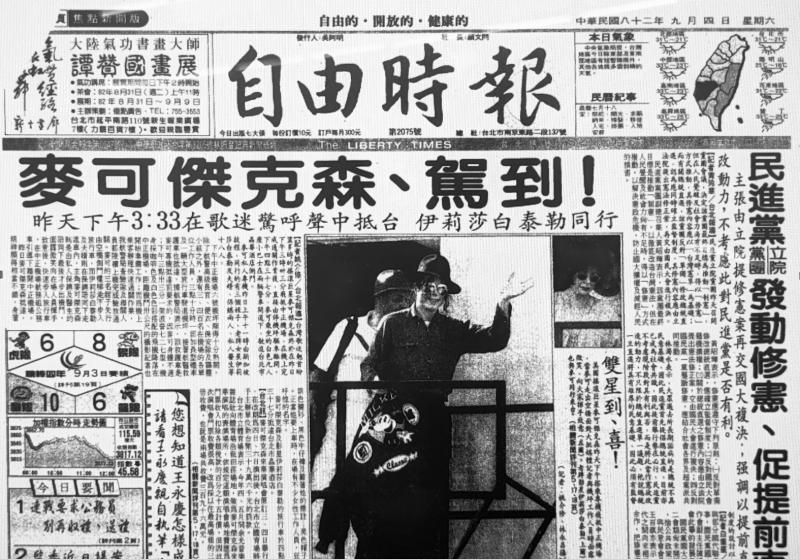
On the other hand, the Taiwanese newspaper isn't making a great case: the "mixture of approaches" used in the headlines are a couple vertical headlines going top down, and several horizontal headings, including the primary headline "Michael Jackson、arrives!", which all go left-to-right. The body text in the infoboxes in the top left and right corners of the page also goes from left to right, though it appears to be true that the article text is in columns. The name of the newspaper (top center) is also printed left-to-right.
At least for Korean, it was right to left only when written top to bottom. Then it changed to left to right. It's never been right to left horizontally. I think it's the same with Chinese. I'm not sure about Japanese.
I've read that there are Arabic-Chinese dictionaries where Chinese is written from right to left to match Arabic direction of writing, but I don't know how common this is.
Do the individual syllables also reverse direction? They're normally read left to right and top to bottom. I'd imagine that they're taken in as complete syllables by readers rather than read sound-by-sound, so they maintain left-to-right.
This seems pretty efficient as there's no deadheading to get back to the other end of the line. When doing puzzles like word searches or scanning things laid out in grids like news article headlines, I do this l2r->r2l type of scanning. I've even caught myself using t2b->b2t scanning as well in these types of situations. It's just much more efficient
But left-to-right kinda is a law of nature: most people are right-handed, and to avoid messing with previously written glyphs it is natural to move to the right.
There’s also scripts written bottom to top (Libyc), and even stranger scripts which are written and read in different directions (Hanunó'o is generally written bottom to top — carved away from the writer really — but read left to right).


We tend to assume that left-to-right script is a law of nature but it is just one of many variations that have been invented and used across space and time. Right-to-left (Arab / Hebrew) [2] is well known but a most intriguing one used in antiquity by Greeks and others is Boustrophedon (alternating from left-to-right / right-to-left).[3]
Boustrophedon mode is in one sense the optimal script form. At the one-time expense of having to learn to recognize letters and words both ways one can then (in principle) speed up reading as the eyeballs don't need to jump across the page to start a new line :-)
[1] https://www.w3.org/International/mlreq/
[2] https://www.w3.org/International/questions/qa-scripts
[3] https://en.wikipedia.org/wiki/Boustrophedon