Pretty sure you can have your stockpiles pre-assebled, or close enough that the final step is trivial.
Anyway, my argument i built on the premise that Germany should never have shut down their nuclear power plants (except when they truely are "spent") and instead built a large number of new ones.
If their nuclear capacity was about the same as the French, it would make a lot of sense to have a strategic stockpile of ready-to-use fuel, both in case supply is restricted for political reasons and because it would serve as a hedge against price fluctuations.
Or, they could just shut down their nuclear plants and the problem with nuclear fuel stockpile goes away as well. And in fact, this is vastly easier to accomplish, and exactly the thing they're already doing.
If you scroll up the thread a bit, the context was that someone claimed that Germany would be less dependent on Germany if they had kept more of their nuclear power plants. That is something they might have figured out in 2014.
Going as heavy on natural gas as they have over the last generation, more or less ensures that they are in Russia's pocket. Shutting down nuclear plants does not make that better. In fact, I argue, it makes it worse.
Your refutation of the possibility of to use Nuclear power to gain independence of Russian energy seems to depend on German inability to achieve indepencende of Russian fuel by setting up a stockpile(1).
Which in turn is justified by claiming that the stockpile would not be needed, since they would shut down their nuclear plants(2).
Which is justified by (1), which is justified by (2) and so on.
My argument is that, had Germany decided in 2014 to increase, rather than decrease their use of nuclear power, with the aim to reduce dependence on Russia, it could be done. But given that, they would have to start looking for (possibly in cooperation with their allies) other sources of fuel to really become independent, in other words, set up agreements to buy fuel from countries like Australia and Canada, on top of whatever fuel was being bought from Russia before 2022.
Basically, my argument requires BOTH of these steps to be taken:
- Decide to keep or increase energy production from nuclear
- Decide to work towards independence of Russia by funding alternative sources + by putting any extra fuel they purchase into a strategic stockpile.
(Edit: formatting.)
These are clearly decisions that were available to Germany (as a country, provided the public had been primed to support them). I don't find the spot in your argument that refutes any of them, without already assuming that the other is impossible.
Also, I don't find where in your argument, in what way these decisions, if taken together, would NOT ensure that Germany would have more energy production capacity in 2022 than they have now.
> Your refutation of the possibility of to use Nuclear power to gain independence of Russian energy seems to depend on German inability to achieve indepencende of Russian fuel by setting up a stockpile(1).
No, my refutation hinged on 1) the fact that German nuclear power is NOT a substitute for the vast majority of German uses of natural gas (chemical and other industry, residential heaters -- neither of which is near-term replaceable with nuclear power without massive investments in electrolysis), and 2) the fact that German nuclear power has the cheapest substitute in form of unused capacity of coal plants (which recently massively dropped in their capacity factor) and accelerated expansion of renewable generation. There is no circularity in this that I see. 1) means that keeping or expanding the nuclear fleet does not decrease dependency on Russian gas, and 2) means that ditching it does not increase dependency on anything else coming from Russia.
So ditching the German nuclear fleet has no downside in terms of reducing dependency on Russia. In fact ditching the German nuclear fleet might somewhat reduce the dependency on Russia on part of the remaining global users of nuclear power, owing to the reduction of uranium fuel consumption in light of the fact that Russia possesses 46% of world's uranium enrichment capacity -- any enriched uranium on the global market that Germany would have to use in their reactors could be used by someone else at that poitnt, with less money paid for enriched uranium flowing into Russia.
> My argument is that, had Germany decided in 2014 to increase, rather than decrease their use of nuclear power, with the aim to reduce dependence on Russia, it could be done.
They could have certainly acted in that direction with such an aim, but since such actions would not have lead to achieving this aim (see above), it would have been a completely irrational course of action.
Only a tiny sliver is for non-energy, and that part could easily be purchased from other countries.
In Norway, a large percentage of heating used to come from oil, but in 2020 any fossil fuel for residential heating was banned. As long as the power is cheap, electric heating is affordable. And if the electricity is slightly less cheap, heating is still affordable if one installs a heat pump (even a cheap air-to-air pump helps a lot).
And even if you were correct in your claim that a large part of the natural gas could not be replaced by nuclear (which is just lack of imagination), your argument would be flawed.
From the link I sent, only 2% of the consumption is non-energy use, but even if that were 50%, reducing dependency by 50% is still a big deal.
> The vast majority of German natural gas use, is for the energy.
You are aware that heating is energy? Residential burners, industrial burners, etc. So this does in no way contradict what I said. Still, none of this gas consumption is directly substitutable by electricity without massive infrastructure changes, not even by nuclear electricity.
> As long as the power is cheap
In Germany, it's not, so there's that.
> And if the electricity is slightly less cheap, heating is still affordable if one installs a heat pump (even a cheap air-to-air pump helps a lot).
That's a part of the massive infrastructure changes that I'm talking about. I've already mentioned elsewhere the 2010 and 2012 EU directives that will make this happen on a timescale of decades as the building stock is progressively replaced, but you can't do this on a timescale of years.
> And even if you were correct in your claim that a large part of the natural gas could not be replaced by nuclear (which is just lack of imagination), your argument would be flawed.
It's not "a lack of imagination". I've never said these uses can't be replaced -- in fact we know exactly how these uses will be replaced (natural gas in chemistry with electrolytic hydrogen, natural gas in heating with passive houses, etc.), so no need to invoke "imagination". The problem at hand is that you can't do this transition on a timescale of a war (...and in the middle of a pandemic, and during a recession, and with a famine coming). This will not be done in months, or even years. Think two decades instead. So this will help us deal with the climate issues, but won't help with the war.
> From the link I sent, only 2% of the consumption is non-energy use, but even if that were 50%, reducing dependency by 50% is still a big deal.
It would, except this has nothing to do with keeping or ditching nuclear plants. This reduction would have to come from the fields where natural gas is being used and neither keeping not ditching nuclear plants would affect the success of such gas-saving measures.
Yes. My house, that was heated by oil 2 years ago, is heated by electricity today.
> In Germany, it's not, so there's that.
Because Germany has underinvested in electricity plants that cannot be shut down by Putin.
> It would, except this has nothing to do with keeping or ditching nuclear plants.
If Germany had kept their nuclear plants electricity plants (and ideally built a number of new ones) electricity in Europe would be cheaper. Thats just supply and demand.
> The problem at hand is that you can't do this transition on a timescale of a war
I agree you cannot transition in 2 months. I talked about starting in 2014. Shutting down the plants this year is only the culiminatino of a chain of bad decisions about energy.
But I suppose in 2014, the psychological damage was already done. It appears like Germany had already decided to get rid of Nuclear after 2011 / Fukushima. This seems to be driven by fear, more than anything.
Which I suppose is the real problem. This never was about making ration decisions about energy security, being dependent on Russia, etc. All along, this was about fear of "nuclear". The rest just looks like rationalization.
Meanwhile, energy prices have gone up all over Europe, since Germany is only the biggest country to have underinvested in electricity production. Even countries that produce an excess of electricity, like Norway, have the same prices. And believe me, ACER is getting really unpopular here, I would not be surprised if Norway is out of ACER by winter.
> Yes. My house, that was heated by oil 2 years ago, is heated by electricity today
Good, so you see how the argument that only 2% of natural gas in Germany are not used for energy applications is irrelevant for the issue of replacing residential and industrial heat sources. These are major energy applications alright -- ones that can't be readily switched to electricity without major infrastructure transitions -- which are already taking place but can't be sped up 100x on a whim.
> Because Germany has underinvested in electricity plants that cannot be shut down by Putin.
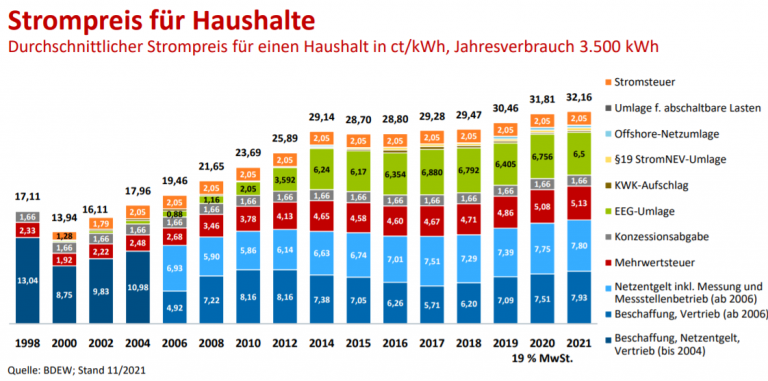
No, actually it's largely because Germany overinvested in electricity plants that cannot be shut down by Putin. Their renewable investments, just like the renewable investments in the neighboring Czech Republic, led -- rather than trailed -- the recent decreases of prices of renewable generation equipment around 2010. As a result of this, Germany has to spend much more money than they would have had to, had they waited just a few years. This made their electricity around six Euro cents per kWh more expensive. (Investments do have to be repaid, after all.)
> I agree you cannot transition in 2 months. I talked about starting in 2014.
Germany started with the transition seriously around 2005. It still takes time, and also isn't a thing that happens at a constant rate because the industrial landscape is evolving. As things such as PV panels, wind turbines, or heat pumps get more affordable, their rate of installation increases.
> If Germany had kept their nuclear plants electricity plants (and ideally built a number of new ones) electricity in Europe would be cheaper.
Debatable, judging from the recent events in the European nuclear industry (Hinkley Point-C, Olkiluoto-3, etc.). The mandated feed-in tariff for HP-C electricity is now more than double than what a wind power plant would deliver. It's inflation-adjusted, so for example around now the electricity straight from the HP-C plant should be worth around 14 Euro cents per kWh, whereas for example new German PV auctions take place at under 5 Euro cents per kWh. And European wind power as well has similar price levels to the latter nowadays.
> But I suppose in 2014, the psychological damage was already done. It appears like Germany had already decided to get rid of Nuclear after 2011 / Fukushima. This seems to be driven by fear, more than anything.
It does not "appear" that "Germany had already decided to get rid of nuclear after 2011/Fukushima". They had mandated the shutdown in binding law almost ten years before Fukushima, so Fukushima had nothing to do with this.
> Meanwhile, energy prices have gone up all over Europe, since Germany is only the biggest country to have underinvested in electricity production. Even countries that produce an excess of electricity, like Norway, have the same prices.
You know, that just might have something to do with energy trading across Europe. The fact that Norway's electricity rates are increasing is a sign of healthy market, because it shows that arbitrage works.
> Good, so you see how the argument that only 2% of natural gas in Germany are not used for energy applications is irrelevant for the issue of replacing residential and industrial heat sources.
Actually the opposite. If I personally could switch away from heating my house with fossil fuels, so could Germans. In principle, it could happen over a few months (depending on the number of electric ovens available in the market, the capacity of the grid, etc), but it is cheaper to do over some number of years.
Obviously, this would cost some money. But basic electric ovens are quite cheap, and Germany is not a poor country. Also, since I already paid that cost personally, I'm not super-inclined to feel sorry for them....
> No, actually it's largely because Germany overinvested in electricity plants that cannot be shut down by Putin.
At best, I would agree that Germany has chosen to switch to expensive energy production. The net output (as opposed to theoretical peak capacity) of renewables is still only about the same as renewables was in 1990, so that is not super-impressive, from a global warming perspective.
I don't believe that the 1990 nuclear industry was as dependent on Russian fuel, as it is today. Har Germany continued to produce electricity in their nuclear plants at the same level as 1990, it would have had the same effect on global warming as their "investment" in renewables have had so far. And any dependence that was created on Russia over this period, was by choice, and could have been reversed.
> but you can't do this on a timescale of years.
Norway made the decision to ban fossil fuels for heating in 2017, effective from 2020. Granted, it affected a smaller (but not insignificant) part of the population. But if there is a will, there is a way.
> You know, that just might have something to do with energy trading across Europe. The fact that Norway's electricity rates are increasing is a sign of healthy market, because it shows that arbitrage works.
I agree. In principle, it is not different from Norway paying full price (and then some) for gasoline/diesel. But they/we are used to to the low prices on electricity, from when local consumption was prioritized. Also, especially after the ban on oil/gas for heating, some feel tricked. So the public reaction is similar to what I imagine it would be in Germany, had Germany stopped all gas imports from Russia overnight. The government may be forced out of the common market before next winter, because of this.
> The problem at hand is that you can't do this transition on a timescale of a war
Maybe I'm being too harsh. My measuring stick is from my own (Norwegian) experience. Britian is not doing much better than Germany, and I would not expect countries like Hungary, the Baltic states, Poland etc to have the economy to turn this around quickly.
Also, Norway is obviously spoiled. We are 100% self-sufficient with renewable electricity, AND we make really good money from exporting oil and gas. We never really had to do the hard choices. (Also, Norway has still had high emissions, due to cold climate and low population density making both heating and transportation very energy intensive, as well as emissions from the oil industry)
France, though, has significantly lower CO2 emissions than Germany, and has had that since forever, even without having the resources that Norway possess. All due to nuclear, and they do it without making massively expensive investments into renewables. More for less, in other words.
So I suppose I predjudiced (postively, but maybe unfairly) when it comes to Germany. I generally expect Germany to be best-in-class when it comes efficiency and rationality, and especially implementation.
So when, in a case like this, it seems like German policies are irrational, especially when compared to French policies, it pops out as an outlier (to me, as an outsider to both Germany and France). I suppose there are good ways to explain this, based on local culture and politics, that go back more than 30 years, maybe all the way back to when France needed their nuclear industry for military use. I suppose these differences, when seen from the inside, are almost invisible because they may be taken for granted.
Maybe, from the German perspective, it is an establish fact that nuclear power is "bad" or "dirty" somehow, while fossil fuel consumption is relatively more acceptable. Maybe the Russian threat is not felt the same way that some other countries feel it. Maybe there is guilt, or maybe the taboo around annexing neighbours is not as strong.
Anyway, maybe best to end this thread. Thanks for staying reasonably polite, and good luck going forward!


Anyway, my argument i built on the premise that Germany should never have shut down their nuclear power plants (except when they truely are "spent") and instead built a large number of new ones.
If their nuclear capacity was about the same as the French, it would make a lot of sense to have a strategic stockpile of ready-to-use fuel, both in case supply is restricted for political reasons and because it would serve as a hedge against price fluctuations.