Of course China is going to be emitting more carbon, they are trying to climb their way up to first world living standards. And why not, they have the human capital, they have the will, and they have the organizational capacity to make it happen.
They are not going to let the hangups of the West be a roadblock on that march.
Neither, for that matter, will India.
These types of worries are strictly for the West, and third world nations participate in the global warming outcry because they see an opportunity for obtaining subsidies from this project.
The moment there are costs instead of subsidies, and third world nations are portrayed as perpetrators deserving of fines instead of victims deserving of subsidies, you will see the developing world rapidly lose interest in this project of curtailing carbon emissions. It will be absolutely hilarious when people in the West realize that none of these nations are their allies in the fight against global warming, that everyone in the developing world is far more interested in improving their economy once the spigot of subsidies is cut off.
China is worried about technological progress, employment, and social stability. Everything else is nice-to-have. I don't blame them.
Global warming is going to hit everyone, developed or developing. The fact that China and other developing nations know this but are still willing to take the incoming damage just shows how much it sucks to be a undeveloped country. But for developed countries what probably sucks more is that this is a problem they cannot solve without the help and sacrifice of the poor majority of the world, and the carbon poor would love nothing more than watch the carbon rich suffer the same pain as them.
For once, the developed world is at the mercy of decisions made in the developing world, and suddenly they have to try and appease instead of ignore or bully. That cannot be a comfortable realization.
It is not that there has been a new China since yesterday. I personally see it as part of propaganda western media conveniently pushing (including the rocket story). Interesting days.
Of course China is serious about environment, it affects Chinese people before everyone else. We have been improvements in many ways in China.
> "For once, the developed world is at the mercy of decisions made in the developing world, and suddenly they have to try and appease instead of ignore or bully. That cannot be a comfortable realization."
Well, that is certainly one way of looking at things. I have never encountered anyone who actually believes that, until now. The fact of the matter is that most people don't care a whole lot about global warming one way or another. Not in the U.S. Not in Europe, and certainly not in China. To be clear, I'm not saying that, if asked, "Do you care?" that they respond "No, I don't care." People like to view themselves as caring about things. The answer to "Do you care about X" is usually "Of course I care." - at least when you are asked by a stranger. But if asked "How much are you willing to spend", the answer is usually "very little.". So the revealed preferences in the US are not too different from revealed preferences in China.
68% of Americans wouldn't pay more than $10 a month to combat climate change. That's to "combat", not even "solve".
So I don't think most people are unsettled or even surprised at China ignoring climate change. If we are only willing to pay less than $120 per year, then you would expect a nation with 1/3 our income to be willing to spend very little. Think of all the ridiculous things Americans spend $10 a month on. Then draw a line and put global warming below that line. So an objective assessment doesn't lead to any uncomfortable truths other than there is only a minority that is truly concerned about this issue, and that such concern appears to be a luxury good even in the West, and therefore will not be a major factor in the developing world. An even cursory awareness of what's going on in the world would have made this very clear a long time ago to anyone who was willing to look outside their own social circle.
I believe American people will pay for it if it affects them, so will Chinese people. I remember when I was small, maybe before 8, I have never seen a plastic bag, everything was paper wrapped, with a string also made of papers. China is developing fast, so fast people are experience new things every day. Chinese people care about health a lot, you will see it in parks every morning, old people go exercise. People care about environment, government cares about environment, businesses start to care about environment.
Developed nations still have a lot of levers for meddling around with the behavior of developing nations. E.g. subsidizing clean technology, but also, sanctions and a level of political interference (which to be realistic hasn't gone very well in the past).
In the more extreme slivers of speculation, climate change might be the thing that undoes the very concept of nation state sovereignty, when the model of absolute freedom to do whatever runs into the reality that we have the technology to affect the entire earth. On the other hand this model wasn't all that old to begin with: https://en.wikipedia.org/wiki/Westphalian_sovereignty
I think you're absolutely right, but would argue that the majority in developed countries do not realize it whatsoever. Instead they simply take for granted that they are the problem so that they may imagine themselves the solution (c.f. carbon taxes in Canada, rich cities declaring climate emergencies they pretend they can help solve, etc.).
I personally predict that there is a 10 years window for any developing country to jump over the entry barrier to a technology developed state, once automation takes over developed world, the window will be closed forever.
For developing world, it sucks both ways, with or without global warming.
The developed world of today did everything as they saw fit when they saw fit. They did not have to worry about global warming or any other issues.
Now that they are developed, it is unjust and unfair of them to say, "Hey we polluted the world in the first place, and became developed. Now you must put climate before development and remain underdeveloped".
As I see it, developed nations should reduce emission much below their goals so that countries like China, India, Indoneshia, and Brazil can prosper.
You cannot just say- remain poor because climate. We are rich and we brought this situation.
> The fact that China and other developing nations know this but are still willing to take the incoming damage just shows how much it sucks to be a undeveloped country.
No, all it shows is how selfish China is. It's a textbook tragedy of the commons. They get all the benefit of polluting but make us take on most of the cost. If there were somehow a way to make it so that all of China's pollution affected only China, they'd be taking it much more seriously, developed or undeveloped.
Much of China’s pollution is from industries that the West outsourced, and which support western consumption today. So it’s certainly not as simple as China being selfish.
"The fact that China and other developing nations know this but are still willing to take the incoming damage just shows how much it sucks to be a undeveloped country"
Ne'er have truer words been spoken. Welcome to the real world outside of the HN bubble.
Easier said then done. Check out https://www.reddit.com/r/NotMadeInChina/ for some cases where you can get a nmic product, but if you go to a store to shop or even shop on Amazon, it’s increasingly difficult. Amazon doesn’t even show country of origin, so you usually have to go to the Q&A to see if it’s been answered. Almost certainly it will say something like, “our products are proudly designed by our team in Sweden and manufactured by our partner in China.”
We could build some blueprint legislation for states that has country of origin and stick it on a website. After that we could rally our state legislature to use our blueprint. It would be easier to go that route than federally. Look at what California does with emissions standards and cancer causing items. States have power.
This is why i am grateful our ass-hat of a prime minsiter has carbon taxes and overcommits us to "green" programs..
because if every one of the 32 million canadians reaced zero emissions, woudl the world even notice?
Look, i am all for "green" programs, but over-taxing us isnt the answer, our contribution is minimal.. we would be far better off helping others get off coal.
Canada is the eighth highest emissions producing country per capita. You're only just better than the USA in seventh place. You're nowhere near 'good'.
Per capita matters as a matter of fairness. Telling large poor countries they have too suck it up so smaller rich countries don’t have to solve the problem isn’t going to work.
That's fine and agreed, but my point still stands that per capita based on some arbitrary borders is not a meaningful measure to the entire Earth's climate.
The climate doesn’t care about per capita though. If more than half of all coal plants are in China, then China needs to change if we have any hope of moving the needle. All the other countries can change but it won’t matter.
So America's done enough? With our lavish lifestyles, large suburban homes, one or more cars per household, eating out all the time, running the heater or AC half the year, unparalleled rates of consumption?
All of that and yet we are supposed to be comfortable telling people in China one generation removed from levels of poverty Westerners could not even fathom: "no, no cheap electricity for you! You're the ones who need to sacrifice!"
Some people are interested in carbon-accounting, others are interested in moral-accounting. What the moral accounters may not realize is that their accounting is rarely useful for solving problems, and is often actively harmful. The first step to making progress in many areas is to say "OK, let's forget about trying to find someone to blame".
Wrong. Carbon accounting suggests it's easier to make cuts in the people who are using the most as they have far more fat to trim and you can get dramatically greater reductions in environmental damage with much smaller impact to overall. standard of living
This is both the moral and practical solution, it's just not what people want to hear.
No it doesn't. The problem is that there aren't enough "people who are using the most" to make any substantial difference. This is the same flaw in the argument that we should fix inequality in America by just taking 90% of the billionaires' money: we'd run out of billionaires after only paying a few months' rent for everyone.
> The climate doesn’t care about per capita though
The climate doesn't care for borders and sovereignty either. "China" is just an arbitrary set of people and businesses- you could as well calculate the emissions of the US + Europe + Middle East, or that of companies with a name starting by a letter from a to k, or that of bald people.
If you want to talk about responsibility, instead, then you need to take in account population, and there the US are much worse offenders.
Sure, we can divide people up into groups in any random way.
But there's nothing fair about requiring people or groups to equalize their emissions, in general.
If you drive a semi tractor trailer, and I drive a car, then we both may need to reduce our CO2 emissions, but equalizing them makes no sense if you in fact need to transport a lot more stuff than me. The whole reason you drive a truck that gets lousy mileage is because it's more efficient per pound of goods transported than if they were loaded into passenger cars.
If we want to reduce global CO2 emissions, then the only rational and reasonable way to do it is to treat every kg of CO2 equally, and not get sidetracked into other notions of fairness.
I'm aware that carbon taxes, cap and trade, etc. may have a lot of problems, it's just that the practical problems of doing the right thing don't change what the right thing is.
Like the saying about looking for your keys under the streetlight when they aren't there.
The Chinese government is responsible for pollution that comes out of China. There's no entity responsible for pollution from names starting with a to k, or from bald people.
Ok, so let's blame China for being the largest emitter of co2. Then the problem would be solved by splitting China equally in two new countries, ChinaA and ChinaB, each with exactly half of the current population and factories and everything else unchanged. The emissions of each half would now be less than the emissions if the US, would you start blaming the US now for being the biggest emitter? Note that absolutely nothing would have changed in terms of pollution.
It would make more sense to blame China for having such a high population density- four times that of the US. However, reducing the population is a pretty harsh demand, and in fairness China has already taken tough measures in this respect with the one child policy.
> splitting China equally in two new countries, ChinaA and ChinaB, each with exactly half of the current population and factories and everything else unchanged. The emissions of each half would now be less than the emissions if the US
Check your math again: this isn't true. Per the article we're discussing, China is responsible for 27% of emissions and the US for 11%. Half of China's emissions is more than all of the US's emissions.
I used data from 2018, which I understand can be outdated now. But then you can split China in four parts, the argument doesn't change. If the problem is the total amount emitted by any political division of people, then splitting it in multiple parts should solve the problem. It doesn't.
But the reason China gets away with as much as it does is that it's so big and powerful. If there were four mini-Chinas, it would be much easier for the rest of the world to say "we're not buying anything from you until you clean up your emissions."
Even if this is the source of the pollution, there's clean and dirty ways to manufacture most things, and China has no qualms about using a dirtier way if it's cheaper.
Here an interesting data point: Bangladesh vs Denmark + Norway.
A population of 163 million for the former vs a combined 11 million for the latter. And yet total consumption based CO2 emissions are about equivalent.
It's even worse when you look at production based emissions. Bangladesh emits less than half the total of CO2 vs Norway + Denmark.
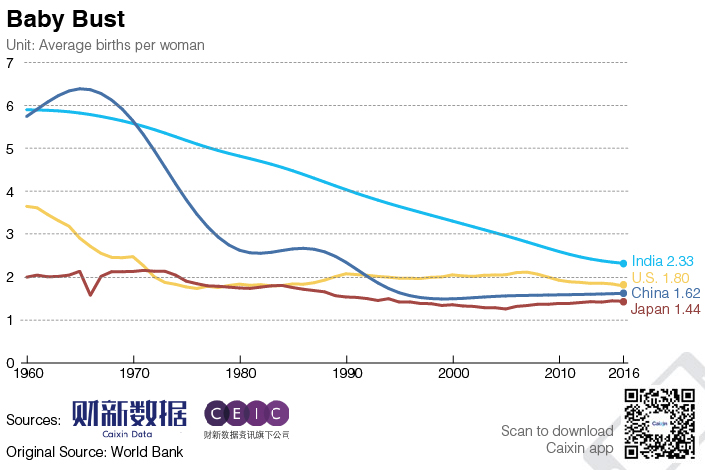
Why? We are told that having a child is the most environmentally damaging decision one could make [1,2,3,4]. And the developed world already has sub-replacement fertility - for about half a century now. But that counts for nothing?
Here are graphs for the US, China and Germany. You could add all three to a single graph but it is bugged and does not show which curve belongs to which country then. Better show them side by side in different windows:
This is the article belonging to these graphs (you can choose countries yourself and have all graphs in the article be change according to your choice):
Emissions are an external cost, meaning its information is lost in the price of making something.
If a country produces a lot of goods that are carbon intensive and export them, the country who import those goods cannot really calculate the carbon emission of those goods with precision. They can do estimates.
This is why accusing china of being a large emitter is wrong for several reasons:
* they are the factory of the world, they export a lot of stuff
* their emission per capita is lower compared to developed countries
Even though it's true that China could switch to nuclear energy, although they already have a lot of it.
Because in fairness, the blame for the emissions should fall on those who consume, not on those who produce. It's like blaming co2 emissions on fossil fuel companies, while you keep happily driving around your big car and flying across the world for holidays.
The consumer countries have no direct regulatory power, so they cannot force China to abide by their domestic best practices for scrubbing of flue gases, waste treatment, and other environmental considerations. There's a moral hazard involved due to our race to the bottom mentality where cheaper is always considered as better, but blame for Chinese behavior rests with China.
It seems quite clear that they are holding China responsible for its own behavior. They have the leverage to do so because China benefits from their consumer appetite.
> It's like blaming co2 emissions on fossil fuel companies
But it's not. In this scheme, the emissions get assigned to the people driving, and not to the oil companies (except the emissions produced during oil extraction).
The "don't count exports" scheme is easy to fool. Focus your economy into products that require high emissions to produce (and don't bother trying to reduce these emissions, that way you can undercut foreign markets better), export them, import low emissions products, and you get the moral high-ground that, once your exports are ignored, you're producing little emissions, even as those exports enrich you.
China ||||||||||||||||||||||||||||||||||||||
US ||||||||||||||||||||||||||||||||||||||||||||||||||||||||||||||||||||||||
India ||||||||||
EU-27 ||||||||||||||||||||||||||||
Indonesia ||||||||||||||||||||||||||
Russia ||||||||||||||||||||||||||||||||||||||||||||
Brazil ||||||||||||||||||||||||||
Japan ||||||||||||||||||||||||||||||||||||
It’s only fair to compare countries based on a per capita basis. Otherwise you are letting some people pollute much more than others because of imaginary lines on a globe
...looking at emissions per-capita is unfair to resource-rich countries that have reeled in their population growth and pulled themselves out of the mud. /s
Since the emissions originate from China, and only the CCP is capable of reducing them I see no value in defining emissions as a per-capita number. The CCP likely cannot be shamed in reversing course. At least they did nothing significant the last few years.
Neither do the earth care about per nationality emissions. In my opinion Per capita emission is better metrics compare to per nationality to improve things.


.jpg)
They are not going to let the hangups of the West be a roadblock on that march.
Neither, for that matter, will India.
These types of worries are strictly for the West, and third world nations participate in the global warming outcry because they see an opportunity for obtaining subsidies from this project.
The moment there are costs instead of subsidies, and third world nations are portrayed as perpetrators deserving of fines instead of victims deserving of subsidies, you will see the developing world rapidly lose interest in this project of curtailing carbon emissions. It will be absolutely hilarious when people in the West realize that none of these nations are their allies in the fight against global warming, that everyone in the developing world is far more interested in improving their economy once the spigot of subsidies is cut off.
China is worried about technological progress, employment, and social stability. Everything else is nice-to-have. I don't blame them.