No, my phone's battery indicator reported a much lower number than what I knew to be true. Say I fully charged the battery and turned on the phone. The indicator would start at 100% and go slowly down as I expected. Then at some point, around 70% the indicator would suddenly jump down to a much lower number, say 30%. If I kept using the phone the indicator would slowly go down at the expected rate, until at some point it would suddenly jump down to like 4%. The phone would then warn me it has extremely low battery and turn itself off.
Now, at this point I could estimate what the true remaining percentage was, just based on how long I had been using the phone. If often turned itself off when I reckoned it should be at 60%. If I turned the phone on again without charging it at all, the battery indicator would tell me that it did indeed have around the 60% charge I estimated.
The battery seemed to be holding charge just fine. If I added up all the usage I got out of a single charge, that time seemed to be about the same as before (a little over a day), it was just interrupted by several rounds of the phone thinking it had no battery left, turning itself on, me turning it on again and the phone sheepishly recognizing then it actually did have a lot of charge left.
Sorry if I didn't explain this understandably in the original comment.
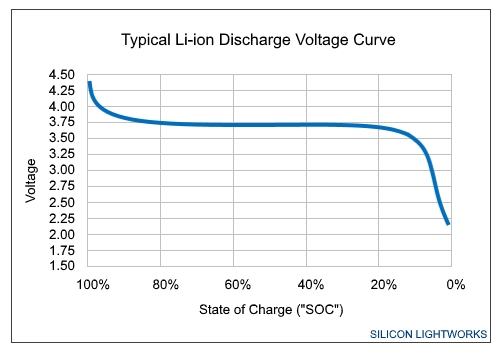
This is great for the powered device, since it's nice and flat, but annoying for determining state of charge from terminal voltage, since it's awful and flat. I have not personally developed a state-of-charge indicator, but I would guess that one might use columb counting for the first half of the curve, then voltage monitoring for the second half, introducing odd discontinuities in the 80%-30% range. A truly clapped out battery will up and die before it got to the second half; a merely old battery will just be strange and inconsistent.
>If I turned the phone on again without charging it at all, the battery indicator would tell me that it did indeed have around the 60% charge I estimated.
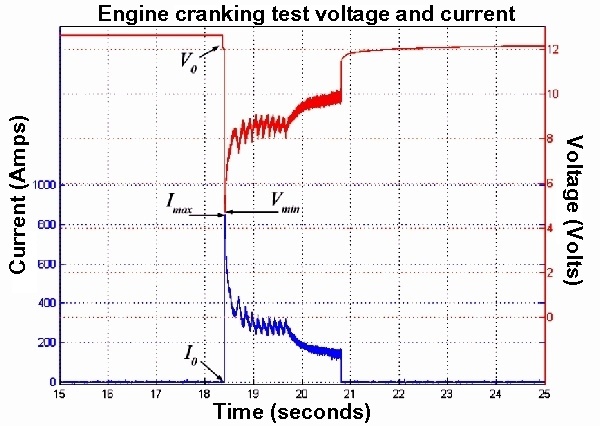
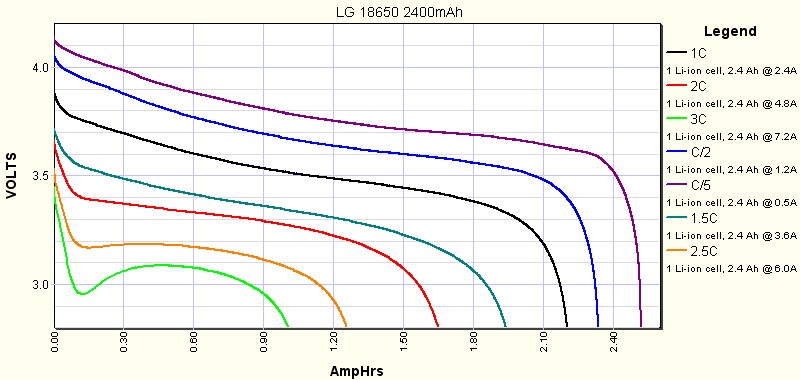
Combine these factors, we discover that while your phone was behaving very unintuitively, it might not have been lying. If you hit an old cell phone with a big enough draw, (prime95, bitcoin mining, opening a cnn.com story without adblock) the battery indicator could correctly say that only 4% of the battery is left. Shut it off, letting the battery recover a bit, then turn it back on, and ta dah, by the voltage curve with a light idle discharge, it's got 60% left.
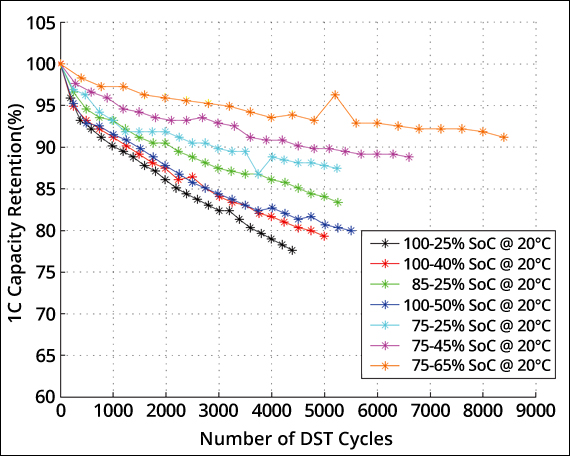
Cell phone batteries generally last two or three years. Four years+ requires light discharges and not recharging it fully. Essentially, not using it at all.
Interesting! I thought the battery itself wasn't the problem mainly because the battery life hadn't gone down (I was still getting the same number of hours between charges if you added up the time my phone was on), but I also didn't know the symptoms I did see were consistent with battery problems. Thanks!


Now, at this point I could estimate what the true remaining percentage was, just based on how long I had been using the phone. If often turned itself off when I reckoned it should be at 60%. If I turned the phone on again without charging it at all, the battery indicator would tell me that it did indeed have around the 60% charge I estimated.
The battery seemed to be holding charge just fine. If I added up all the usage I got out of a single charge, that time seemed to be about the same as before (a little over a day), it was just interrupted by several rounds of the phone thinking it had no battery left, turning itself on, me turning it on again and the phone sheepishly recognizing then it actually did have a lot of charge left.
Sorry if I didn't explain this understandably in the original comment.