I think cars should be banned from most densely populated city centers in general. There is a word describing it "Pedestrianization"
Reasoning:
Cars pollute the air which makes the people living and walking in the city centers sick.
Cars pollute with noise.
Cars cause pedestrian and bicycle accidents.
Its nice for peoples health to be able to walk and run in open areas.
Streets which previously was used by cars can be converted to public green areas and you can also plant trees there. It would open up new green areas for cafes and restaurants.
Public transport should replace cars in such dense environments. You will thus ride to the outer part of the city park your car there and take public / electric bike transport from there.
Wikipedia article about Pontevedra, "Pedestrianization" section
"As a result, 65% of trips in the city centre are made on foot. Pontevedra was recognized in 2016 as one of the 15 best cycling cities in the world"
https://en.wikipedia.org/wiki/Pontevedra
My home city (capital of the country) did exactly that and it brought a huge amount of life and new businesses to the city center. Not to mention that tourism exploded as well - the city center is now a very pleasant place to go out and grab a coffee next to a river or on a street with no loud and smelly traffic to be seen (picture during summer: https://files.stocky.ai/uploads/2019/01/image-Preseren-squar... )
Of course, the locals were throwing an absolute fit when the change came: "We won't be able to move furniture!", "What will the emergency vehicles do?", "How will old people cope?", "It will ruin the real-estate market!", "OH the humanity, who will WALK all the way from a parking spot?!"
Turns out - it worked exceedingly well. We need more of this.
It is exactly the same story each and every time. The same old objections, the same old fears and the same old success.
You would have thought by now the pattern was well recognized and we could skip the middle part, but no, it seems like we have to go through the same ride over and over again.
Unfortunately in the US most of the major cities have essentially been designed (or redesigned) around private vehicles, so banning them is not going to happen. However you are absolutely correct - walking through Times Square in NYC is a pleasure (aside from all the guys in Batman costumes) with traffic removed compared to turn of the millennia. I don’t care to bike but the bike lanes squeezing out all the auto traffic have been a benefit also. But would it work in Houston or Denver? Not unless they built a massive public transportation infrastructure and moved the businesses and housing closer together, essentially rebuilding the cities.
The most recent part of Manhattan to be designed was still over two centuries ago in 1811, so we're not going to have that problem at least.
But I think you're over-estimating how hard it would be to get rid of traffic in many other urban cores in the US. You don't need to do the entire city; you can just do the densest parts. It's not that hard to beef up a city's existing bus services and use them to totally replace cars.
They had to really look hard to find a part of downtown that looks like that. If you zoom out a bit you can see how all that parking came to be - the nearby stadiums / conference centers.
But you can compare to, say, Baltimore, where there's barely any surface parking around the convention center there, despite the fact that it's right next to a major sports stadium.
Sure, you can make that comparison, I just don't know what useful conclusion you'd get from it. Maybe property rights are stronger there. Maybe nobody offered enough money. Land in Atlanta has historically been relatively cheap compared to New England.
I have a pet theory that states that land values are higher on the coast mainly because sprawl doesn't have as many places to go, so it concentrates in smaller areas. Atlanta was historically a rail hub, exacerbating sprawl because transport could always move people farther outward. Picture pouring money onto a map, and walls are anywhere it's infeasible to develop the land. The money will spread out where there's no natural barriers. It will pile up if there's a lot of them. Money piling up means increased property values.
I've seen this image before (and many more like it), and it's truly sad what we've done to our cities.
But the good thing is, parking lots are huge opportunities for developers. I'm from DC, and the city has radically developed itself over the past few decades in turning what used to be entire blocks of surface parking lots into massive apartment and office buildings up to ten floors tall. It's very easy to develop a parking lot; that land tends to be relatively cheap to acquire and demolition costs basically nothing.
>"The most recent part of Manhattan to be designed was still over two centuries ago in 1811."
That's not correct. Battery Park City was developed in the mid 1970's.[1] And that development is particularly significant here as it includes a car-free green space in the form of Hudson River Park which begins there. Hudson River Park itself also being significant in that it won out over the proposed Westway Project which would have placed an interstate highway there instead.[2] The extension of Hudson River Park all the way up to the 72nd St Boat Basin is also a very recent and significant development.
FYI, Battery Park City is part of Manhattan and was designed in the 1960s to 1980s, with the land created during excavation for the World Trade Center.
The area can still be accessed with vehicles that have permits and a remote that opens it. Those are mostly:
1.) Delivery vehicles early in the morning (~6am) and late at night (~1am+) can come through to supply businesses in the closed area. They have a remote that opens the street blockages.
2.) If an oversized personal delivery needs to be made to a resident, it's possible to get a onetime permit that allows a truck to access the area.
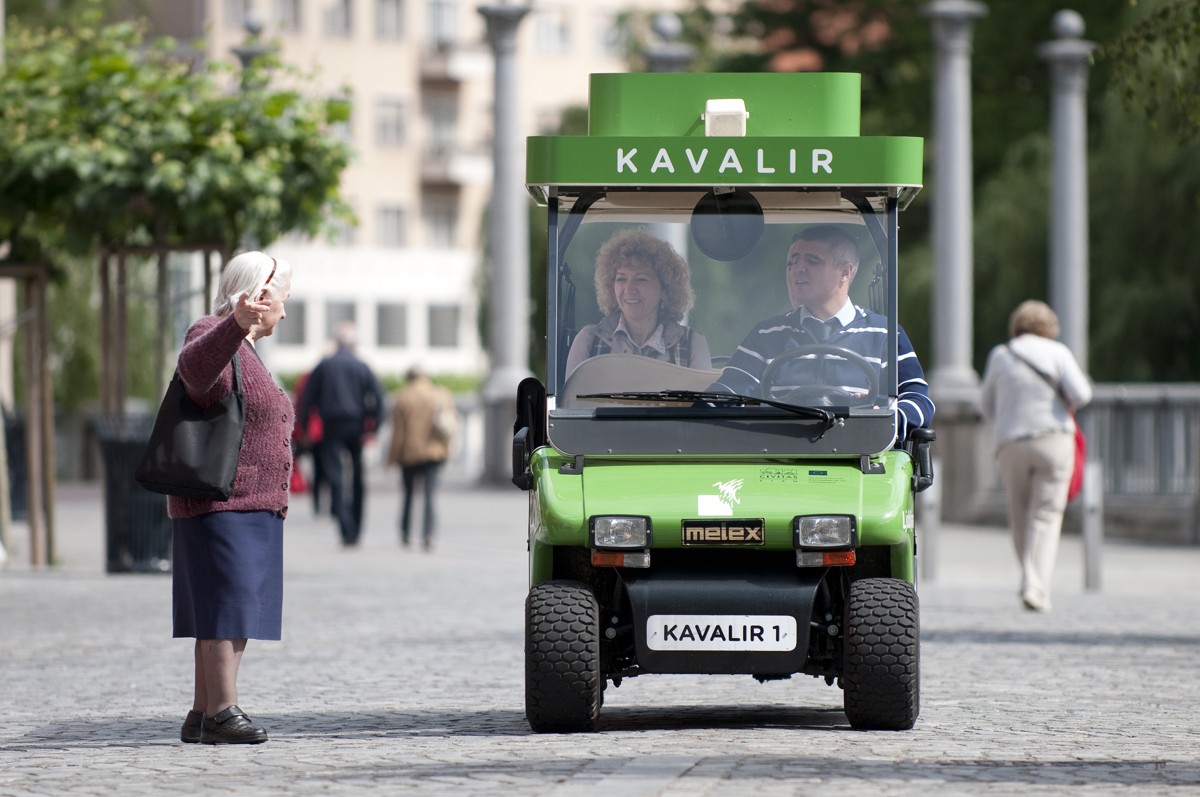
3.) For people who have trouble walking the city has provided a few free electric powered golf carts/taxis that you can call and they come pick you up and deliver you to a destination (picture: https://www.visitljubljana.com/assets/Ljubljana-in-regija/Ka...). Since they're small and quiet they don't bother pedestrian traffic.
I wonder if Uber/Lyft could provide such service in US - they're already doing electric scooters, so why not electric transport for car-free areas?
Note that this is strictly old town center which has relatively small amount of residents but it's mostly dominated by businesses, hotels and airbnbs these days. The area is small enough to walk across in ~15minutes by foot. Near the edges there are underground parking garages so you can reach it via car (since public transport in the city isn't that great).
You can also move most, if not all, furniture that fits through a house’s door or elevator on a small electric van or even a (three-wheeled) bicycle.
Electric vans also could be the preferred method of supplying shops with goods. That need not be much more expensive if containers can be moved from larger vans onto such smaller vans at city boundaries.
If you have furniture that’s so large that you have to hoist it up and get it into the building through a window, you likely already need a permit to use the device that hoists up the furniture.
Can confirm, have moved king-sized mattresses, large dressers and cabinets, etc via a trailer on an ordinary bicycle. It’s really easy!
Where I’m from there’s a tradition in the bike community called a “bike move”. When you’re moving, you invite everybody to show up on a certain day with their trailers and cargo bikes. Everybody packs and moves you in a distributed manner! All you have to do is provide coffee and donuts in the morning and pizza and beer for after. Fun, community-building way to move.
If you strap the mattress to the box spring to stiffen the mattress you can set it on its edge and it won't sag. Then just set the box spring and the mattress on a flat bed bike trailer and you are good to go.
There's a big difference between "the average SUV" that you're talking about and "a big SUV" that the other person is talking about. A Ford Escape is just a taller hatchback, but a Ford Explorer or Expedition are a different story.
Just for my own curiosity, since I don’t recognize the city from the photo, where is it? I’m wondering how it compares in size (both area and population) to Manhattan.
It doesn't and the closed-off area is relatively small. And yet the benefits are very clear - there's pretty much no reason why you can't create several such closed off areas in Manhattan and leave traffic/public transport flowing between them.
This pattern has started showing up in several European capitals these years - I know for certain of Vienna, Berlin, Zurich, London and I've seen some in Barcelona as well.
It doesn't have to be 100% closure obviously and it doesn't have to be a dumb implementation that just closes off full traffic to an area with 1.7mil people without addressing major downsides. There IS a place for nuance in this world ;)
I was recently in Rostock Germany and I saw plenty of pedestrian areas closed to traffic but with signs saying "feuerwehrzufahrt" which means "fire truck access road". The pedestrian area was protected with bollards or fences that could be unlocked by emergency vehicles who needed access.
So many problems that we Americans fight about have been solved ages ago in other countries around the world with far less drama. We're not as unique as we think we are.
Yeah, presumably the same way they solve it everywhere, which is that police, ambulance, fire, and city all have the same keys to the same bollards. And when they don't, they just use their bolt cutters or drive up over the sidewalk. No biggie.
Even if you ban regular cars you're still gonna have to deal with commercial/emergency vehicles (ambulances, moving vans, delivery trucks for local businesses.
Yes, but they still need roads. Lots of these plans seem to include re-purposing the roadways, without considering the remaining vehicles that still need roads.
No, not at least what I have seen. Even in the thread you are now answering in, there is examples (https://www.theguardian.com/cities/2018/sep/18/paradise-life...) where a mostly-car street turned into a mostly-pedestrian street, with still the option for vehicle to travel if they must.
Same if you take a look at the Superilles (Superblocks) in Barcelona (http://ajuntament.barcelona.cat/superilles/es/), they still have a way for vehicles to navigate, but the space for them is much smaller and has a lower limit of speed.
Many streets in Japanese cities fit this. There is only one loosely defined car lane and no sidewalks. So it's a pain to drive because if someone is driving the opposite way, someone has to pull over and yield.
The lack of sidewalks makes it so that the road's primary users are pedestrians, so cars are forced to drive carefully (slow) at all times, making these roads even less desirable for drivers.
The "soft pressure" leads to cars mostly using car-friendly roads unless they absolutely have to use the pedestrian ones.
Manhattan is different in that it connects New Jersey and Brooklyn into a super region, they are dependent on each other to thrive. Banning cars would be an absurd nightmare at least in this situation.
I work in Manhattan and live in Brooklyn, and my office overlooks the Holland Tunnel (connection to New Jersey). Roads are a backlogged mess every evening, where "evening" on Friday seems to start at noon. Traffic cops are in a half-dozen intersections around the Holland Tunnel entrance manually restricting flow and more importantly rerouting cars to keep all the possible entrance routes roughly balanced.
The vast majority of this traffic is from Manhattan - otherwise it wouldn't be spread across so many routes. If you want to designate a cars-ok route in Manhattan between the Battery Tunnel (to Brooklyn) and the Holland Tunnel and let that back up, you could do that and it would be less of a mess than the status quo: it would stay on West Side Highway out of the way and it would have less traffic.
One time I took a taxi from Newark to my home in Brooklyn, and the taxi driver dropped me off right after getting out of the Holland Tunnel (next to a subway stop) saying he didn't want to deal with more traffic. There is no effective vehicular link between New Jersey and Brooklyn right now. There is a moderately effective link between each of those and Manhattan, that's it.
It’s mind boggling how much affordable parking there is in Manhattan. I was doing some work in Staten Island and had an appointment in Manhattan later in the day, leaving via NJ, so I drove and was able to find parking for less than $50 in the financial district.
This should have been impossible, and I should have been forced to leave my car where it was, take a bus to St. George, and get on the ferry.
If you convert to monthly at that daily rate, parking costs $1550/month. If you figure your car’s share of the space in the garage is on the order of ~250 sq ft (the space itself plus a portion of the lanes in the garage), that seems about inline with what studio apartment housing goes for (quick google search turned up 500 sf studios in the $2500-$3000 range)
I’m just loosely estimating here but $50/day for vehicle storage seems like about what I would expect it to cost based on other land use in Manhattan. But of course none of it would be possible without a massive subsidy in the form of public road access.
Yes, because when you factor in the cost of transit and the schedules its either cheaper or the same to drive in dollar terms or way cheaper in terms of time.
Everyone gushes about how awesome transit is, but that’s only true for a few areas of Manhattan and Brooklyn. If you need to take a trip that isn’t in the happy path, a car is way better.
Uber gets me from the Upper East Side to LGA in 20-25 minutes. Public transit takes over an hour, requires changing from bus to train to train to train.
Lots of Holland tunnel traffic comes from Long Islanders avoiding the hefty toll on the Verrazano. It is also backed up because of poor traffic controls on the New Jersey side and ongoing construction projects.
Sounds fine too me. I’m not saying there should be no wheelchair accessible stations, but seeing that they are a miniscule minority, I don’t think that my tax dollars be paying to make everything accessible to them. It’s not possible, anyways, without incurring massive costs. Imagine what would happen to rents if the government mandated that all apartments and houses to be wheelchair accessible. It would be a total disaster.
Subway stations in many systems around the world are accessible. It doesn't take much for a minimum viable product - drop a 5m diameter tube for a single elevator from street level down to platform level, put separate ticket gates on it. Impact on surface infrastructure is much less than that 5m. Retrofit it in a few stations a year over the next couple decades.
Your take seems rather shallow. Accessible infrastructure includes curb cuts (originally designed for wheelchairs, also make sidewalks useable by the elderly, strollers, etc who have issues with a 6" step), audible crossing signals (meant for visually impaired, also alert those who are looking at their phones), bike lanes (meant for cyclists, improve the conditions for pedestrians and residents too), .... The list goes on and on where minor improvements in infrastructure design create massive improvements in public spaces.
The "miniscule minority" served by ramps includes pregnant women, the elderly, anyone with so much as a twisted ankle or pushing a stroller.
I'm raising this in the context of the elimination of cars. The current infrastructure pushes a lot of people into taxis. So if you eliminate cars you either have to expand accommodations or just declare the island inhospitable to anyone that doesn't pass a fitness test.
You can support effectively restricting the wealthiest hub of our largest city to just people who are like you and in your life situation, but it's not going to be a widely held position.
What’s wrong with NJ Transit? Besides everything of course, but at least most of NJ is connected to NYC through Secaucus. I can’t even imagine what people did before that station.
Holland Tunnel is a problem every day. I can see it every day.
My taxi story is an anecdote, sure, but it goes to show there isn't reliable NJ/Brooklyn transportation via Manhattan streets. If I had been going towards the airport I would have missed my flight. Or put another way - right now on Google Maps, getting from where I am in Brooklyn to EWR would be faster via Staten Island than via Manhattan. If the argument is that X is reliable, examples of X being unreliable once in a while are in fact evidence against it and not just anecdotes.
Your own definition of a problem perhaps not mine or the millions who use it every year. Its faster to go around now because manhattan takes some of the traffic, if it didnt do that what do you think will happen with that traffic.
This isn't an actual argument against severely limiting cars. Most of the people traveling the super-region already use the subway or buses. That will become easier and more efficient without private cars.
> Most of the people traveling the super-region already use the subway or buses.
That only works well if your origin or destination is in Manhattan. To go from Union City NJ to Belmont Park on a weekend is a 45 minute drive or > 90 minutes on transit consisting of bus, subway, LIRR, another bus.
There are similar examples even within NYC, like Red Hook to Jackson Heights.
There will still be roads. They are needed for pedestrians and bicyclists. But they are not commonly open for car traffic. Here in Munich, there are large pure pedestrian zones. But some of them a free for bicyclists after 9pm in the evening and in the morning hours (like 8-10) delivery traffic is allowed. And the police and ambulance cars can drive it any time it is needed.
Well, the roads still could be built to support the load of an occasional heavy truck, whatever the traffic limitations on that road are. And in most places, there are existing roads which carry the necessary loads. The repurposing would at most affect the topmost layer.
You need a way to reach your goal by car this must not necessarily look like a traditional road.
It is essentially a inversion of priorities: instead of having roads with pedestrians and cyclists allowed, you make it a pedestrian area with cyclists and cars allowed.
No, you definitely don't have exceptions for taxis.
Why are you saying that we wouldn't survive without taxis?? I almost never take them except to the airport, and I'm easily willing to give that up if it means I don't have to tangle with horrible congested car traffic on a daily basis.
Do you live in Manhattan? What makes you so sure we couldn't survive without taxis, given that we have the densest subway network in the United States, even more bus lines than that, and Citibike?
> What makes you so sure we couldn't survive without taxis, given that we have the densest subway network in the United States, even more bus lines than that, and Citibike?
lmao imagine high paid consultants politicians and tv celebrities on Citibike.
> I almost never take them except to the airport...
And you probably have functioning limbs, respiratory system, eyes, etc.
> ...the densest subway network in the United States...
Manhattan is not very accessible. The stations do not have elevators in most cases. The platforms are narrow and often dangerously crowded at peak hours.
As an experiment, I suggest you push a bad of flour around in a stroller for a week or two. Be sure to have a bag with at least a diaper, wipes, and a bottle with you.
After the experiment, imagine doing it after recovering from a recent surgery.
Most people have functioning limbs, respiratory systems, etc. We shouldn't design a system that allows everyone to drive just because a much smaller minority has a harder time taking alternatives. We already have paratransit for the elderly and handicapped in NYC. My 97-year-old great aunt uses it. And those people will benefit from getting rid of most of the rest of the vehicles, as it will reduce congestion (and thus travel times) for them, and increase the availability of curb-side pickup/dropoff, which is currently severely choked by private cars parked everywhere, typically for free!
So if you truly care about helping the disabled, then it definitely makes sense to get rid of most of the rest of the vehicles off the road.
As for kids, yeah, lots of people without cars in NYC have them. Given how rare/expensive parking is, it's definitely more hassle to try to use a car for those trips than to not use one.
You keep insisting that it's essentially impossible to raise a kid without having a car. This is flat out untrue, especially in New York City or any other place with good mass transit. Many, many people who don't own cars raise kids.
I didn't say it was completely impossible. I am insisting removing access to cars makes a hardship even worse in general and, yes, impossible in some cases. Keep in mind that some people get special license plates because doctors do not believe they are capable of walking across parking lots to get to their destinations.
At any rate, people with babies and mobility problems don't take elevators to the subway platforms because generally they don't exist or they double as outhouses.
In Manhattan, these people spend a lot of money on delivery services or rent for walkable neighborhoods (because the subway won't cut it, as I explained). It is a luxury to live this way. People with these concerns generally move out of places like this.
In outer borroughs, there is bus service, but one doesn't wait 10-30 minutes each way (not an exaggeration) in freezing weather for a bus with a baby or a heart condition. And the bus stop that probably wasn't accessible to stroller or walker due to unshoveled sidewalks and berms of trash-pepoered ice.
I am not saying it's impossible to live this way. People somehow do it, though I suspect they are shut in for large portions of the winter. I am saying it takes various forms or privilege or hardship to make it work. It's flippant for able bodied and financially well off people to hand wave about how walkable New York is without trying it out with their own canes and wallets.
It's a bit like saying, "let them eat cake" to be honest. It's just lacking a sense of experience and practicality.
Aren't you assuming that they would be replaced by nothing? As an example you can then add more buses with more predictable timelines, electric bycicles, etc...
>99% of vehicle traffic is people who can walk. If we truly limit cars to just those who need them for reasons of accessibility then we've basically solved the problem.
Sure, but in my city that was supplemented by (free) electric vehicles for people who can't walk. Why isn't that possible in rich US hosting companies like Uber and Lyft? Aren't they capable of providing zero EV transport in closed enclaves?
You say that like electric wheelchairs and scooters don't exist. People too disabled to even use those already require assistance anyway, so they're no worse off requiring assistance in a (nearly) car-free environment.
As someone who suffers one of the above and uses taxi services on a daily basis, that's a load of crap and such a change would make my life significantly worse. I'm not n=1, I'm a member of an entire demographic that clearly know nothing about but feel confident enough to make broad sweeping nonsense claims.
All benefits above are still true if you allow this. Actually they did just this in several busy streets in vienna where i live. It’s not perfect, but it’s a lot better than before.
Those are much fewer than cars and without them blocking the road emergency vehicles can move much faster and without a thick layer of parking lining every street, commercial vehicles can have designated spots.
If you want more words, let's look into "public transportation", "paratransit", "vehicles that are not cars", "walking canes", and "false dichotomy".
In other words, the answer to your question is "no", and the proposed solution is friendlier towards people who are old enough to have difficulty walking (and some of whom maybe shouldn't drive anyway).
So you're going to allow people to run delivery services in busses? Because how else can you deliver to the housebound? Bikes are out: They're not allowed on pedestrian areas, and you can't haul much on one anyway. Electric scooters are out for the same reasons, as are "mobility" scooters.
I suppose there's no law saying you have to allow the housebound to live in a region.
What everyone who has done this and does not have a car does. Why do people pretend there are situations they can't live without a car, when most people in the world do it, and even a lot of people in your city do it.
people who spend an hour+ a day for years on end in their car have mentally expanded their subconscious definition of themselves, their corporal being, with the skin of the car. this is a necessary mental process to prevent them from clipping mailboxes and 'rubbing paint' with other drivers that they then can't really "turn off". its why road-rage reactions are on a par with being physically assaulted or threatened, and its why whenever we talk about shifting public space and roads from cars to anything else they feel personally threatened and attacked.
There's an interesting related study which was looking for causes of road rage, and found a correlation with the number of bumper stickers [1]. The content of the bumper stickers didn't matter, just whether or not there were bumper stickers. The conclusion was in how people interpreted the space of a car. More bumper stickers indicated that somebody viewed the car and the space that it occupied as personal space, rather than as transportation, or as a way to use a shared resource.
That is an absolutely brilliant explanation of the "personal attack" feeling of road rage. After commuting by foot/subway/bike/scooter for a few years its shocking to see the reactions of my own (educated, professional) friends when someone dares to walk through a sidewalk! Don't even get them started about "those damn bikers".
u/cagenut's theory reminds me of Marshall McLuhan's potentially complementary "autoamputation" thesis. His attempt to example how a car (for example) feels like an extension of ourselves.
IIRC: Overstimulation of some senses simultaneously shuts down those senses (autoamputation) and makes us hyper aware of other senses.
I live without a car and prefer living without a car. I can easily do this because I’m an able bodied person in London. I’m a Software Engineer, so my wife can afford to take Uber and cabs to/from public transport in a pinch.
The thing that I like about this particular change they implemented in manhattan is that it notably increases the bus-accessibility of the city. But if we’re widening the conversation to “just ban cars”, we really should look at what impact that would have on plumbers, drummers, and the elderly.
> Why do people pretend there are situations they can't live without a car,
Because 95% of Americans truly can't live without a car.
If you banned cars today, I could never get to work, never see my family, my child could never attend school, we could never get groceries, and within two weeks we would all become broke and homeless. This situation described 94% of the people in my city (population around 1 million)
> even a lot of people in your city do it.
Yep. ~3% of the population of my city take public bus transit instead of the public car transit everyone else uses. The bus folks spend 2+ more hours commuting every day, and have access to only about 15% of the MSA (by population), or 10% of the MSA (by land). They also pay higher rent than everyone else, for this privilege. And the cost to provide this service to them, has a TCO higher than just providing them a 'free' car in the first place.
(And, to clarify, I don't even consider this a bad thing. I get it, for kids, or elderly folks, disabled people, people who just don't want a car or whatever. It's good that the general public makes sure everyone has transportation, and it's good to spend tax money to ensure this happens. But it is by no means more "efficient" or "greener" than driving is)
--------
Could we "fix" this? Sure! If everyone was a super wealthy millionaire, like in Manhattan, it would be no problem. Build a whole bunch of luxury condo buildings, make everyone live in them, ban all existing public car transportation and make everyone take some LRT train/bus that only goes to the few places you allowed, is often late or broken or screwed up in some way (at the same rate that MTA is, for example). Soft-ban parenting and children while you are at it, everyone will be so busy paying off their rent they won't be able to afford kids anyway. Force everyone to re-wire their whole lives to live in your box.
And we have that in my city too. About 3% of people here are wealthy enough that they can judiciously rewire their entire life to support "car-free" living. They are hyper wealthy, so they can afford to live in the heart of downtown, in a glass condo, living right on top of their satellite office, where they pretend "banning cars is so amazing and eco-friendly" as they pay to get their shopping delivered (by a poor person in a car), get their groceries delivered (by a poor person in a car), eat at restaurants (staffed by poor people driving in via cars), and drink at bars (staffed by poor people driving in via cars).
-----
This is why most Americans are looking to renewable energy and EV vehicles. It's realistically the only shot non-wealthy Americans have at living any sort of sustainable lifestyle. The financial pollution from cities is just too much to handle, and has no functional workaround for real people.
> Because 95% of Americans truly can't live without a car.
I'm calling bullshit on this. Way more than 5% of Americans are already living without cars. You don't have a great read on how many people actually get around. Most cities of any size have buses, and people actually do take those buses.
Also, the median household income in Manhattan is ~$70k/year. I have no idea where you're getting this idea that everyone who lives here must be "super wealthy millionaires", but it's not remotely true.
You're making the typical false claim that rich people can afford to not drive and poor people are dependent on cars, when it's actually precisely the opposite; richer people are more likely to have cars, whereas poor people are more likely to not have them, and be dependent on public transportation. The poor people aren't driving into Manhattan each day for work, that's for damn sure! They can't afford the $60/day parking cost! And this is true in all cities, not just NYC.
> You don't have a great read on how many people actually get around.
I'm reading the numbers direct from my local bus authority. I'm sure transit ridership in Manhattan is higher (since they actually have a real subway system and such). But of course, most Americans don't have any access to LRT / subways, so...
> You're making the typical false claim that rich people can afford to not drive and poor people are dependent on cars.
Because it's mostly true? Especially for all the Americans who don't live in Manhattan, the literal wealthiest place in the nation.
I know this is going to sound odd, but most Americans don't live in NYC. Hell, most NY metro residents themselves don't even live in NYC (only about ~43% of them do, according to the census estimates)
Approximately 8.6% of US households do not own a single car, as of 2017. Only 76.4% of commuters commute via single-occupancy vehicles; another 8.9% commute via carpool. These statistics are nationwide. Your claim that "95% of Americans truly can't live without a car" is contradicted by the fact that more than 5% do not own a car in the first place.
It's true that living in, say, Rantoul, Illinois is going to be difficult without a car. But the list of cities that have at least some form of bus service does go down to some pretty small cities (<100,000), and most of the country anyways lives in large cities or their suburbs, where transit is viable.
You were talking about all Americans, and now you're talking about just your one city. Your one city isn't representative of all of America.
How are you defining wealthiest place in the nation? There are many cities with much higher median incomes than Manhattan. The median income of Palo Alto, for example, is $137,000/yr, which is about double Manhattan's. And there's plenty more cities like Palo Alto across the country with high congregations of wealth. And Manhattan, of course, isn't a city in its own right; the median income across all of NYC is only $50k/yr. Manhattan is much more diverse class-wise than you seem to realize. I think you're conflating all of Manhattan with just a few of the most tony neighborhoods. Here's another source; no county in NYC comes close to the list of top-earning counties in the country: https://en.wikipedia.org/wiki/List_of_highest-income_countie...
Please, show some figures supporting your claims about Manhattan.
And it's literally not true that rich people tend to drive the most and poor people the least. Here's a source (one of many) on that: https://nhts.ornl.gov/briefs/PovertyBrief.pdf Here's a quote from the abstract: "Households in poverty are limited to a shorter radius of travel compared to higher income households. They have the lowest
rates of single occupancy vehicle use and the highest usage of less costly travel modes: carpool, transit, bike and walk. Households in poverty have lower vehicle ownership rates, which has led to an increased use of alternative modes of
transportation and higher vehicle occupancy rates."
"And we have that in my city too. About 3% of people here are wealthy enough that they can judiciously rewire their entire life to support "car-free" living."
We see the same thing in Oslo, Norway where the local government is trying to reduce car use in the city. The main concern is from people with disabilities who fear for their disability parking. I believe it is because the main mobility device they have been provided is a car, so they have been used to moving about with a car. That they can use electric mobility scooters, electric trikes and a number of other mobility devices and also public transportation like everyone else doesn't seem to cross any ones mind.
I saw these all the time when I lived in Copenhagen as well. NYC needs to make its subway be more accessible for this to be a proper solution, though. In Copenhagen it's easy to take your scooter on the Metro or S-Train for longer distances, and then drive in the bike-lane network for shorter distances. But many NYC subway stations are ancient and don't have accessible entrances, so you can't get a mobility scooter from the street onto the train and back up to the street.
I’ve heard from a dwarven friend in SF that the SFBART elevators are also frequently used as toilets. Is this also true of the existing subway elevators?
It might work if NYC got better at hauling garbage, clearing snow, and ticketing people for blocking sidewalks in other ways (tables, signs, delivery trucks, etc.).
I live and work in Manhattan and I broke my ankle in a bike accident for about 4 years ago, and I was hobbling around on crutches for about two months in total before I could start (gingerly) biking again.
I've never owned a car here, so I made it work. Fortunately there's buses, and buses are quite accessible.
I don't really understand your question? People who live here generally don't own cars anyway, so what alternative besides public transportation exactly are you expecting? Keep in mind that traffic is so congested during commuting hours that the subway is typically faster, and also, two taxi/Lyft rides per day is quite expensive and beyond the reach of most people.
It is true that the MTA needs to do a better job of retrofitting elevators onto the stations that don't have them yet.
I know this sounds like a killer argument, and I don't know Manhattan, but in most of the cities I've been to you can't take a private car direct to a destination, park it nearby, and walk a short distance. The streets are already no-parking zones.
I see you're getting downvoted but I don't understand why - pretty much exactly this happened to me recently, I had severely reduced mobility in my leg for about 2 months, but I was told that I don't qualify for a blue badge. So while I luckily could drive(left leg affected, automatic car), this was one time in my life where I could actually benefit from being able to 1) get closer to where I need to be 2) park close to the entrance, but because it wasn't a permanent or long term disability I couldn't get the right permit.


Reasoning: Cars pollute the air which makes the people living and walking in the city centers sick. Cars pollute with noise. Cars cause pedestrian and bicycle accidents.
Its nice for peoples health to be able to walk and run in open areas.
Streets which previously was used by cars can be converted to public green areas and you can also plant trees there. It would open up new green areas for cafes and restaurants.
Public transport should replace cars in such dense environments. You will thus ride to the outer part of the city park your car there and take public / electric bike transport from there.
Here is story about Spanish city Pontevedra which banned cars https://www.theguardian.com/cities/2018/sep/18/paradise-life...
Wikipedia article about Pontevedra, "Pedestrianization" section "As a result, 65% of trips in the city centre are made on foot. Pontevedra was recognized in 2016 as one of the 15 best cycling cities in the world" https://en.wikipedia.org/wiki/Pontevedra