> ...this is a time when Amazon is pushing innovations that don’t solve any real-world problems but may create some: like smart speakers, with their threat of big brother-style surveillance in exchange for a minimal increase in convenience, or complex and expensive cashierless stores that won’t deliver much of an improvement to our shopping experience but may cost underprivileged people their jobs. This is a time when an entire driverless car industry is trying to convince the world that its products are safe before it can even come up with convincing stats – or prevent deadly accidents like the one in Tempe, Arizona earlier this year. This is a time when Google is trying to subvert new privacy regulations to turn them against content producers. A time when Facebook, blasted by media and regulators for ignoring people’s privacy concerns, starts a dating service which will collect people’s most intimate data.
That is a really pointed indictment of our current industry. Wow.
I don't agree with some of the assumptions, but it really points to how rarely an innovation like the iPhone really occurs.
I occasionally loose sleep, wondering what products were lost due to Jobs' early death.
Edit: Ok, fine. I loose sleep wondering what ideas were out there that languished because Jobs wasn't around to see their potential and capitalize on them. The argument "he wasn't that important because he didn't actually invent X" is played out, and it fundamentally misses the point.
>...like smart speakers, with their threat of big brother-style surveillance in exchange for a minimal increase in convenience
It seems like everyone in this thread is forgetting that the HomePod[0] is a thing. Apple's privacy practices are better than the other listed companies, but they do have a smart speaker just as capable as the others.
I think anyone who's used Siri would debate you about the "as capable as the others" part of your statement. Not to mention that when it was announced, several of its features were tied to the introduction of AirPlay 2, which still has yet to be released.
Right, but I am not worried (at the moment) that the HomePod will be used to collect my private information to be sold later on. I think this is false equivalence. How is the HomePod any different from connecting my iphone to a speaker?
The HomePod has a very simple proposition. I give Apple money and they give me a speaker. They aren't trying to use the HomePod to gather data to see what else they can sell me.
Bezos specifically said that the entire purpose of their hardware is to get people to buy more stuff from Amazon. You really don't think both Amazon and Google are collecting data to improve their real money makers - targeted ad revenue and marketing?
And the iPhone exists to get people to use more Apple products and services. Vendor lock-in isn't the same thing as data harvesting. Those companies may very well be collecting your data but your statement doesn't prove it.
With a 40% margin, Apple would be quite happy if you never bought anything but an iPhone. Why would Amazon sell you something that even the CEO admits that he isn't trying to make money off of?
One thing I dislike about the homepod is the silent failures. Where I say 'hey siri turn off bedroom' and the homepod lights up and then does nothing without any sound whatsoever.
> The argument "he wasn't that important because he didn't actually invent X" is played out, and it fundamentally misses the point.
If I have a position to contribute it's that those ideas are still out there. Job's greatest gift was his sense of taste. He had refined a sense of good art.
If more management had such sense they would be better patrons feeding good art and killing tasteless hacks projects.
Has this talk with a friend, but it was actually centered around accessibility of technology for older people (or less technologically-inclined people, if you must).
If Jobs had aged, needed reading glasses, and maybe had Parkinson's, would there be more of a push towards making devices easier to use? Would Siri be more functional?
I know Jitterbug exists, but it seems almost insulting. (If anyone has used one and feels otherwise, please share.)
If Jobs had aged, needed reading glasses, and maybe had Parkinson's, would there be more of a push towards making devices easier to use?
There are accessibility settings on iOS that mitigate every one of those items (and more), and iOS has consistently been one of the most, if not the most, accessible phones out there . What specifically are you looking for?
I want an iPad sized machine that displays as much as an iPhone, and I want an iPhone who's home screen has 2x3 grid of icons instead of ever-so-slightly bigger 4x5 icons when zooming is turned on.
Thankfully Android allows for alternate launchers, even though some icons are horribly ugly.
Would Apple ever admit to doing something functional-yet-ugly?
In his biography, Jobs bemoaned the utilitarian brutalism of the medical devices he relied on in his final years of life. He absolutely would've oversaw the development of slicker accessibility.
For those of us who were PDA users in the late 90s and Treo users in the early 2000s, the iPhone is an incremental improvement on those ideas.
The presence of ubiquitous wireless networking (I am lumping cellular wireless and WiFi in together) was the real game changer.
If you are not convinced, try this thought experiment: Imagine yourself in 1998 standing on the street in a major city holding a Palm pilot. It has an SDK, a TCP/IP stack and a POP email client. But no wireless connection.
Now add a wireless connection. Could you tweet or Facebook? Sure, if those things existed then.
Yes, all the technology was there. We had smartphones and they would have continued without the iPhone. The value of the internet in your pocket is too big for the smart phone not to become a huge thing.
Eventually.
But Apple NAILED the UI. They made it so simple that 3 year olds can use the UI and are confused when other computers don’t work through such great touch controls.
How long would we have been stuck with tiny screens (relative to the original iPhone) or giant devices (like the sidekick) to get a decent sized screen?
How long would it have taken to get the App Store? Would we get one? That single innovation (making it trivial for people to find/buy software) has been transformative for our industry.
The iPhone pushed us ahead years. Maybe a decade. We skipped a ton of teething time and got straight to it.
Remember, RIM thought the iPhone demo was faked and impossible. That’s how far ahead Apple was.
I'll give you accessibility and decent touch controls in a pretty package. But I can't let this slide:
>How long would it have taken to get the App Store? That single innovation (making it trivial for people to find/buy software)
Package management was not an Apple innovation, and before iOS 2.0 there were no officially supported native third party applications at all, and the only way power users accomplished this was by installing a package management system based on APT (installer.app/cydia). Jobs believed that web applications with native controls would be all anyone needed with the original iPhone.
So what do they do in iOS 2.0? Give you a crippled, prettier package management solution that requires Apple hardware, and fees, to develop and publish on, and gave the finger to power users.
And I don’t believe Jobs EVER thought that, that was his spin. Everything that has come out since seems to indicate that he knew web apps sucked but that was what they could get out the door fast. The internal APIs didn’t seem to be in a releasable state.
Normal people have never used APT.
I remember how you got software for Palm or WinCE. It was a pain, you had to search the web or buy it boxed. You better not lose that memory card or download file. And since you bought it from tons of places you always had to put your card in.
What I’m talking about is the simplicity end users had never seen on any device (to my knowledge). The store already had your card, just type in your password. It knew what you bought, you could redownload it for free. No sketchy websites. And one central place to search.
That was miles ahead of any other way of buying software.
>And I don’t believe Jobs EVER thought that, that was his spin
If you read his biography he had to be convinced to have users create their own apps and install them on the iPhone. He vehemently shot down the idea before he had to be convinced of the idea by Bill Campbell (the coach) when Steve was vacationing in Hawaii.
Read the book and you’ll understand more of the backstory
Oh, I understand he wanted to keep it sacred so the ‘commoners’ couldn’t sully it with their lack of taste (see: fart apps).
But it was immediately clear that everyone wanted to program for it. And once they decided to go down that path my impression from articles and interviews is that webapps were something of a stopgap until they could get native code ready to release.
I agree with everything you said. But just as important as the technical leap was the business model improvement. Before the iPhone, at least in the US, carriers dictated what functions could and could not be present in the phones. The video offerings were nothing but short snippets of content offered at steep prices from the carriers. Phone manufacturers considered the carriers to be their real customers, and the carriers wanted to make sure that every phone feature was a money stream for them. Apple was the first manufacturer with enough clout to get a carrier (Cingular) to offer a smartphone that was not crippled by the carrier. Once the iPhone became popular, it was no longer possible for carriers to hobble the smartphones they sold, in order to nickle-and-dime their customers.
Totally agree. I thought of that later (and I wasn’t sure how well it fit into the narrative of my original comment/the article) and wrote about what they did to the carriers here [1].
I remember when I got my RAZR, it was the first phone I had that could play video. I was able to watch a 3m cartoon from Boomerang (Tom and Jerry or something like that). The quality was surprisingly good.
It used up 60-70% of my battery and the little phone got very hot.
And that was a $15/month service.
And let’s not formget the mapping ‘services’ that Google and Apple completely killed.
It really wasn't as massive a leap as you make it out to be. It's likely that we would have ended up with something very similar to today's smartphones even if the iPhone had never existed.
It wasn't the first smartphone. It wasn't the first phone to use a capacitive touch screen. The first iPhone didn't even have the app store - it launched with the 3G a year after the the first iPhone was released, if I remember correctly. At that time, Android and Blackberry both had app stores in the works. They might have released before the iOS App Store - I don't remember.
Anyways, Apple did create a great product that deserves all of the popularity it has but they absolutely did not push us 10 years into the future of computing.
How long do you think it would have taken? Seriously? It took Google a few years to catch up having their massive resources and Apple as a guidepost.
RIM had no incentive, they were trying to lock you into the BB server product and tried to get consumers on it to. The phone was a means to an end.
MS wanted to push Windows. They’d been trying since CE first appeared and it still didn’t take off. As long as Balmer was there why would they do something different? They KEPT DOING IT even with Apple to follow.
Palm was the closest. I guess they might have been my bet. But they were having trouble and had tr legacy of thinking about things the way PalmOS had done things. That might have slowed them down.
Google was just copying RIM. They’d have gone somewhere, but I don’t know it would look anything like today’s smartphones. That may not be a bad thing.
Apple did not move us up just 2 or 3 years. I don’t know how to come up with an exact number, and obviously it’s not something crazy like 20 or 50. But I could see a decade.
How long did it take the rest of the industry to catch up to the Mac from ‘84? How long would it have taken if they didn’t have the Mac to look at?
Paradigm shifts in UIs are hard to predict. Even if you make a good one it can be really hard to break in when something else is successful (even if only adequate).
Apple defined the modern smartphone, and it wasn’t an IBM PC like thing of taking existing parts and just putting them together. It took a ton more work outside the existing molds.
I knew the Amiga was pretty close, but in the grand scheme of things it’s somrthing of an also-ran (sadly). I didn’t know the exact years for the Amiga though.
I was thinking of MS world. Windows 3 wasn’t until 1990. You could argue it took until Windows 95 for most everyone to go GUI.
The actual history of Android disagrees with your hypothesis.
"Chris DeSalvo, who worked alongside Andy Rubin at Danger before joining Google to build its mobile OS, says that the iPhone's announcement forced everyone on his team to realize that they 'are going to have to start over.'
Already in intensive development for two years by 2007, Android was Google's vision for a mobile operating system of the future. Still, in spite of all the work that had already gone into it, the Mountain View company was sure it couldn't carry on along the trajectory it'd been following — the earliest Android devices looked very much like Googlified BlackBerrys — and had to alter its plans to compete with the iPhone's new touch-centric interface. A book excerpt in The Atlantic cites Andy Rubin, who led the early development of Android, as saying "I guess we’re not going to ship that phone," in reference to the Sooner project Google was initially planning to reveal to the world."
The iPhone did no "outrun" them. They weren't even in the same race. When the iPhone came out Google did a massive overhaul of android in order to emulate the iPhone. Prior to that android was meant to look like blackberry.
We wouldn't have, because Apple was the only company that was user-focused, not technology-focused.
Windows, RIM, Nokia, and others had all tried to produce similar devices. They invariably ended up with a clunking mess of buttons and features that appealed to geeks and/or business people, and no one else.
The genius wasn't in putting the parts together - although that was a significant achievement. It was in making a device that was uniquely beautiful, elegantly understated, and so easy to use it could (literally) be picked up by almost anyone.
No other company has ever taken the obsessive interest in design and aesthetics that Apple had under Jobs.
Not even the current Apple, which understands visual presentation, but seems to have prioritised ease-of-manufacture and profit margins over user delight.
Jobs was hardly infallible, but when he had a hit he hit it out of the park.
As for what we don't have - VR, smart home, and health, are all bumping along when they could be soaring.
The other big miss was handing content creation over to YouTube. Apple could easily have set up a content store to match/beat YouTube, as a follow-up to podcasts and the app store.
I have no idea if Jobs even considered any of the above. But Cook doesn't really get content, so Apple are unlikely to win big in these markets now - more likely to offer a not-quite-right product like Watch, which was mildly interesting, but not the game changer it might have been.
I was there. It was an absolutely massive leap. It captured people's imagination and proved that imagination could be reality in a way nothing else has since.
It's quite easy to trivialize things in retrospect. But at that time, in that context, that device was pure magic.
It changed so many people's relationship with general computing period.
And like many people pointed out here, it's not about any individual piece, but it's more about how all the individual pieces fit together into one product, and one story that was so different from the prevailing story at the time. It was absolutely the execution that set them apart and moved our industry forward.
I remember back then, in the early days of the smartphone era, the lack of good Android phones that could be comparable to an iPhone. Even the supposed high-end Android devices were severely lacking in terms of performance and smooth UI when compared to the latest iPhone.
I think that the first Android phone that could actually compete with an iPhone must have been the Samsung Galaxy S3, in 2012, 6 years after the release of the original iPhone in 2007.
Apple was way ahead of the competitors back then, they basically set the golden standard for what a smartphone should look like and it took many years for the competition to catch up.
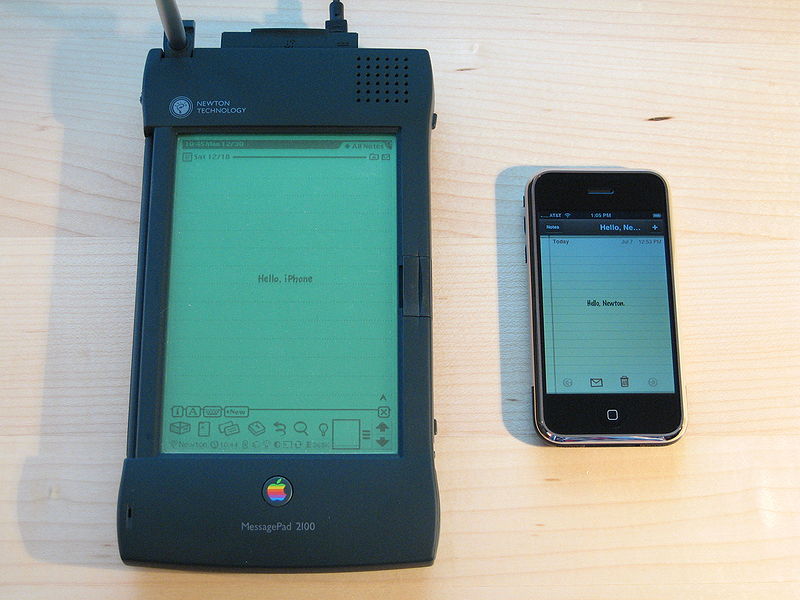
The LG Prada is certainly worth some words of acknowledgement, but acknowledging it wouldn't fit the narrative that page is attempting to cultivate. There are also examples going further back, such as the IBM Simon, and of course Apple's own Newton, which is technically not a smart phone.
It wasn't the first smartphone, but it was the first phone of any kind that wasn't bundled with crapware from the cellular companies and locked into their ecosystems. That was a huge win for consumers, and it was solely due to the persuasive power of Steve Jobs.
It doesn’t exactly fit the article or my original comment but what Apple did to carriers is just as big, possibly bigger, than the hardware/software of the iPhone.
The carriers dictated the phones you could buy (in the US). They dictated the siftware on them. They dictated the interfaces. If they didn’t like a feature hey turned it off. I remember a camera phone that had Bluetooth support for sending files but Verizon turned it off because it competed with their expensive MMS service.
I remember paying $5 for a terrible version of Bejeweled. I remember Sprint wanting to charge me $4 A MONTH to have Tetris on my RAZR.
Android still suffers the crapware and delayed updates. Maybe Google’s latest attempt will finally fix that.
But the iPhone RULED over the cell companies. They did what APPLE wanted because Apple held all the power.
Verizon couldn’t tell you which games you could buy from the App Store. AT&T couldn’t make you use their email client. You never saw a Sprint branded browser or video startup screen. They were largely irrelevant. They were demoted to what they truely are: infrastructure.
Does anyone want to go back to the world where carriers had 100% of the power over phones?
What a difference that made. And I do wonder if anyone else could have ever done that. Apple had the right product at the right time (AT&T losing bad) to get enough leverage to do it.
Yep. Jobs originally went to Verizon, which balked when he said they would have no control over the phone. That's why the original iPhone carrier was AT&T and only AT&T.
The original iPhone didn't have the AppStore. It was an incremental development on the original iPhone.
Palm and Blackberry devices at the time did have AppStores. I was a happy Treo user...and the iPhone didn't have the ability for me to build apps for it. I also used my finger to touch the screen.
What the iPhone didn't have was a physical keyboard. That was the primary design innovation.
How long would it have taken to get the App Store?
You mean like HandNGo (spelling?) that existed several years before the iPhone came out, let alone the iOS App Store? Quite popular with Windows Mobile folks, that was. There were others that I've long since forgotten about, but they existed.
Yeah they had a lot of deep institutional knowledge built up working with arm on the apple newton when Jobs was over at Next. Its arguable that if Apple had not already gone deep into Newton before Jobs arrived there would not have been the skills necessary on board to birth the iphone. While Jobs killed the newton he didn't lay that team off by any means they essentially flipped from Newton into ios, using the same arm skills they intially developed working on Newton.
He did not. But he DID repeatedly question the value propositions that Apple is based on, and produce a new value proposition that cannibalized the existing business.
Apple is now fundamentally following the course of milking the last value proposition that they were left with. There is a lot of profit to milk, but long term the industry will leave that value proposition behind and Apple will wind up one of the losers.
In the long term, we're all dead. Apple has been "doomed" for years, but seems to have hung on for 42 years. I think it's highly likely to survive another decade. I'd say that 50+ years in technology is pretty good for a business.
Even a 1% shift in the direction of something as massive as Apple, compounded over an additional decade of Steve Job's tenure (assuming retirement at 65), could make a massive difference - whether this would be good or bad for humanity is another question and still debatable.
Indeed, the iphone was coming with or without steve jobs. At the time almost everyone had a mobile phone, the only thing they didn't all have was internet / wifi / gps on their phone, and a capacitive/useful touch screen. When the iphone dropped it combined it all of this into a great product but nokia, samsung and others were all on their way with competing products that would have filled the void had the iphone not been there.
> nokia, samsung and others were all on their way with competing products that would have filled the void had the iphone not been there
We used smartphones in the labs at Motorola when I started working there in 2001. They ran Linux and had all the capabilities you would consider essential to a smartphone, not just the form factor. They were targeted for public sale in 2002 or 2003, if I remember correctly, but got shelved because the dotcom crash caused the networks to delay upgrading their infrastructure (yes, high-speed data networks had been in the works since the 1990s). A smartphone for sale in 2003 would have been absolutely useless. You'll remember that the phone networks could barely handle (or couldn't depending on your viewpoint) the iPhone for the first few years.
I didn't work in the cell phone division so I can't say for sure, but I think that most of the manufacturers let their smartphone development stagnate or stall from the early 2000s until 2006 or 2007, while Apple kept plugging away at it. When they proved that people would buy a smartphone even when their mobile network couldn't handle the traffic, all the manufacturers put effort back into development but by then they were far behind Apple.
Those products were cancelled but his death accelerated the round of products made by young people inspired by his legacy. We’re in the lull of Jobslessness; the shock of his death.
Jobs was, for all intents and purposes a phenomenal business person in spite of the fact that many people early in his career didn't see it.
Name a product apple invented that was HUGE? Go ahead and think about that. GUI & Mac was Xerox, the iPhone was Xerox and palm and...
Simply put he was a master at finding good things and refining them into great things.
Lets look at the design side. MacBooks for all their glory are just advanced machining (cnc + automation) put to work at scale (and thats "new" but not groundbreaking). OSX is just *nix with a nice GUI (something open source could learn from).
Jony Ive leaves apple, then I might start to worry.
I don't mourn the loss of Jobs as an inventor. I mourn the loss of Jobs as a person who could recognize great ideas for what they were.
I hear some version of "He didn't actually invent it" over and over again, and I think it demonstrates a fundamental misunderstanding of what made Jobs a visionary. Before the iPhone, nobody was making anything even remotely as good as the iPhone.
> Simply put he was a master at finding good things and refining them into great things.
I'm not sure if you mean that as an insult, but honestly it's probably the most important thing he could have done; there's no shortage of good ideas out there, but most of them have terrible execution. Being able to see through that bad execution to the good idea, and imagine a great execution not encumbered by what it had, is a profoundly valuable skill.
I mean... if you're playing that kind of naive equivalency then the first "smartphones" were the early PDA/Phone hybrids like the HP OmniGo 700LX, the pdQ, or the Nokia 9000 Communicator.
But that would be silly, because the modern "smartphone" era was absolutely started with the iPhone.
You misunderstand. My answer was to refute that the innovation in smartphones came about with the iPhone and not the LG Prada which was released the year prior, market penetration notwithstanding. I was talking about smartphones in the vein of the iPhone not of the technology that could be assembled to make a phone.
HP OmniGo 700LX, pdQ, and Nokia 9000 Communicator didn't have touchscreens and were like night and day compared to either the Prada or iPhone. You are comparing apples to oranges.
Nothing in the LG Prada was innovative - it's design was that of PDAs from a decade before. It's touchscreen did nothing that previous models hadn't.
Was it a nice industrial design? Yes. Wasn't very original though (and neither was the iPhone's).
You're also shifting the goalposts - you said smartphone, not "had a touchscreen". It was the first capacitive touchscreen but not even close to the first touchscreen btw. The IBM Simon in 1992 likely takes that win.
What the iPhone did that was innovative was in how it improved upon and combined the technology. It also pushed forward a lot of things in those technologies by several large leaps.
Long story short - the LG Prada is superficially visually similar to an iPhone and, likewise, bringing it up shows a very superficial understanding of the history of the mobile phone space.
Touchscreen was simple hardware it does not make a smartphone any more than a Camera or Internet connection does. There where 3 major gaps, gestures, native apps w/App Store, and a web browser capable enough to run 'Web 2.0' apps. And while not a direct phone feature an internet plan with useful bandwidth caps for regular browsing which also a major jump in how you used them.
Android, Windows phone, and iPhone all added these core features.
I dunno. The LG Prada deserved credit for being the first (mainstream?) phone with a capacitive touchscreen, but I think if you're really looking for a spiritual predecessor to the iPhone, so to speak, then -- assuming you don't allow PDAs with phone functionality, like Handspring's line -- the Danger Hiptop, a/k/a T-Mobile Sidekick, is probably much closer. The Prada looks much more like an iPhone but the Hiptop/Sidekick had visual voicemail, one of the best mobile web browsers on the market[1], and an on-device app store. It doesn't get nearly enough credit for the trailblazing it did.
[1] The Hiptop used server-side rewriting of web sites to adapt them to its screen. This seems bananas now, but remember, the web was less than a decade old, and the notion of "responsive design" was years in the future. Back then, most other phones were stuck with WML.
LG Proda had a capactive touchscreen, but it failed to use it. You simply pressed virtual buttons instead of using gestures. Pinch to zoom might not seem like a big deal but it's something that iPhone got right and everyone copied.
Another issue is LG Proda stuck with J2ME instead of offering native apps.
So, the Proda was close, but it really missed the mark. IMO, the fact it took 4 years to after the hardware was possible before the iPHone showed up shows how significant the innovation actually was.
"Smartphone" was coined as a marketing term by Microsoft in the early 2000s to refer to PDAs with cell radios that ran Windows CE. These early smartphones were bricks -- not Zack Morris phones, but hand-sized bricks nonetheless -- and required a stylus to operate.
Yes. That was the point. However, you are forgetting that the first "smartphone" with a _touchscreen_ was Simon made in 1992 by IBM. Even so, Simon wasn't in the vein of the iPhone, which is really what this discussion is about, not marketing terms.
> OSX is just *nix with a nice GUI (something open source could learn from).
I think open source developers know this but it's not their expertise. What we need is a way to make it easier for people with that expertise to contribute to projects.
Doing a bit of work with GTK I realised just how hard it is to abstract the look/design stuff out, it's very intertwined with the code meaning folks with artistic ability have a steep learning make seemingly minor GUI changes.
This explains why the web looks really good and stuff like electron is attractive.
> Simply put he was a master at finding good things and refining them into great things.
Every great creator has stood on the shoulders of giants. That doesn't diminish their greatness. I can't think of a single creation in the past 50 years that isn't a pretty direct consequence of the knowledge that preceded it.
All I see is a bunch of proprietary connectors and dongles, and I sleep like a log.
Jobs was just the salesman. Those products aren't lost, but they may have had a harder time getting to market without the "visionary" around to hype them up.
Salesman is an oversimplification. He was a productizer that could sell. :)
Also, does anybody know what cable the longest (number of years) a specific Apple cable/connector has remained compatible with the ever-changing hardware?
Apple has always had BS connectors, like the Powerbook 5300 (1996)and G3, G4 laptops power connector - an male RCA plug, but the inside contact replace with a 3.5mm headphone plug.
That brick power connector is a brilliant design. It is based on the IEC C7 connector with an extra (optional) spot for a grounding pin. You can take the power cord from a lot of small appliances and plug it into the slots as an extension cord.
The innovation of the iPhone was in the execution. The ideas were around, along with a ton of failed attempts at it. A computer in your pocket had been an idea for decades. Apple made one that a critical mass of people could/would actually use.
This is so dead-on. Having the idea is often the easy part—it's the execution that makes or breaks it. Yes a great idea can be valuable but it's nothing without the execution to bring it into reality.
Conversely, ideas which appear shitty or idiotic in their failure (Juicero, for eg.) might have thrived with sensible, correct execution.
This is why having the right team matters more than having the right idea and one should take a hard look at oneself as much as the product when facing failure.
Yes, but Apple couldn't have made the iPhone without a touch screen, ARM, Wifi, etc, hence claiming that Apple is the sole responsible of past and future innovation in their product line is naive.
Not really. The main innovation was business one that allowed Apple to steal US markets. They convinced two major carriers to offer expensive big data plans.
I am still not convinced. I had Windows CE pocket computer in 1998 and several others after. They all start up just like an iPhone with a grid of icons to tap on. The only thing missing from them vs iPhone for me at the time was a good data connection. They didn't exist except for more than I was willing to pay.
I'm not saying the iPhone wasn't amazingly better in execution and had great design. What I'm rather saying is if Apple hadn't released when they did with in a year or two the existing PDAs would have gotten cellular added and it would have been far clearer to everyone the progression was from PDA -> iPhone, an incremental step, rather than the more common mis-conception of feature phone -> iPhone that everyone mis-interprets as coming out of nowhere. There's a long history of PDAs before iPhone and if you take any one of them the jump to iPhone is not nearly as big a jump as people make out.
I migrated from a Palm Treo 650 to an OG iPhone. Superficially they're similar in functionality (I didn't really need a stylus for most Palm apps) but there was so much you could do with an iPhone that the Palm just couldn't touch.
Execution details like Apple contracting with Cingular/ATT to provide unlimited 2G for $20/mo was a huge substantive usability difference. I had to pay $40-$45/mo for similar ubiquitous signal on my Palm - needless to say I didn't - so Palm apps weren't built on that assumption.
My list of the enabling technologies for the iPhone is:
- USB 2.0 - developed by others, Apple's first use was in computers.
- Flash memory - developed by others, Apple's first use was in iPods.
- LCD screens - developed by others, Apple's first use was in laptops.
- ARM chips - developed by others, Apple's first use was in... iPods? iPhone? Not sure.
- Lithium ion batteries - developed by others, Apple's first use was in laptops.
- High-speed cellular data networks and chips - developed by others, Apple's first use was in iPhone.
- Multi-touch sensor and software - developed by Fingerworks, acquired and further developed by Apple. First use was in iPhone.
- Mac OS X - developed by NeXT, acquired and further developed by Apple.
- iTunes - developed by Soundjam, acquired and further developed by Apple.
You can see why Steve Jobs used to say that Apple is really a software company, and only designs hardware so it can do the software it wants. Most enabling technologies for the iPhone were provided by other companies; the only ones Apple acquired for exclusive use and development were the software and UI.
I'm thinking of the first iPhone here--Apple has obviously since moved a lot of chip technologies in-house too. Again, though, that seems to be tightly coupled to their focus on software.
Yvon Chouinard has a definition of innovation that I really like, which is (paraphrasing) that innovation is the application of technologies in novel ways to create new products. Thus the iPhone was an innovative product, even though Apple themselves did not originally invent any of the enabling technologies, and only owned a few.
> ARM chips - developed by others, Apple's first use was in... iPods? iPhone? Not sure.
ARM was created by Apple and Acorn to create low power chips for mobile devices like the Newton. You remember the Newton right? One of the first PDA's. Didn't make it but they did help shape the wave of PDA's that led to the iPhone.
The product wasn't even new. It was just popular due to Microsoft-class backroom negotiations with carriers to sell data plans and the fact that the launch perfectly coincided with launch of 3G networks in the USA.
> expensive cashierless stores that won’t deliver much of an improvement to our shopping experience
Having to lineup to checkout is definitely the most time-consuming and unpleasant part of shopping. It's why I way prefer online shopping.
At a busy time at the grocer, I take 3 minutes to pick up the 3 things I want. Then all of the checkout lanes are backed up for >10 minutes. Even self check-out.
> That is a really pointed indictment of our current industry. Wow.
Is it? I read it as a series of attacks from someone who thought the status quo was just fine, and doesn't actually understand the value being delivered. Since they don't understand it, there must not be any. Since there isn't any value and it just hurts vulnerable people, it must just be callous evil.
For example, Amazon's cashierless store sounds great to me! I absolutely loathe the forced smalltalk of dealing with cashiers. I adore automated checkouts.
And Amazon has been amazing for driving down prices on daily goods. I'm happy to see them expand into something like grocery stores where high prices are a problem for everyone.
Grocery store checkout jobs are not a basic human right that should be immune to attack. Neither are content producer business models.
This isn't an indictment. It's an expression of incomprehension.
It feels like it was written by an old man who doesn't understand how innovation in consumer technology works. Companies produce a bunch of seemingly pointless products, but some use of them sticks and is built upon until you get a product that sees widespread use. Ex. Tablets - everyone thought big phones were pointless, but now tablets are everywhere.
I feel like the real point is that cashier jobs are not something to be taken for granted. They are not a constant of the universe. The position serves a purpose, and the purpose is not to employ the underprivileged.
I probably now fall into this camp as well. I made fun of Apple for years, but while I still hold an emotional and likely completely irrational dislike for their products, if someone were to ask me for a recommendation on a phone today, the only phone I could recommend in good conscience is an iPhone, because it's the only option that takes privacy and security seriously right now.
Yeah. I love their commitment to privacy and security, but I only wish their platform wasn't so locked down. The only reason I went with Android in the first place was so I could side-load personally-built apps. IIRC (I could be wrong), if you want to write and side-load your own personal iOS apps, you have to pay a $99 fee and they deactivate after a week.
Actually, if you don't pay the developer fee, you can only install 2 apps per apple account and they get deactivated in a week. If you do pay, I think its unlimited apps and a 3 month long period before they get deactivated.
not true. I’ve written a couple personal apps that sync with health kit data collected from my Apple Watch and nutrition apps to help me track things in a way that is useful for my fitness goals. In 2016-2027 I used these apps to put on 30 lbs and stay relatively lean but I’ve never wanted to publish them in the app store. I don’t pay for any developer program. Just need to download some (free) developer tools / SDK for XCode, build the source, and put it on my phone. The install is tethered, but afterwards it stays there until I delete it. Restarting the phone doesn’t delete the app either. Only time I needed to re-install was when my 5s crapped out and I had to get a new phone.
When did that change? I wrote an app that I use every day and have been for about 4 years now. The most recent time I've had to load it on a new phone was in Dec of last year.
My apple dev account was originally a paid one though so maybe that has something to do with it?
I really hope I don't run into this deactivation thing.
Are you sure you don't have a paid account? My provisioning profiles expire after 7 days (the app is still on my phone but upon launch it just crashes with a white screen)
This is completely false, I have several apps that I've built on my own personal account, which is expired because I haven't released a personal app in a year or so, all of them are still running just fine after a year.
Incorrect. Provisioning profiles created by free Apple developer accounts only last for 7 days. After that you have to fire up Xcode and rebuild your app and reinstall it.
This IS NOT INCORRECT. I have numerous apps that still work. Provisioning profiles have nothing to do with the app running and everything to do with installing the app. If you need to re-install the app XCode automatically regenerates a new provisioning profile for you. Please educate yourself about the details of how technical items work before speaking negatively about something.
I have my fair share of complaints about Apple but speaking negatively via ignorance is always something that should be corrected.
I have an iPhone, but it is soooo painful to me that my awesome as hell MacBook Pro for work has USB C for everything, including power, and yet my phone does not. Meanwhile my team lead, sitting directly across from me, has an android phone that charges with USB C.
I actually am not bothered by that so much as that Apple did not produce a decent 1st party USB-C hub and most of the ones I've purchased produce a lot of signal noise (curse of sensitive ears + quiet home office) so I had to return (if I got around to it before return period) or donate them.
The issue IMHO would be moot if they included a USB-C charging adapter (and a USB-A dongle/converter) on newer iPhones.
Also it sucks that Amazon is so full of fake stuff. Hard to find/promote good accessories. Apple needs to step up and provide quality 1st party or heavily promoted 3rd party accessories.
I made the same transition a few years ago. Over time I've supplied my family with iPads to 1) get us on a common chat platform and 2) reduce my tech support requests as much as possible. It has worked well!
I have a Pixel 2 XL and Chromebook for work. There are a few features I wish iOS would take from Android, and a few I wish flowed the other way, but if you buy in to the Google stack, it's hard to beat the Pixel/Chromebook pairing.
I can't really recommend abandoned/dead OSes to people. Otherwise I'd recommend Win10 Mobile, which is still my personal favorite and (for the moment) still receiving extremely prompt security updates.
> because it's the only option that takes privacy and security seriously right now.
iPhones are a luxury. If you can recommend them it means you already belong to the richest part of the planet. For the rest, they jut can't afford it, and Apple was never interested in making anything cheap.
IMO they are luxury as running shoes or fresh legumes are luxury.
It costs more, but can be prioritized on a budget as an expense that makes a difference.
Actualy I think even for very tight budgets, investing in a good phone might have more impact than a lot of other purchases (even a computer depending on the case ?).
Very recently a lot of French towns added mobile payment options to coin meters. An iPhone SE is supported by most apps, I have now idea for the limit for android phone, and I wouldn’t imagine it works on the lowest end ones. I would imagine being able to run that app or mot could make the difference between being ticketed for overdue parking or not.
iPhone SE, or previous models are definitely affordable, and it seems like a good investment considering these devices are supported for 4 years on average, so on a 2 year-old second-hand device you’ll still get 2 years more of security updates, which is something Android can only dream about.
Will you also complain about Samsung because their flagship is too expensive?
>Pixel phones get security updates for at least 3 years from when the device first became available on the Google Store, or at least 18 months from when the Google Store last sold the device, whichever is longer. After that, we can't guarantee more updates.
If my Nexus 6 was any indication, a power user will wear the device out before three years anyway. Batteries are not end-user replaceable parts and require an expensive repair or specific tools and skills. Apple addresses this through IOS updates to throttle processor speed and extend battery life but in either case (Apple or Android) the hardware updates are IMHO compelling enough to trigger consumers to purchase new.
Only for Pixel phones bought unlocked. This doesn’t apply to most people that buy (or rather are coaxed into buying by the salesperson) whatever Samsung or Huawei device from a carrier.
Bear in mind, the fact that they can't commit to two years after final sale means they are selling devices that will be insecure before the average two year cycle people tend towards with phones.
Selling a phone as "new" that doesn't have at least two years of life from the date of sale should probably be referred to a consumer protection bureau.
A worker at Foxconn has about the same discretionary income as blue collar workers in the states; their food and housing is covered by Foxconn, but isn't normally listed as part of their salary.
Now, albeit, they're slightly on the higher end of Chinese workers, but it's not just the shitty aristocrat's kids spending money on iPhones. The people making the things make enough money to buy one, just the same as my hairdresser does.
In that case Foxconn isn't an example of an average company paying average wage. The disposable income per capita in China was 36396 chinese yuan in 2017, which makes a little over 400 USD per month. Median disposable income is even lower. You're not even close to buying iPhones with that kind of wages.
China has a lot of rich people even if they are far from a majority. It isn’t poor taxi drivers and ayis using iPhones, but more like those who are driving black Audis.
Just keep in mind that the NSA has remote sudo access to everything on your phone[0]. It's not completely secure and they're known to abuse their power time to time.
The link you sent just shows that they have zero days on Android: but they also have similar exploits available on iPhones.
Besides, the NSA having zero day vulnerabilities is nothing new and not limited to Android. Saying they have "remote sudo access" is misleading also and implies that they were deliberately built into android, although that may not be what you meant. Either way, the NSA will always have the type of people employed who can find zero days on smartphones and most importantly, not tell anyone about them.
You really should give some context to what you say or it's meaningless.
Also if you reside in one of the countries within the 14 eyes, they do have access to your phone[0]. It's a really good reason to think twice about buying american products and visiting their country knowing that they are creating a surveillance state. Wouldn't you agree?
I don't understand what you mean with the remark about context. But otherwise no, I don't live in any of these countries. Also, it's not that I "don't care". It's just that by what I know, Apple is the least risk to my privacy and well being.
Having been a fan of Apple for over a decade now, over the last year I've come to the opposite point of view. Their iPhone and airpods are great products and of course they can ride a long time on those, but in every other area from Macs and accessories I feel they are falling flat on delivering great user experiences. From FaceTime to Siri, to crappy Apple TV remotes, Home Kit... there are just a LOT of mediocre products that sit idle for years. Of all times, the company is at the point most worth criticizing. I do blame Tim Cook for this stagnation in product development. And indeed their lack of ideas means they have nothing better to do with their cash, that they are buying back shares. Ehh, I'm so jaded these days on Apple.
My parents are actually frightened of the new Apple TV remote. They hide it somewhere where they won't knock into it, because they know it'll switch the TV's input to the Apple TV, and they'll have to hunt down a different remote to switch it back to the cable box.
Interesting you say that about the Apple TV remotes. I thought they were all horrible but I really like the new one. The speed at which I can move around and the precision of selecting things is really great.
Why can't I tell which side is up without looking at it or accidentally changing something? Why is the black IR sensor the same size, shape, and location as the charging port, but on the wrong side? Why can't it decide that a log press when it's upside down is probably someone sitting on it? Why is it too small to comfortably hold?
Maybe this thing works for people without kids, but I'll take a boring remote any day.
We had a lot of trouble with the new Apple TV remote. Stuff like it getting knocked slightly and the Apple TV going wild, etc. Luckily the AppleTV generations that use it also support HDMI-CEC so we just use our TV remote instead.
On Tuesday’s call, there was just one question about innovative offerings, and it concerned health applications, an important driver of Apple Watch sales but not a potential world-beating sensation. Apple appears to be happy to think small and focus on its shareholders, not on pie-in-the-sky ideas, like other tech companies, including industry leaders.
There's a key point I think the author is missing here. If Apple could spend $50 billion on R&D and get a worthwhile return, I think they absolutely would. Their below-par R&D is not from a lack of wanting. It's because they are much more focused. They don't burn cash on new ideas just because they can.
And if I thought Apple's health aspirations were limited to Apple Watch, well, I wouldn't be in the stock.
Another way to look at it is that for the iPhone to exist, a long string of failures had to exist going back to the PDA market, the Newton, the iPAQ, nokia smartphones, etc because the intermediate steps has to be funded to cost and size reduce the components needed until an inflection point was reached.
Apple invests at inflection points, after massive R&D spending by others have created many of the pieces needed.
You could call it brilliant or you could call it parasitic, I tend to find it a parasitic freerider in a way, not publishing as much research openly, not acquiring or funding as much of the startup community, in general, not funding research for the purpose of research and taking the risk of uneconomical results. This is similar to a University doing research for decades on a Particular drug pathway or health condition and the a pharmaceutical swooping in, taking the end result and patenting a medicine. Sure, they still spend a lot of money on developing the drug and going through medics trials, but public investment on the basics that came before it is what enabled it.
I’d like to see more basic R&D funded by Apple, not just product development. More Bell Labs, IBM TJ Watson, Microsoft R&D.
And my understanding is that companies have considerable latitude in designating whether a particular activity is "R&D" or not.
R&D expenditures don't seem like a metric that can be precisely compared across companies, or even reliably connected to future business success. It's not like companies that report the highest R&D spending are always the ones winning.
I agree with your second paragraph, but quibble with the first.
I don’t think there’s that much latitude. The IRS routinely questions companies large and small, in detail, about whether they were really developing new products, or just polishing/improving existing products. The former counts as R&D (and gets favorable tax treatment), the latter is not.
The test is more complicated than this, but latitude is not a word I would associate with this term of art.
I get why the IRS would be interested in companies trying to hide operations inside the favorable tax treatment of R&D, but do you think the opposite is also true? Would the IRS (or SEC) care if a company underreported its R&D spending by choosing to classify new product development as a typical expense?
Point taken. I don’t know if the SEC would care, seems possible, but you’re right, it hadn’t occurred to me anyone would deliberately under report R&D, there probably is latitude in that direction.
At what point do you hit massive diminishing returns? $3.4b a quarter is $285m in R&D every single week. That's a lot of money, no matter how you slice it.
Yes, the guy's logic is whomever spends the most on R&D generates the most innovation (or something). How does he know what Apple is working on with R&D? What a silly statement.
Because other companies that spend a lot on research actually publish a lot of papers for other colleagues in the industry to read.
The fact that Apple rarely publishes research is part of the problem, because it’s relationship with scientific community is unbalanced and more of a taker than a giver.
No-one outside Apple knows, and we won't find out for at least another 5-10 years when executives start writing books about it, if ever. But you miss my point entirely.
Perhaps a better way of putting it is in this comment from Tim Cook in 2009[1]:
We believe we need to own and control the primary technologies behind the products that we make and participate only in markets where we can make a significant contribution.
If there ever was a car-project (which there was enough smoke for that I think there probably was), it was because Apple's management genuinely believed at the time they could make a significant contribution to the automotive industry. The fact that, after trying for however long, they concluded the money had been pissed up the wall doesn't make the attempt any less valid.
The author of this opinion piece is praising Apple for its willingness to NOT innovate.
I strongly disagree.
The best solution to privacy concerns is not to stop innovating. Surely there are better solutions.
Apple is leading the way on some consumer privacy issues and I applaud them for that. But surely if Apple halts innovation, it will die as all companies do. Let us hope they are smarter than that.
I think the point here is that Apple is not innovating in "stupid" areas(for the author) - like cashierless stores, automated cars, surveillance speakers etc.
In a way, yes, that is admirable - I think all other tech giants are going in the "wrong" and harmful direction, while Apple still concentrates on making good hardware with matching software(their abysmal attempts at MacOs fixes notwithstanding).
Isn't it naive to criticize cashierless stores and automated cars as "stupid areas"? Arguing that those will cost jobs is akin to saying a 100 years back that the "iron horse" will cost jobs. Mankind has to continue to innovate and it is disingenuous to argue that a cashierless store is a "minor convenience".
My current experience with just about any cashierless option at a grocery or department store is far from a minor convenience, it's almost entirely an inconvenience. I now get to do what I did over 20 years ago and bag groceries, except then I was paid for it.
However, it allows the store to place one minimum wage employee over multiple lanes versus having to have one per lane (or even two if it was like the grocery store when I grew up that actually had backers AND checkers).
So, like many innovations, it adds little to no convenience but is a very effective way of cutting labor costs. By Grabthar's Hammer... what a savings.
I despise the cashierless checkouts too, however, the recent advent of scan-as-you-shop options here in UK(Tescos and Sainsburys have it) means that I walk into the store, put items directly into my own bags that I brought with me from home, scanning each as I put it into the bag, and then at the end I walk up to one of many terminals(there's never any queue), return the handset, pay with card and literally walk out. It was transformative to my shopping experience(as in - made it a lot better).
Counterpoint: I've found that using self-checkout lanes lets me get out of the store a lot faster than waiting for a cashier. People use them because, in general, people hate waiting.
Of course, while Walmart has 30 cash registers, there's only ever 4 staffed at any given time, so you could argue that if they just had more staff they could get people in and out at the same speed.
To each his own, I exclusively use the self checkout line whenever I can (especially at costco) and it saves me a ton of time. Besides the point here was about innovation and working towards a better future, which the amazon cashierless stores might be. Just because the current solution for self-checkouts is bad doesn't mean we should stop innovating.
Working towards a better future sounds like an admirable goal, but that's ad-speak on top of actual goals of the innovation, which is more profitable retail.
I don't personally think a robot grocery store is something I'm interested in, but that's entirely subjective.
I don't think the argument is that they are stupid because they cost jobs, any more than the idea that smart speakers are bad because they will cost jobs.
How exactly is Alexa different than Siri on iPhones? Why is one a surveillance speaker but the other isnt? I'm near my phone far more often than I am in my living room.
Apple also consistently makes the trade-off of privacy above user-experience; in order to offer similar features to Google photos, they train neural networks on-device.
As well as how seriously they take the biometric data from Touch ID and Face ID, I'm much more comfortable around a HomePod than Alexa.
I read the whole article and I'm not impressed. The crux of the article seems to be that he now admires Tim Cook and Apple because they don't spend money on progressive technologies that have a potential for harm. His examples include smart speakers, driverless cars, and cashierless stores that presumably shouldn't be pursued because of their potential for societal harm. Look, things like privacy, safety, and job opportunities for the underprivileged are immensely important, but his arguments are flawed. By the same standards, the iphone and a myriad of other important technologies should never have been pursued.
I've been an Android user for years; I recently decided to change to iPhone, and this article really captures the reason why: Apple seems to be the only company for whom a cloud backup of my phone book is a liability, not an asset to be monetised.
From the perspective of the vendor, it would be a cost center rather than a revenue generator (thus a liability). From the perspective of the customer, it's an asset because he isn't selling personal info for backups (which would be a liability).
Googling for 2 seconds shows that numerous companies over the years have gotten in trouble for scraping contacts. A couple fast examples.
June 16th, 2015: Linkedin settled a lawsuit for over $13 million in a class action grounded on their alleged use of users’ email contacts it obtained from the “Add Connections” feature in its service.[0]
Apr 30, 2013: Path, the photo-centric social network that just hit 10 million users yesterday, has been getting some heat for what some users say are spammy tactics to recruit new users. Digital marketer Stephen Kenwright downloaded the app earlier this week, tried it out, uninstalled it, and went to bed. When he woke up, he found that Path had gone on a rogue mission early in the morning, texting and robocalling an unknown number of his contacts, including his grandparents. [1]
Google's main endeavor is to develop an actual product. They design and engineer something in the hopes that people use it. (Then they sell ads, like the publishing industry has done for 200 years.)
The difference is where the exchange of money happens. Because Google's, and Facebook's, Amazon's, and most SV startups' services are free, you get the privacy problems and the ulterior motives and the trust issues. With Apple, you paid for the product up-front. The transaction is done and in the open. They don't have to do anything skeevy to make money off their product.
Apple has plenty of non-aligned incentives, they control the store (+30% subscription tax on Spotify, taking down apps that compete with "core functionality"), they don't want you to repair your phone (and planned obsolescence) where ewaste and their profit is connected.
Apple does not seem to want you to open the phone, but they are easily the most repairable phones available. Most repair shops will repair any iPhone, and you can stumble through it yourself using YouTube or iFixit.
I believe Apple gains directly from the longevity. People know that Apple products last long and hold resale value; where I am the iPhone 5s from Sept 2013 is sold second-hand for ~$150CAD
Devices with high resale value mean customers can upgrade frequently.
And Google technically sells hardware. I'm not talking absolutes, I'm talking about where the primary cash source is. Facebook, for example, couldn't be consumer-friendly if it wanted to, because psychological manipulation is core to its business model.
It is kind of amazing how much the landscape has changed. I have always used Apple computers and phones, and I used to view Apple as a vaguely sinister company, but one that produced the best products. It is very weird to me that they are now a model for non-evil practices among large tech companies.
> I used to view Apple as a vaguely sinister company
What about Apple gave you the impression they were sinister and what has changed?
I've actually been going the opposite direction with my opinion of them. All of their talk of "you are not the product" and "we respect your privacy" is great but feels opportunistic given the current climate. The foundation of Apple's products that they are touting as privacy focused were actually about controlling the experience. They've cleverly spun happenstance into a platform to promote their products.
None of that really strikes me as sinister though, when I say that they've been going in the opposite direction I'm referring more to the way they support their hardware and their shady tactics when it comes to device repair. For Apple the profit is in selling you a new device, they make no money if you don't upgrade. A repaired device isn't a profit, it's the burden of continued support. So what we're seeing is products that look great but aren't designed with longevity in mind and replacement focused support.
Apple shipped the iPhone 6 with a battery that degraded quickly and by most would be considered faulty. Rather than issue a recall or some other pro-consumer solution, they hid the fact that batteries weren't functioning to specification by throttling the CPU/GPU and degrading performance. This also had the nice benefit of coaxing users to upgrade because their device was slow.
When Apple got called on this, their response was to claim it was a benefit to the user rather than admit the batteries were faulty. They then graciously offered to lower the price on a battery replacement. So instead of a costly recall, they're profiting or breaking even on you having to pay for a replacement. If that wasn't enough, many people are reporting that Apple is refusing to replace batteries on devices without first fixing other faults like cracked screens or "broken" microphones [0].
Apple is also using it's new found position as bastion of your privacy to justify other shady practices like disabling components or bricking hardware entirely if it isn't "genuine" and then claiming it's to protect the consumer's privacy.
Their growth as plateaued and I feel like this is only the beginning of the Comcastic abuses of the customer we typically see from the market leader trying to find new ways to grow. That's why I think they've been becoming more sinister anyways.
I'm not the OP but since the early 1990s I've had an uneasy feeling about Apple, primarily due to their ability to sustain a cultish following.
It went beyond encouraging loyalty bymaking good products ( though that was the era of the dire Performa ) and into mocking and belittling non-believers, and rewriting history in a sort of Soviet-airbrushing style.
I don't know whether the company itself nutured that but it was unsettling. Microsoft was explicitly dominating like a tyrant, but Apple was a cult leader with a thin smile and an army of vehement adherents.
The cult like follow Apple has enjoyed has never really bothered me. From a business sense it makes sense that they would cultivate it if the culture was beneficial to them. You see the same sort of fanaticism with cars, guns, televisions, cameras, watches, sunglasses, and a myriad of other products.
I think that understanding of marketing and brand, in addition to the value of engineering, is what made Jobs such a great leader. He understood enough of both sides of the business to make them work together cohesively where other companies tend to favor one or the other.
I wonder if the author likes Apple because Apple has, as he states himself, stopped innovating. This means that Apple's offerings offer stability, which means comfort.
That being said, I agree with the authors sentiment.
I'm very fond of Apple's business stance; my concern is not with it, but with their technological stance. Apple products are built on lock-in; they are proprietary and closed, not open. Frankly, at this point they're not even really all that good (in fact, sometimes embarrassingly bad — something not limited to Apple!).
I want the freedom to tinker, the freedom to review, the freedom to extend. That's why I use Linux.
Locked and closed compared to what? What makes Android what it is to most people is a bunch of closed sourced Google Services and a bunch of closed sourced binary drivers. That are so closed that not even Google was able to upgrade some of their Nexus devices because they were dependent on closed source drivers.
Pfffft. Yeah there's "nothing stopping you" except for everything.
You can't get rid of the window manager, the Finder or the Dock. Heck, you can't even stop Finder from running in any supported way and even if you manage to, you can't replace Finder in every program to open or save files.
You can't replace the Dock because Apple won't let you modify a private API for describing available screen space. Every Dock replacement has the same bug - windows end up behind the replacement dock when you maximize them.
Even Microsoft gives you hooks to change things like the Taskbar, Explorer and so on where Apple gives you nothing.
Yes thanks, that's what I was laughing about. You can attempt to run such a system, but since nobody does (and for good reason) all your tinkering will be in vain and you'll have a fairly useless system. Enjoy that!
You can't actually tinker with the things that you want to use though, can you? Nope. Again, Microsofts offerings simply outclass Apple here - they've got hooks to let you modify just about every interface in Windows whereas with Apple you have to resort to basically re-building your entire OS for the right to tinker.
Apples offerings are simply not tinker-friendly and everybody knows this, notwithstanding desperate attempts from the Apple-faithful to disagree.
> The Finder isn't used to "save files".
Yes it is. The GUI components for every "save file" operation in almost every existing Mac app are absolutely sourced from and tightly integrated with Finder.
So I just showed you how you could do it with links and because "no one does it" that means it "can't be done". Have you thought that the reason "no one does it" is because most people don't want to muck with their systems and just want to get stuff done?
You want to "tinker with the kernel" but you are complaining about modify a plist?
I didn't say that I wanted to tinker with the kernel. I want to tinker with the Finder, the Dock and the actual window manager that everybody uses, not XQuartz which nobody uses.
You showed that in order to tinker with Apples stuff you have to completely replace Apples stuff. That's hilarious!
If you go dig into my comment history I have several comments where I praise Richard Stalman and his commitment to open source. He is the zealot (and I use that word with both positive and negative connotations) that open source needs.
But I have to ask what ARE you running then? Intel? AMD? What about your phone?
If your going to make this argument in this way you better have a Stalman like response. If you are running closed source in your stack then your argument is selective.
Everyone is running closed source somewhere, even Stallman. He says in his web page describing how he does his computing that he uses credit cards sometimes, uses closed source software running on public computers that he doesn't use often, and doesn't consider anything that doesn't regularly update it's software a computer.
You might be in favor of Stallman's compromises but he has a selective argument just like everyone else.
In the case of FaceTime, it's VirnetX that's to blame. Apple's pledge to open-source it ran hard into a lawsuit from VirnetX that required Apple to redesign and still currently has them paying $439M to VirnetX for patent infringement.
This all sounds noble and all , but doesn’t Apple know just as much or more about you via phone / watch / iCloud / iTunes / Apple Pay / Apple TV?
Are we celebrating here that they’re not openly selling this information or using as primary business model ? Or that it’s only used for internal business?
Apple has been criticized in the past for having an internal culture/dictates to avoid "synergizing" this kind of info between their products/services - criticized because it affects the quality of features like Siri.
Contrast to companies like Google (who don't directly sell your info but still profit from it) or Facebook (who have had numerous exfiltration incidents over the years and who sell very targetable info that could be used to isolate a single person).
Meanwhile Equifax has horrible security and you aren't even remotely their customer - they just collect your data and get passive income from that.
I only wish the author hadn't forgotten to mention the quintessential non-Apple company: SNAP[0]
Many say the current game of musical chairs is overdue for a pause. My money (not literally) is on Tech stocks taking the biggest hit. But as the article put it, Apple isn't a Tech company -- it's a manufacturer (and superb retailer!) of products that are observably differentiated, as they clearly command higher prices for virtually the same functionality as their competitors.
I think Apple is a true tech company. How can you define a tech company? it has got holds on both hardware and software for its ecosystem. Doesn't that make it a tech company?
At this stage, if any company which can create an OS like iOS would be considered tech company leaving aside the hardware part.
Apple’s market cap will keep rising for the next few years without any innovation through buybacks and service revenue from existing devices. But the fact that they’re not talking about new products or hinting at anything down the line concerns me...
> But the fact that they’re not talking about new products or hinting at anything down the line concerns me...
Why would they show their hand? There's little to be gained from it and it would harm their brand when these technologies don't pan out how they would want. See Google Glass - huge fanfare but no real substance.
Besides, we hear of technology that is supposedly being worked on inside Apple. Project Titan, the AR headset that is looking at a 2020 release date.
> After Apple’s latest results announcement, one could knock it yet again for its stable dependence on a single mature product — the iPhone...It shows that a stage of useful progress is over and doesn’t tip over into overhyped uselessness
Stagnanation isn't acceptable for any company. Apple has always been about "overhyped uselessness"(eg. Touch Bar, animoji). The article makes claims that Apple "offers a fix" referring to the battery throttling, but any company of that scale is obligated to. They were shamed publicly. I agree with privacy commitment, but that alone, isn't enough.
His argument that Amazon is not innovating to solve real-world problems seems grossly uninformed. AWS is putting out new features almost weekly that solve lots of real-world problems across all industries.
Apple is focusing on the 80%, and have developed a strategic advantage based on privacy. This is not a new lesson.
Commercially this is smart and profitable, but it was at the expense of the 20%. The fact is that their products stopped meeting my needs. So instead of a apology, I would like to thank Apple for the lock in that took over a year to unwind before I could leave the Apple ecosystem. It was a harsh lesson that I will never forget.
What a strange article. He spent most of the time saying, "I could criticize Apple for .." which seems like a criticism shrouded in something else or backhanded compliment (if that). Also, what's this infatuation between good and evil? Why does that even belong in a tech conversation?
Because technological advancements are almost by definition poorly understood and people tend to be scared or at least skeptical of what they don't understand.
One of these days I'm going to write a bot to keep track of title changes. "Apple is a traditional business" is the current title, for the record. I expect (I hope!) it will be changed again soon, because it doesn't make much sense.
When we do that, we try to find a phrase in the article itself that represents what the author is saying. That's what we did here. If there's a better, more representative phrase, we can change it again.
"Apple is a rock of common sense in an industry that’s gone rogue" (the subtitle) would be better.
"Apple is the perfect tech company for this day and age, an example to the rest of Silicon Valley" (the take-home message in the first line) would be better.
The Apple "is a traditional business" remark refers to the main point of this opinion piece, which appears right before that statement:
"This is a time when companies whose innovations are more intrusive than useful, more gimmicky than problem-solving, operate with business models that either burn investors’ cash or turn the users into products.
"At a time like this, Apple is a rock of common sense, sobriety, dignified engineering supremacy, prudent financial and supply chain management, effective marketing, and customer-oriented retailing."
Without the proper context, "Apple is a traditional business" could mean anything and doesn't mean anything at all.
"Apple is a rock of common sense in an industry that’s gone rogue" is too baity, even more than the original title we changed. It's guaranteed to provoke objections if we put it in there. Ditto with "perfect tech company"—can you imagine the arguments that would lead to?
You're welcome to make a bot to track title changes. People have done this kind of thing from time to time, e.g. https://news.ycombinator.com/item?id=16018430. IMO the main thing it would show is how much work goes into getting this right, and how hard it is.
Edit: Btw I agree with you that the title we changed it to isn't great; I just haven't thought of a better one or seen a better suggestion. If someone has an accurate, neutral title that preferably uses representative language from the article, we'll happily change it again.
The problem with opinion articles is that they are not "objective" by definition. A representative title cannot be objective. It's unfortunate that interesting articles (they may be somewhat interesting, if they get to the front page) are devalued by listing them under aseptic, uninteresting, click-repellent titles.
Tim Cook made it clear be thinks that no industry should have any regulation, especially his (technology, privacy, consumer hardware, should all have no regulation, he thinks!). He thinks Facebook should have done what it did - no regulation is best regulation he says.
No, Tim Cook is exactly as insane and rogue as the rest of them. He is just doing what he can do make Apple the most money. He is not full of common sense. On the contrary, he's basically insane.
Apple should be regulated. So should every industry. If you're a CEO and you think you shouldn't be regulated, it's clear you're out for #1 and #1 alone.
Apple is not some saviour of the universe. They're just making money, and should be critized, not apologized to!



That is a really pointed indictment of our current industry. Wow.
I don't agree with some of the assumptions, but it really points to how rarely an innovation like the iPhone really occurs.