> Levels of CO2 in the atmosphere have surged past an important threshold and may not dip below it for "many generations".
Is this at all reversible? I presume not.
The real problem is that lots of people and putting a lot of effort and money into reducing emissions - where if the above is correct seems very very difficult (with a growing developing world) and likely a waste of time.
Surely we should be trying harder to scrub CO2 from the atmosphere and spend less time on reducing emissions?
> Surely we should be trying harder to scrub CO2 from the atmosphere and spend less time on reducing emissions?
It's simply a matter of cost. While we are continuing to put CO2 into the atmosphere, preventing one gram of CO2 from being emitted is equivalent to scrubbing one gram of CO2 from the atmosphere, and at present the former is far, far cheaper than the latter, and there is a huge amount of low hanging fruit still to be gathered. In fact, a lot of the emissions abatement is profitable - for instance an LED lightbulb might cost $5-10, but saves you 500-750 kWh over its lifetime, which is $50-100 worth of electricity even without pricing in carbon. The hope is if you introduce a carbon price (for instance by cutting other taxes and introducing a revenue neutral carbon tax) that you can further spur investment so that the market will make more of these technological developments towards resolving the problem. That may involve scrubbing carbon, for instance the recent process which has got a lot of publicity, using renewable electricity to turn CO2 into ethanol. But you're looking to resolve things at the lowest cost, and it may be that scrubbing is unnecessarily costly, and you can do everything through other means. We need to just price in the externality and let the market do what it does best.
Sure maybe cutting emissions can be cheaper than scrubbing - but the article says the CO2 levels are already too high. If we magically stop all emissions right we should be scrubbing as well.
So maybe we should be reducing emissions where its easy - and scrub
> Sure maybe cutting emissions can be cheaper than scrubbing - but the article says the CO2 levels are already too high
Ah, I see what you mean. It's a bit like national debt and deficit I suppose. At the moment, debt is high, and the deficit is high. CO2 abatement measures can reduce the deficit, but not the debt. You'd need CO2 scrubbing to actually push the deficit into surplus, and reduce the debt, rather than just stabilize it.
In an ideal world, you're right that we want to be getting the total concentration down, not just stabilizing it by reducing the rate of increase. But I think that stabilization would be such a major challenge for the foreseeable future that we should be looking to that first. Prioritizing more expensive ways of trying to reduce the total concentration in 30-50 years, over cheaper ways of stabilizing the concentration right now would, in my opinion, be making the perfect the enemy of the good.
Also, I'm not sure stabilization at 450 or 500 ppm (equivalent to 2-3C warming) would be that bad, what we're trying to do is avoid the definitively atrocious outcome of warming above the 2-3C range.
We release it because it allows us to produce energy (burn something). To remove it from atmosphere would require to put it some higher energy state so that we can store it and that require again some source of energy. Pumping pure CO2 in some mine will probably not do the job.
In reality, we will try to just reduce temperature without removing CO2, but CO2 causes problems other than tempterature rise. See ocean acidification.
Lots of unused land are shrubs, grass and hillsides. The mediterranean coast used to be all trees a little more than two millenia ago[0]. Some semi-arid zones around deserts could also support reforestation.
yeah, but we release it because burning things is an easy way of releasing energy whenever / wherever we need it. Reducing CO2 can be done pretty much anywhere in the world. So if we needed to build a nuclear powerplant somewhere just to power our CO2 scrubbers, so that our cars and planes could burn fuel, that's completely doable.
If we were to "just stop growing", it would pretty much collapse the entire civilization on the spot. Unfortunately, the assumption of growth is the basis of not just the economy, but a lot of things in the society.
Sure, I think we should move away from the growth-based economy. But this needs to be a gradual process.
The path to reducing emissions is much clearer than the path to efficiently scrub CO2 from the atmosphere. Also, scrubbing CO2 from the atmosphere gets harder and harder as CO2 emissions grow. There is some research to sequester CO2, but I don't think we have an ideas that are better than planting trees.
The elephant in the room that people don't talk about is population growth. If we don't get that under control, there really is no chance of us avoiding catastrophic consequences, like melting of the methane clathrates.
The vast majority of the CO2 is produced by only a small part of the population (the rich people in the west), and they aren't the ones whose population is growing.
China has a birth rate distinctively under the one necessary for a constant population. But as people keep living longer, the total population is going to grow slightly for some years to come. The bigger environmental impact is, that the energy consumed per citizen is still growing as prosperity develops.
Prosperity == higher living standards, which means more resource consumption per capita. So you merely substitute population growth with increased living standards as driving factor for emission increases.
I take issue with Hans Rosling (even though i happen to live in Stockholm). His message is 'dont worry, they will have babies for 50 years, then it will be all ok'. Sub-saharan Africa will have a similar population density to south east Asia. The world will have 10 billion. That's ok. But the truth is we don't know the carrying capacity of the earth. It's deeply unpopular to say this, but the only way i can see us solving this collective action problem is with a world government.
I really wish people would stop saying we're screwed. I know it's a compensation for climate denial, but I think it's terrible rhetoric. If you say, "it's too late, we're screwed," then the message is that nothing really needs to be done but deal with the consequences.
This is a big, scary situation and it's easy to feel hopeless in the face of it. But we are faced with multiple potential futures. Our outcome is tied to our action and the outcomes could be anywhere between mild and catastrophic. No invisible hand is going to swoop down and fix this one for us. This one's on us.
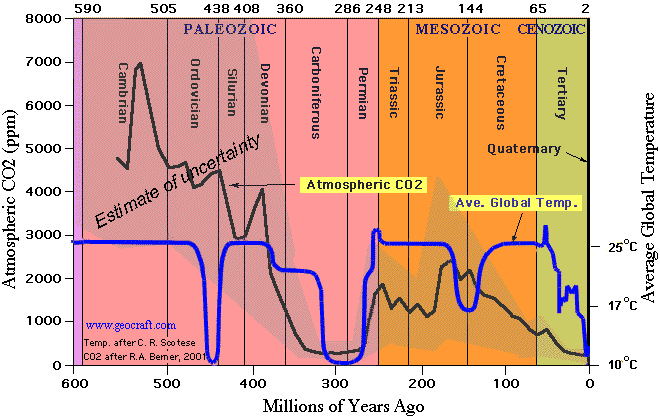
While this diagram shows, that the current CO2 content is lower than in many historic phases of the earth climate, this has little impact on the seriousness of our current situation. The biggest problem we have with the change of the CO2 content of the atmosphere is the speed by which it changes, and consequently the speed of the warming up. Eco systems change way quicker than they can adapt too. And dying eco systems and their input on our life are the big problem humanity is facing in the next 100 years.
That doesn't mean much if the carbon does not get bound to the soil. If plants just take up CO2, die, release it again then it stairs in the atmosphere. This applies to crops and rain forests, algae.
Only few systems tend to fix the CO2 over long periods of time, such as boreal forests or permafrost tundra. And guess which ecosystems are retreating due to global warming and releasing their previously fixed CO2?
New plants will replace the dead plants and utilize the replaced CO2. Binding CO2 to the soil would be optimal, but I fail to see how the lifespan of plants is relevant here.
Because plants are subject to changing climate too. If regions get drier then all that CO2 will get released in a short amount of time. This is like technical debt. It's released CO2 that does not affect the climate yet but could do so in the future due to feedback loops.
And even if that doesn't happen, it's only 25% of the released CO2. 50% are still warming the climate and another 25% are still acidifying the oceans. So that's a pretty high cost for a few greener forests.
And then there is the issue that increased CO2 levels mostly increase the complex carbohydrate contents in plants. They do not produce more proteins since they need nitrogen for that. Which may actually make things worse for the foodchain. E.g. it decreases the nutritional value of pollen, which is a problem for bees.
So there is really not much positive value in there.
Well, if by that you mean that people dying in countries which are low polluters happen to belong to the same species as the biggest polluters, then yes.
But in the grand scheme of things, we can't rely on such a mechanism, because the consequences are not proportional to the causal actions.
As an example, ask yourself this: what proportion of people would be ready to, say, pay twice as much for electricity if it meant that 1 million people/year less would die in some African country?
Humans are not the primary source in the tricky sense that someone looking to deny the evidence couldn't deny.
But they are the primary source of the net emissions or, in other words, the increase of CO2 levels.
It's a bit like if your neighbor produces just enough grain for a year's worth of food for his family of 10 and you steal just enough for yourself. Technically, you aren't the primary source of the decrease in food, but you are the primary (and only) source of the fact that your neighbor's food supply are lower than needed.
You can prove it to yourself by asking what happened to all the carbon in coal and oil extracted since the 18th century. It tracks the rise in atmospheric CO2, as you would expect, since we burned it.
I've been pointing this out to obstinate nerds for years. This really isn't complicated: human-generated CO2 does not magically disappear, and we know exactly how it interacts with infrared radiation. Just put these two simple facts together.
If you're wondering what software entrepreneurs can do about it, here's a reply I recently wrote:
----
I'm in a climate change startup, and here's how I look at it: 87% of the energy sources we use are fossil-based[1] and will need to be replaced with non-fossil alternatives in the next 30 years. That's trillions of dollars worth of infrastructure and technology growth opportunity for clean energy and energy efficiency[2]. The next Google will be an energy company[3].
To answer your question more specifically, in order to actually pull the 87% energy transition off, clean energy sources face huge financial and engineering challenges. This presents a lot of business opportunities for tech startups that can improve efficiencies for those clean energy companies. Energy efficiency, electric self-driving vehicles, solar, wind, nuclear, geothermal, public transit, etc. all need to grow by 100x in 30 years, and a huge chunk of that growth will be software driven.
The advanced energy industry is already a $1.4 trillion industry (larger than airlines and fashion industries)[4]. So there is, right now, a ton of market size for climate change tech, and it will grow by several orders of magnitude over the next few decades. Now is one of those rare moments where you can save the planet and have a business model.
For example, my startup is a SaaS company that is used by tons of distributed clean energy resources to smooth out the process of collecting energy data for feasibility analyses. We shave about 5-10% off the installed cost of energy audits and distributed solar, and make money doing it.
So if you're interested in doing tech startup in climate change. Do it! We need all the help we can get. If you're interested in the Bay Area professional clean energy scene, check out the calendar https://bayareaenergyevents.com/ (I run it) and start showing up to stuff!
Nuclear certainly keeps the CO2 emissions down. France has a pretty low CO2 footprint based on 80+% nuclear electric power. However, nuclear is not only controversial, but going forward, expensive. For new installations, wind and solar installations are cost competitive if not even cheaper, with little environmental or economic risks attached.
So wind and solar are currently the cheapest, but you can only get to about 50% penetration with those without storage[2]. The rest has to be "dispatchable".
Exactly. If subsidies are removed from the equation, solar in particular is quite a bit more expensive. Wind and solar also lack the 24/7 reliability of nuclear.
No, solar is about 100€/MWh without subsidies. Indeed, the one big problem remaining with wind and solar is constant supply over the day. But the larger the connected grids are, the better this balances out. While a nuclear power plant delivers a constant output 24/7 (this is also not ideal as we are lacking consumption in the late evening and night, thats why Belgium put lights onto their highways), nuclear power plants regularly get pulled of the grid entirely, if there is a technical problem. A new one should of course have less downtimes than an older one, but one needs to plan in a certain amount of replacement capacity.
The wikipedia article about Hinkley talks about the costs and guaranteed prices: https://en.wikipedia.org/wiki/Hinkley_Point_C_nuclear_power_...
I am pretty sure, that does not even include the long term cost for the nuclear waste. The roughly 100€/MWh brings it into line with offshore wind, which is about twice as expensive as onshore wind, but more steady and reliable. Solar is roughly in the same ballpark too in middle Europe, in Dubai a new solar plant is being built which promises to be less than $30/MWh.
Hinkley point is an aberration. its doesn't make any buisness or strategic sense for the UK.
Its double the cost of grid power, in perpetuity, in exchange for some vague handwaving that the Chinese might try out some of their experimental reactors on british soil. Or perhaps a "free trade deal" which is equally moronic for UK manufacturing.
Is there any good cost estimate, what the final electricity price produced by the Olkiluoto reactor is going to be, with its construction cost ballooning from 3 to 8 billion pounds?
For example: most grids in the western world rely on constant/predictable supplies of power.
Nuclear/coal/gas/hydro provide a constant level of electricity with a clear spinup/spindown time.
That being said, in hot countries solar is a good option, as when its hot, its generally sunny which means the aircon demand can be serviced well.
But, thats assuming that the sun and the wind are constant.
They are not, so you have to store that energy somehow. Grid scale batteries are just not really feasible yet, unless you happen to live in wales[1] or scotland[2].
However they now are only really there to overcome British tea breaks(thats a bit unfair). But they are the product of a nationalised energy infrastructure that thought about doing things properly. (now its just be massive diesel gennies to deal with the comedically narrow line between blackout and working grid)
So actually the problem of generating electricity from natural sources is pretty much solved (barring costs) The biggest barrier is storing electricty for a stable grid.
I said cost competitive, not that they are cheaper by the last cent today. Onshore wind is cheaper, solar currently in the same ballpark. But the cost of Hinkley is going to raise during its life time, which solar keeps getting cheaper. And is the long time storage cost of the waste and the dismantling of the plant already priced into the cost of Hinkley?
I have in other subtrees of the discussion. Hinkley C is guaranteed about 100 €/MWh with raising fees according to inflation. This is roughly the same cost as offshore wind, onshore wind in Germany is around 60€/MWh, solar 100-120€ MWh, there is a solar project in Dubai which promises to be better than 30€/MWh.
Nuclear can be done correctly as France has proven. How many major nuclear disasters have their been? Japan is the most recent, but are nuclear disasters really a major threat compared to covering large swatches of land with solar panels or worse, windmills?
I pose that as an honest question: what's the cost benefit of nuclear vs. highly inefficient solar or wind?
What's the environmental cost of producing massive batteries to store solar or wind energy?
There are huge unintended consequences that ought to be explored.
How many birds are killed by house cats and cars every year? Of course one needs to keep investigating how to make windmills more bird-friendly. The solar plant which killed birds is a solarthermal one which concentrates the sunlight via mirrors. Photovoltaic plants do not kill birds.
France has a good history of running their plants, but they do get older. So the risk is constantly raising. I am living in Bavaria, Germany. Here is is still not considered entirely safe to eat mushrooms and wild boar from the forests, as they still carry contamination from the Chernobyl incident, and are expected to do so for the next decades. And Chernobyl is about 1000 km away from here.
I was going to post on this topic, so thanks for getting it started!
If the interests vested in CAGW (catastrophic anthropogenic global warming) want to be taken seriously, they MUST push for drastically increased funding for advanced nuclear. Designs for advanced nuclear reactors already exist that eliminate the possibility of meltdown, as well as the need for water cooling. Such reactors would be perfect for coal plant replacement, which is the main necessity for power generation.
The grid needs a large percentage of electricity to be reliable, unlike wind and solar. We also need a source for the rapidly increasing power needs of the world. Safe, clean nuclear power is the answer, and is also the best solution in terms of environmental footprint. Yes, better than solar. (Solar is great when the real estate is "free", in other words rooftop solar and solar buildings.)
One innovative company (of many) working on this is Thorcon Power. Thorcon's concept is to site the reactors 30 meters underground for extra security and safety. It believes it can deliver electricity at three to five cents per KWH in today's dollars.
"[...] all the fuss about global warming is grossly exaggerated. [...] There is no doubt that parts of the world are getting warmer, but the warming is not global. I am not saying that the warming does not cause problems. Obviously it does. Obviously we should be trying to understand it better. I am saying that the problems are grossly exaggerated. They take away money and attention from other problems that are more urgent and more important, such as poverty and infectious disease and public education and public health, and the preservation of living creatures on land and in the oceans, not to mention easy problems such as the timely construction of adequate dikes around the city of New Orleans."
Freeman Dyson, heretic thoughts about science and society.
The scary thing about global warming is that it happens on a timescale that our political institutions aren't equipped to handle, and requires concerted effort by countries that are not equally affected. It's also hard to model and has outcomes that range from "mild disruption" to "Earth turns into Venus".
The precautionary principle suggests that we take it seriously.
Unfortunately I don't remember where I did read it, but I do recall reading a paper rejecting the idea that Earth could follow a runaway green-house effect as on Venus.
I don't know if people seriously see that as a real possibility or not, but at the very least I've never heard any scientist mentioning it seriously.
EDIT: well, apparently it wasn't so hard to find. It's right in the first paragraph of the Wikipedia article about runaway greenhouse effect[1]
"For instance, a “runaway greenhouse effect”—analogous to Venus--
appears to have virtually no chance of being induced by anthropogenic activities."[2]
I very much hope that the worst case is not a Venus like runaway effect. But there are many possible outcomes which for practical purpose for us humans are equally bad. There have been geohistoric events where the temperature rose by 10 degrees, causing most of the eco system to collapse. Eventually life recovered from this, with many larger species gone.


The last 2 years where it can be seen the level never returned under 400 ppm: https://scripps.ucsd.edu/programs/keelingcurve/wp-content/pl...