(Sorry, couldn't resist.) I could be the lone dissenter here, but to me well-written comments are a lot more fun to read than near-gibberish.
I wished more people tried harder to be better communicators, but it is what it is. If AI can decipher these comments and produce a much more coherent statement, then I'm for it.
The world changes. Time marches on, and the very skills you spend your time developing will inevitably expire in their usefulness. Things that were once marvelous talents are now campfire stories or punchlines.
LLMs may be accelerating the process, but definitely not the cause.
If you want a career in technology, a durable one, you learn to adapt. Your primary skill is NOT to master a given technology, it is the ability to master a given technology. This is a university that has no graduation!
Is it though? If it was that universal, we'd employ the best programmers as plumbers, since they have the best ability to master plumbing technology. There are limits, and I think the skill being to master programming technologies is a reasonable limit.
If you're a great programmer, can you can stop using Angular and master React? Yes. Can you stop telling the computer what to do, and master formal proof assistants? Maybe. Can you stop using the computer except as a tool and go master agricultural technology? Probably not. (Which is not to say you can't be a good programmer at an agritech company)
The “this wrecked my industry” sob story is especially rich when the vast majority of tech workers ability to demand premium salaries comes directly from creating software that makes existing jobs obsolete.
Let’s talk about the industries the computer killed: travel agents, musician, the entire film development industry, local newspapers built on classified ads, the encyclopedia industry, phone operators, projectionists, physical media industries, and a few dozen other random industries.
We aren’t special because we are coders. Creativity and engineering thoughtfulness will still exist even with LLMs, it will just take a different form.
Since I love programming, I feel pretty lucky I got to live and work in the only few decades in which it's economically viable to work as a computer programmer. At least "musician" had a longer run, but I guess we had it coming.
What exactly would people retrain into? The future these companies explicitly want is AI taking ALL the jobs, It's not like PMs are going to be any safer, or any other knowledge work. I see little evidence that AI is going to create new jobs other than a breathless assurance that it "always happens"
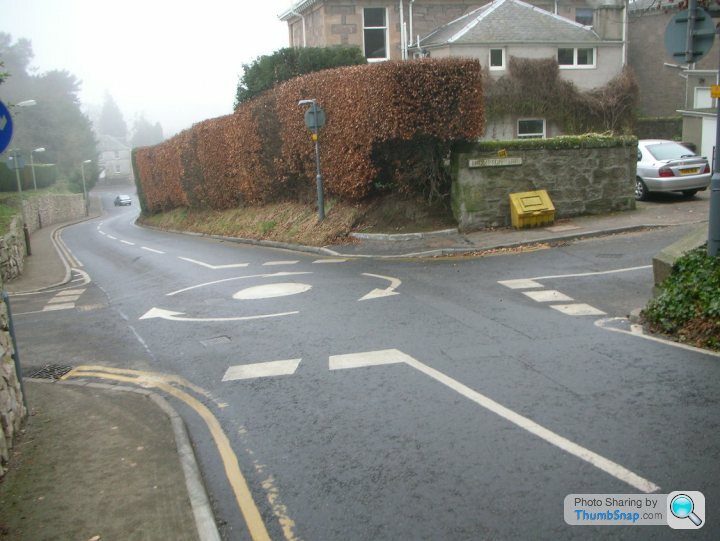
The only places where a 4-way stop has room to make a roundabout are places where there is not enough traffic for it to matter either way.
The biggest obstacle is that there are just too many 4-way stops in urban areas where there is no space left to make a roundabout, you would have to tear down buildings. I don't think that is a valid argument in that scenario.
The more I look at that... Isn't that basically just a four-way yield, and the markings are mostly superfluous? You're basically doing the same motions in a regular intersection.
I guess that's the point, and the markings are just to give drivers the intuition of treating it like a regular roundabout (yield to your left [or right in the picture]).
> the markings are mostly superfluous? You're basically doing the same motions in a regular intersection.
The image linked, yes. However I've never seen one quite like that in the US. Instead where I'm at we have a small circular barrier in the center of the intersection (and some very eye catching reflectors) that you actually have to drive around. It's a very good design (imo) because it physically forces vehicles to slow down and swerve so there's no way to inadvertently blow through it at speed the way that sometimes happens with a 4 way stop on a long straightaway in the dead of night.
The space requirement is only slightly higher than the one linked above, still much less than a proper full size roundabout. It's basically a cement barrier sticking 1/4 of the way into your lane.
It's not necessary to stop if there's no car to the right (as this is left side driving), if there is but it is turning left, or if an oncoming car is turning left or going straight.
Yes. The markings are part of the road language. E.g. the X in the road with Keep Clear doesn’t actually do anything. It won’t keep you clear. You have to keep clear when you read it.
This is ultimately the first question I have whenever someone tells me about a bouncing new AI shiny... "Where does my data go?" Because if it does not stay on my machine, hard pass.
What I want to know is the privacy impact of this partnership. I see terms like "Apple will be running Google's models on their infrastructure" but that definitely is not enough detail for me to know where my data is going.
Any details on privacy and data sharing surfaced yet?
> People listening to music for free is less than a drop of water in the ocean of causative reasons musicians get fucked.
Astonishingly ignorant hot take. Music is what MUSICIANS DO. Some of them are also performers, many are not. What they create is the same as what a painter does, or even a chef or architect. However it is not a physical good so people with tiny brains think that means "iT's FreEEe!!1!" when each musical instrument used costs money, the recording cost money, the distribution cost money, the filing/registration costs money, and then there's all the years of time and effort spent learning how to do all of this.
The fact of the matter is that right now music is treated very similarly to software. There is ownership and copyright, and being able to make a digital copy for minimal cost/effort does not magically remove that ownership.
If you don't like it then you should change the laws. It's like being mad at cops because of the speed limit, when the likely culprits are your local city council.
I think you're misunderstanding the point GP was trying to make. Artists and musicians in particular seem to think that copyright is their friend. Because, in theory, it's a mechanism by which a revenue stream could appear when you produce artwork. But copyright is not the musician's friend at all. It's a mechanism by which record labels consolidate power as the middlemen and route revenue to their executives with very little money ever going to artists. and with every technological shift, the labels find a way to give less and less to the consumer and give less and less to the artists. So now it's extremely unusual for somebody that's a fan of some music to actually purchase that music, and artists are getting paid less and less when people do listen to their music.
My personal belief is that systems that allow people to get paid when they're not working are not sustainable, and therefore intellectual property has a fundamental flaw. The end game for musicians is to perform live and use their recordings as advertisements for that. That makes them very similar to jobs I've held my whole life where the second I stop showing up for work is the second I stop getting paid.
That's a pretty nice fundamental law. Explains the rot that occurs with land ownership as well. Really, stopping wealth accretion via non-action would probably help with some of the nastier outcomes of a regulated market economy. I suppose it's probably too late for us, however. Revolution, ahoy!
haha, I swear I read Marx and Engels, but it was 25 years ago. So I suppose the problem we find ourselves in now is the feedback loop of capital sources being so well endowed there's no risk of investment to create more capital.
>My personal belief is that systems that allow people to get paid when they're not working are not sustainable, and therefore intellectual property has a fundamental flaw. The end game for musicians is to perform live and use their recordings as advertisements for that. That makes them very similar to jobs I've held my whole life where the second I stop showing up for work is the second I stop getting paid.
Although I agree with the overall sentiment of the article, the reality in 2025 is that it is a totally dead market and we are still trying to figure out WTH is going on.
Some companies are holding their breaths due to political instability, others are in sectors that are already getting decimated (likely from the same instability above), yet others have reached a point where they (and "they" appear to be in a majority in their respective industries) are more centered on efficiency than headcount.
I'm employed and I'm grateful... I know plenty of people searching and are getting nothing but silence in their search. I think both sides of the hiring equation are getting a hard reset right now.
The market is definitely not dead. It started warming up last summer and has continued to do so throughout 2025.
But the market is two-tiered in a way it hasn't been before, particularly w.r.t. remote hiring. Almost all engineers want remote jobs and a small number of employers offer them, so the remote job hunt still puts employers in the driver's seat. But (good, senior) engineers hold the cards right now for in-office roles.
Yes and No... My take on the current job market is this has been a slow-slide into oblivion. When I was a kid, we used something like engineering practice to develop software. You would have someone across the hall with a title of "product manager" or something who understood the business and the problem they wanted to solve (and how much money people would likely be willing to pay for it.) Then you would get a set of 15 requirements, 5 of which needed to be met before the product could be shipped. As an engineer, you put your head down and thought about how you would build each feature and there was a back and forth about which features got built at which time and you built something that looked like a product roadmap for the next three to five years. [ This was in the commercial embedded space. Aviation, government and banking all lived in slightly different worlds. ]
Around 1999 there was so much money in the dot-com run-up that the only thing that mattered was shipping something quick before the investors wised up and sued you for fraud. Engineering methodology took a back seat to expediency and this crazy bunch of weirdos practicing eXtreme Programming were used to demonstrate the spiral methodology the big guys used wasn't the only game in town. People took time out from their lunch meetings with VCs to read books by Fred Brooks and Tom DeMarco, if for no other reason than to memorize phrases like "Technical Debt" and "Mythical Man Month." If you say "Fail Quickly" and "Show me your flowcharts..." and you'll sound like a mysterious, wizardly futurian with a deep understanding of the hidden world of the matrix. But most of the people in the 90s in sili valley were ponces.
So where was I? Oh yeah... what we're seeing is the eventual end of a 25-30 year slide away from anything resembling "engineering" and "engineering practice". And I'm not saying that's completely bad. I mean... yes... please hire "real" engineers to design, build, test and deploy avionics firmware. You do not need an engineering degree to create a vibe coded web page that texts your fiends with name suggestions for their children or pets. MyTripToSacramento.Com can probably get by with a product manager and a dog. The dog is there to bite the product manager when they try to change the web site.
The 2025 job market has been dead for 30 years, we just didn't notice it until today.
How can it be AGPL and not provide full source? AGPL is like the most aggressive of the GPL license variants. If they somehow circumvented the intent behind this license that is a problem.
Spitballing here but if it's their code that they have copyright on, they can license it to us as agpl, without binding themselves to those same terms. They have all rights as copyright holders regardless of a given license.


(Sorry, couldn't resist.) I could be the lone dissenter here, but to me well-written comments are a lot more fun to read than near-gibberish.
I wished more people tried harder to be better communicators, but it is what it is. If AI can decipher these comments and produce a much more coherent statement, then I'm for it.
reply