The article is probably right about text processing though. It sounds like they took an inherently parallel task with no communication and (accidentally?) crippled it.
I'm not sure what's going on with that subtest, and the lack of scaling is certainly egregious. But we've all encountered tasks that in theory could scale much better but in practice have been implemented in a more or less serial fashion. That kind of thing probably isn't a good choice for a multi-core test suite, but on the other hand: given that Geekbench has both multi-core and single-core scores for the same subtests (though with different problem sizes), it would be unrealistic if all the subtests were highly scalable. Encountering bad scalability is a frequent, everyday part of using computers.
I have it on my to-do list to install FreeDOS on bare metal to set up a retro gaming box. Tried once, but for some reason the installer failed writing to disk. Anyway, if anyone is making new FreeDOS games, I'll gladly pay for them, and it'll give me an excuse to go down that avenue again.
If enabling CSM in your BIOS isn't an option or isn't enough for FreeDOS, there is a translation layer that can get it to run on UEFI hardware: https://github.com/FlyGoat/CSMWrap
OK, I just posted a comment saying FreeDOS will no longer run on hardware because of lack of BIOS support, but that might change things I guess. Hope it can be made to work.
Another big problem for FreeDOS is the lack of sound card support. I do not know if anyone has solved that yet.
If you want more, look at the extensions section of the LSP page and then go down the rabbit hole.
I likewise do not use Doom or any of the bundled variants because I want full control and understanding of my config. But those variants are still useful to learn what's out there and selectively add things to your mix.


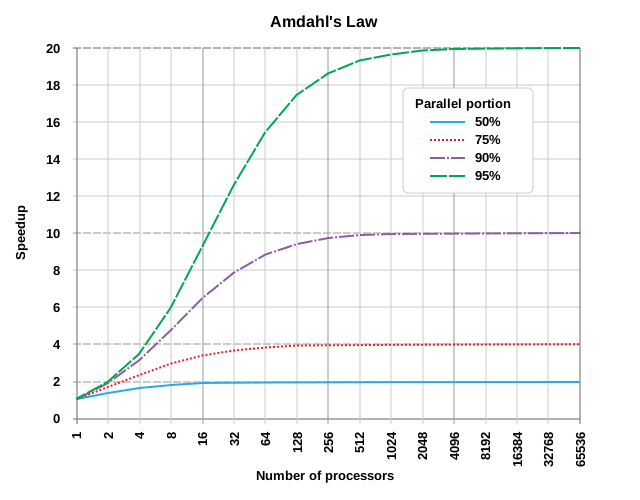
First plot really says it all.
reply